

Google Colossus is Google's massive internal storage platform, ensuring high performance for services like YouTube, Gmail, Drive, and many others. Interestingly, despite the rapid evolution of storage technology, Colossus continues to use HDD to store the majority of its data. This raises the question of why Google chooses this solution instead of switching entirely to SSD like many of its competitors.
The Colossus storage system is built on the Google File System (GFS) platform - a distributed system responsible for managing massive volumes of data. To ensure performance and reduce costs, Google has combined traditional HDD with SSD as a cache to optimize data retrieval speeds.
Data Processing Performance on Google Colossus
Google has revealed that the Colossus system processes massive amounts of data at impressive speeds, especially in applications like BigQuery, Gmail, and YouTube. Below is a detailed table of the I/O sizes and expected performance for each application:
| Example application | I/O sizes | Expected performance |
|---|---|---|
| BigQuery scans | hundreds of KBs to tens of MBs | TB/s |
| Cloud Storage - standard | KBs to tens of MBs | 100s of milliseconds |
| Gmail messages | less than hundreds of KBs | 10s of milliseconds |
| Gmail attachments | KBs to MBs | seconds |
| Hyperdisk reads | KBs to hundreds of KBs | <1 ms |
| YouTube video storage | MBs | seconds |
Why does Google still use HDD for Colossus?
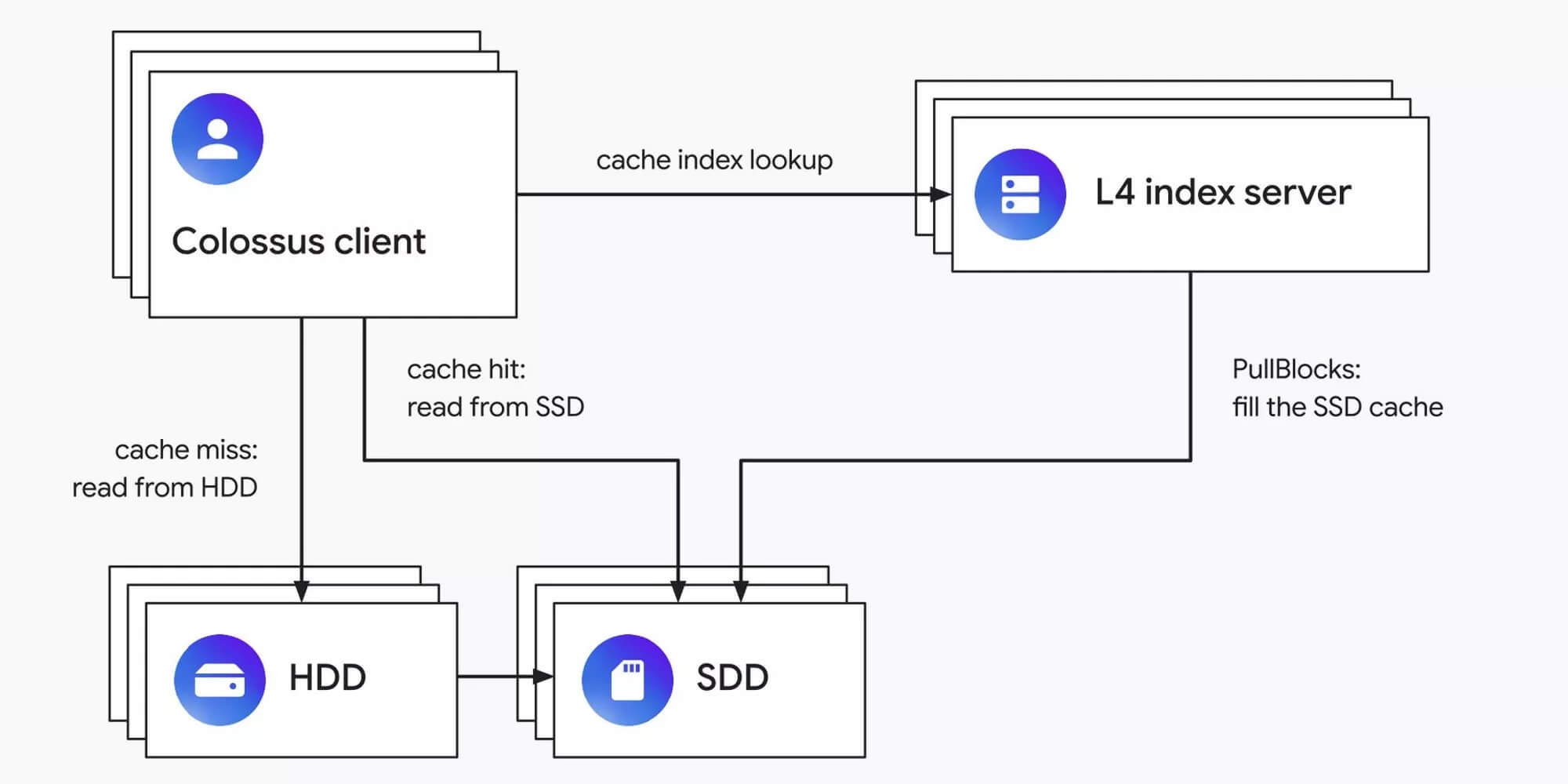
Although SSD offers faster speeds and lower latency, Google continues to use HDD for Colossus for the following reasons:
- Lower storage costs: HDD still has significantly lower costs compared to SSD when storing massive amounts of data.
- Large capacity: HDD provides larger storage capacities, suitable for applications that need to manage exabytes of data like Google Drive and YouTube.
- Long-term cost efficiency: Using L4 distributed SSD caching allows Google to optimize data reading and writing, thereby reducing overall costs.
L4 SSD Caching: A Data Acceleration Solution
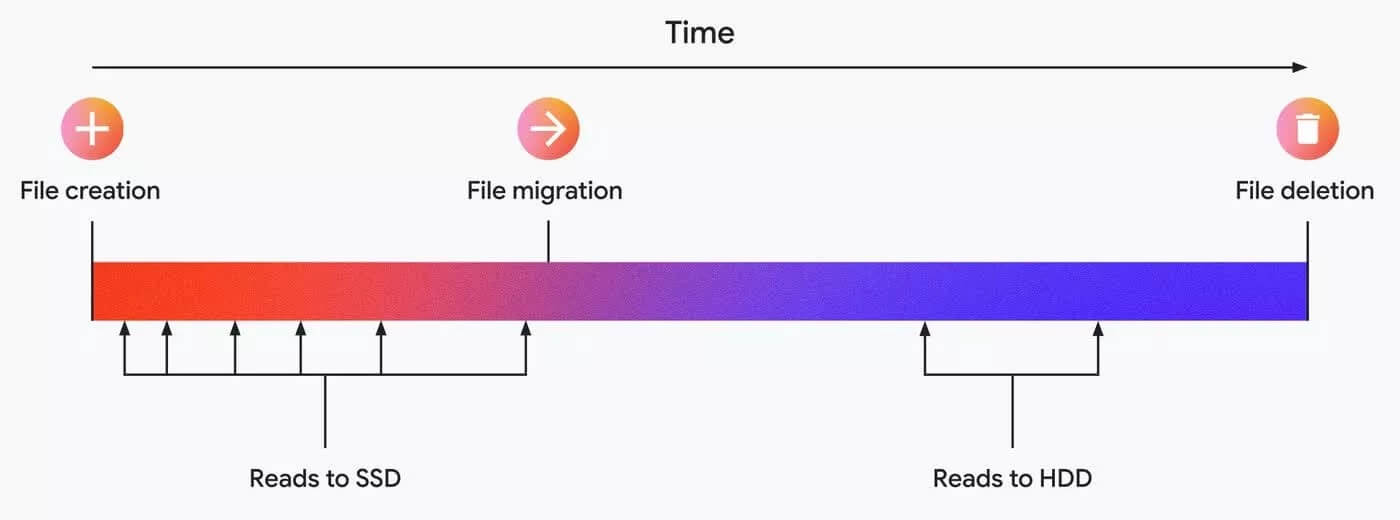
Google has implemented L4 SSD caching to improve data access speeds on HDD. This technology uses machine learning to identify which data should be temporarily stored on SSD to optimize performance.
- Learning and data classification: L4 analyzes access patterns and classifies data to determine which data should be stored on SSD for a certain period.
- Intelligent migration: After analysis, data is moved from SSD to HDD to save costs and ensure storage efficiency.
Summary: Google Colossus is not only a massive storage platform but also a testament to the intelligent combination of HDD and SSD to optimize performance and cost. With superior processing speeds and the ability to store exabytes of data, Colossus remains a vital foundation supporting Google's leading services. In the future, Google will continue to upgrade its systems to maintain its leading position in the global data storage industry.