
After the launch of the iPhone 17 series, Apple has captured the attention of the global tech community as new devices quickly appeared on the Geekbench platform. This also marks the first time users have had a preliminary glimpse into the power of the two new processors: the Apple A19 and the Apple A19 Pro. According to many experts, these initial results are not only technically significant but also demonstrate Apple's ambition to expand its position in the high-end segment.
A19 Pro: The pinnacle of single-core performance in the mobile world
On the iPhone 17 Pro Max model, the Apple A19 Pro chip recorded Geekbench 6 scores of up to 3,895 points in single-core tests and 9,746 points in multi-core tests. Compared to the previous generation, the A18 Pro (3,479 single-core, 8,568 multi-core), this represents a leap of approximately 10 - 15% in single-core performance.
Notably, the A19 Pro's single-core score far exceeds the Snapdragon 8 Elite (2,862 points)-currently Qualcomm's most powerful chip-by more than 36%. Not stopping there, Apple's new processor also surpassed the M4 (Apple's own new tablet SoC) and the Ryzen 9 9950X (AMD's high-end desktop CPU) in single-core tests. This is an extremely impressive achievement for a mobile chip.
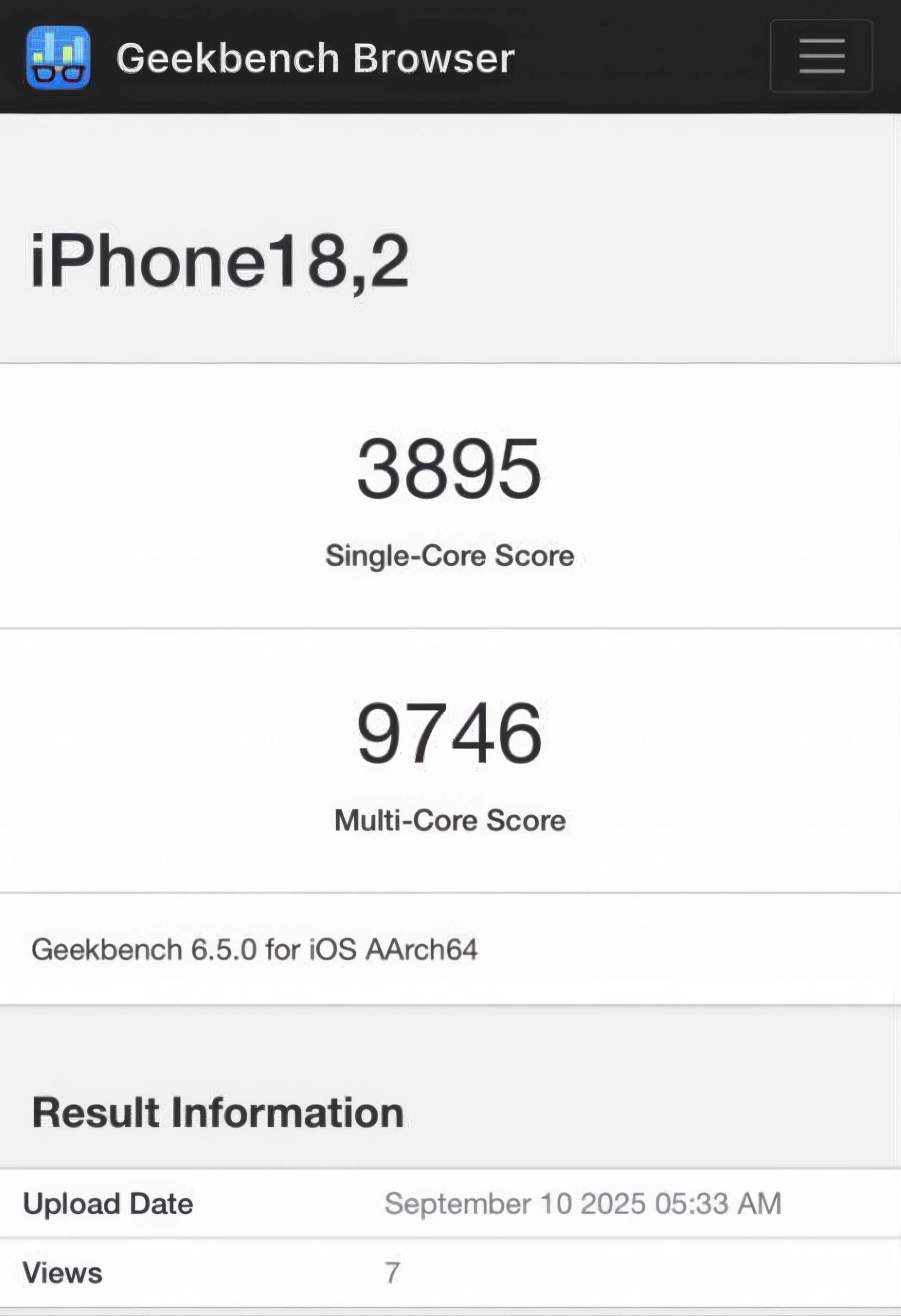
However, multi-core performance is somewhat more modest. Despite reaching nearly 9,746 points, the A19 Pro is only about 2 - 3% faster than the Snapdragon 8 Elite and still trails far behind desktop CPUs from Intel, AMD, or Apple itself. This clearly reflects the power constraints and multi-core limitations of current mobile devices.
Significant GPU improvements, standard iPhone 17 also receives a major upgrade
Regarding graphics, the A19 Pro performs very impressively. With a 6-core GPU architecture, this chip achieved scores up to 45,657 points, an increase of up to 37% compared to the A18 Pro. In fact, this GPU performance has approached the Apple M2 and M3, the chips currently used in the iPad Pro and MacBook Air.
For the standard iPhone 17 using the Apple A19 chip, the Geekbench scores are also very positive: 3,608 single-core points and 8,810 multi-core points. Compared to the A18 chip in the iPhone 16 (3,377 and 8,362 points), this is a jump of about 7%, showing that Apple continues to optimize performance across its entire product line.
However, according to expert opinions, these upgrades may not be enticing enough to make iPhone 16 users upgrade immediately, especially if their usage needs do not change significantly. For tech enthusiasts using an iPhone 14 or older, the A19 could be a more compelling choice due to the clearly improved performance.
Exercise caution with initial benchmark results
While the Geekbench numbers bring high expectations, the tech community still warns users to be cautious. Benchmark results can be faked or may not fully reflect real-world experiences. Therefore, it is necessary to wait for detailed reviews from independent reviewers, especially in daily usage environments such as gaming, photo/video editing, or livestreaming.
Additionally, software optimization and thermal management during heavy workloads also play a massive role in determining the actual performance of a processor. Consequently, these results should only be viewed as initial indicators, not the sole basis for evaluating overall power.
In summary, the Apple A19 Pro has demonstrated its ability to dominate single-core performance on mobile devices, while also delivering a leap forward in GPU capabilities. However, multi-core performance and real-world application remain areas that require further verification. Based on what has been shown, Apple's new chip series continues to hold a leading position in hardware-software optimization in the current smartphone industry.