

AMD has officially introduced the OpenClaw framework, a breakthrough solution that allows AI agents to operate entirely locally on Ryzen and Radeon hardware instead of relying on the cloud. With a vision for the Agent Computer era, the Red Team giant is striving to return data control and privacy to users, enabling intelligent virtual assistants to operate continuously without expensive subscriptions or concerns about network latency. In reality, this is not just a hardware advancement, but an affirmation of a future where artificial intelligence becomes an inseparable core component of personal computing by 2026. If you are looking for a way to have superintelligence at your fingertips without sending data out to the internet, AMD OpenClaw is the answer the tech world has long been waiting for.
AMD OpenClaw brings professional autonomous AI experiences home
The most valuable aspect of OpenClaw is its ability to transform ordinary PCs into independent AI processing stations. Instead of sending requests to remote data centers, AMD allows users to run complex Large Language Models (LLM) directly on their own systems. This framework operates smoothly in the Windows environment via the Windows Subsystem for Linux (WSL2), utilizing the llama.cpp backend and LM Studio to process models like Qwen 3.5 35B. This brings immense practical value: you no longer have to worry about leaking personal information or business secrets when interacting with AI. All data, from work documents to private conversations, remains safely contained within your hard drive.
Furthermore, the system supports Memory.md, a memory framework based on embedding techniques that helps AI store local context without needing cloud synchronization. In practice, owning a virtual assistant that deeply understands your personal data while ensuring absolute privacy is something online AI services struggle to achieve. For developers, OpenClaw provides a streamlined roadmap to configure a complete AI environment on Windows, making the testing of AI agent architectures faster and more efficient than ever. This is a strategic move by AMD to eliminate dependence on third-party infrastructure while simultaneously saving operational costs for long-term AI projects.
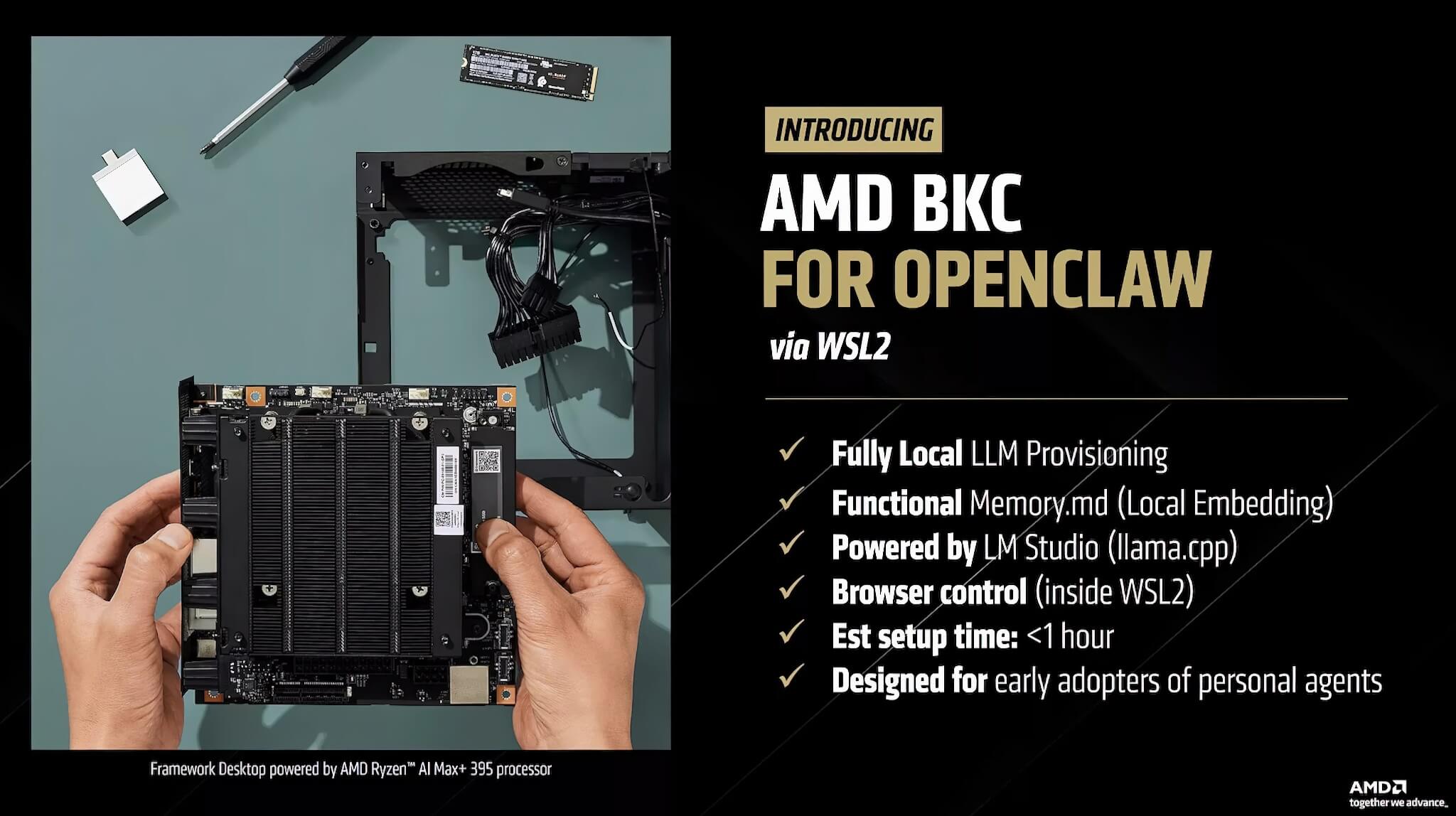
Ryzen AI Max and Radeon AI Pro power in the OpenClaw era
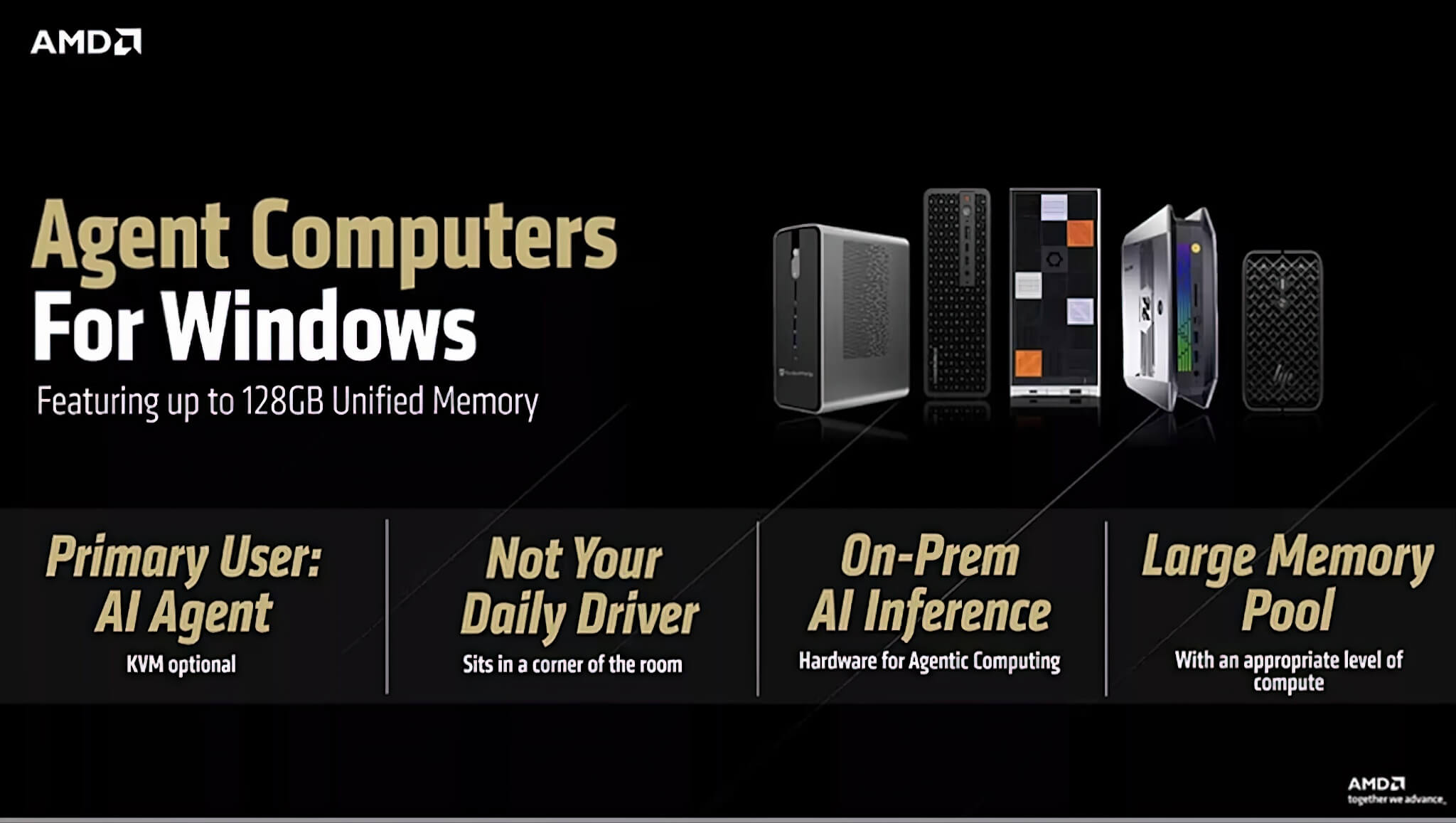
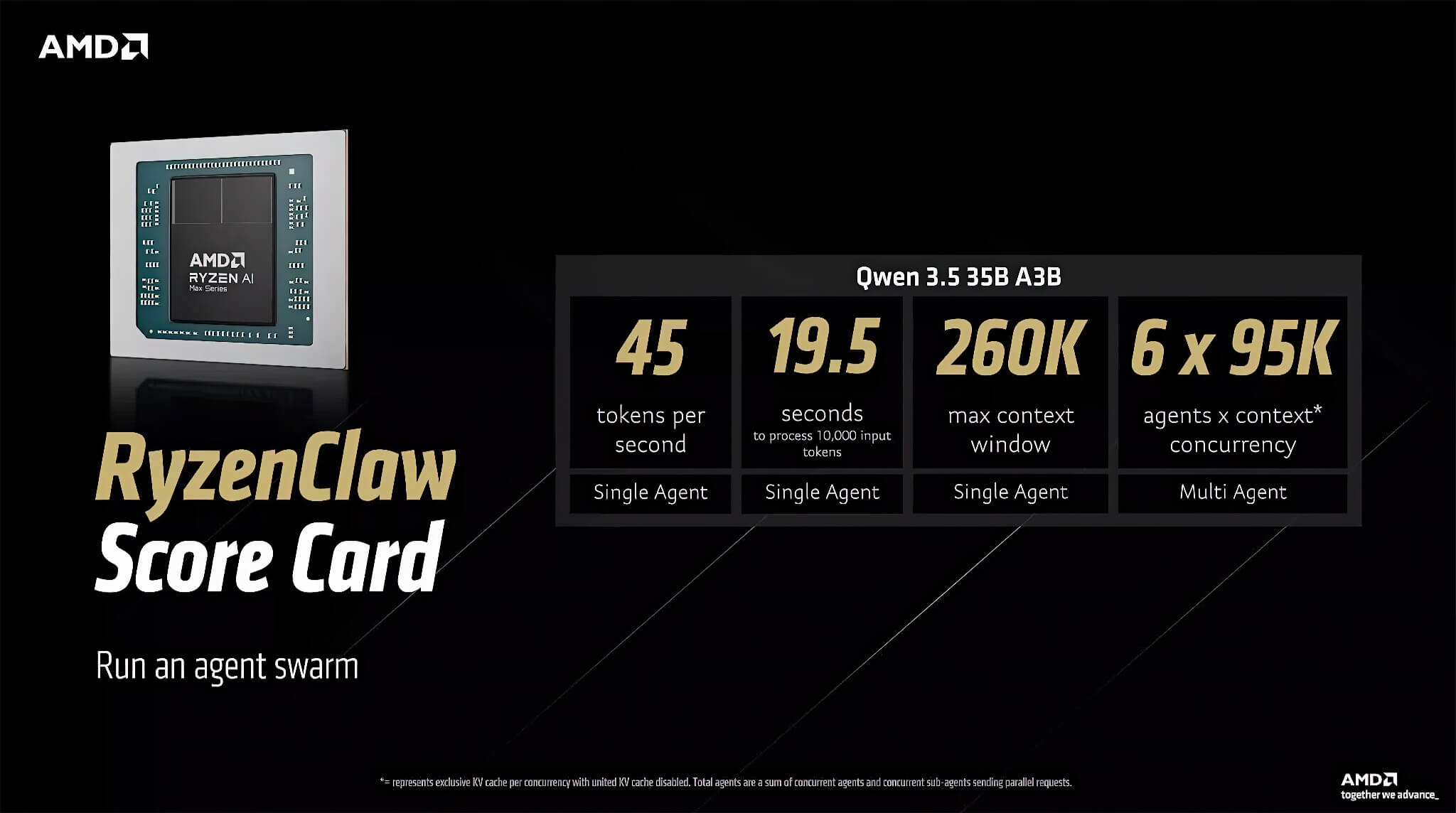
To realize the ambition of local AI, AMD offers two specialized hardware configurations named RyzenClaw and RadeonClaw. The highlight of the RyzenClaw configuration is leveraging the power of the Ryzen AI Max+ processor combined with up to 128GB of unified memory. With this setup, the Qwen 3.5 35B model achieves an impressive token generation speed of up to 45 tokens per second, providing nearly instantaneous responses. Notably, with a massive context window of up to 260,000 tokens, the machine can remember an amount of information equivalent to hundreds of pages of documents in a single conversation. In practice, the ability to simultaneously run up to 6 local AI agents is an incredible feat for previous consumer systems, allowing you to easily set up complex automated workflows right at your desk.
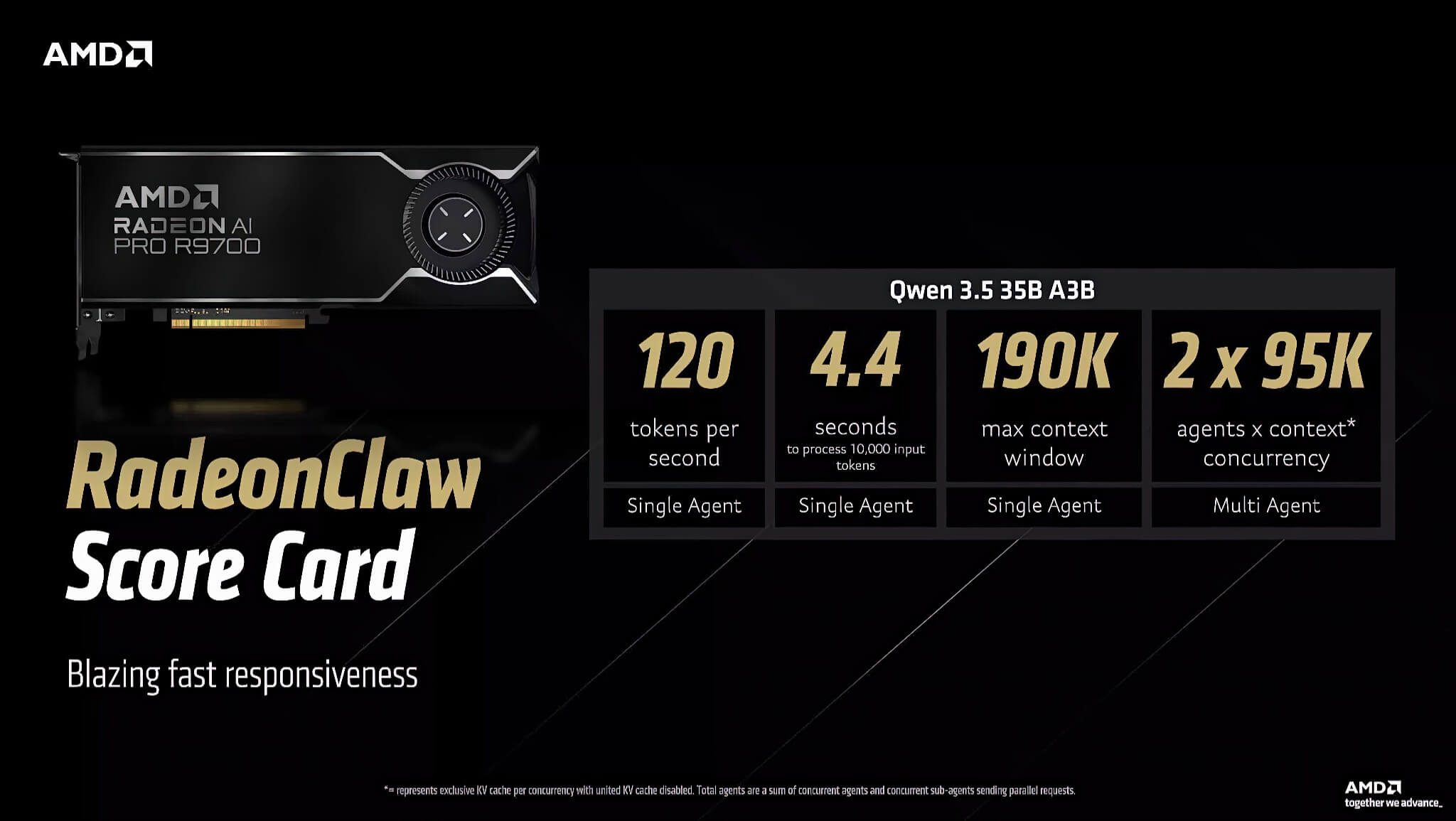
If you are a professional prioritizing raw processing speed, the RadeonClaw configuration with the Radeon AI PRO R9700 graphics card is an option you cannot ignore. With 32GB of dedicated VRAM, computing power is pushed to a new level, with processing speeds reaching the 120 tokens per second threshold. This allows you to analyze an input data block of up to 10,000 words in just 4.4 seconds. However, the trade-off is that the context window decreases to 190,000 tokens and the capacity to run simultaneous AI agents is limited to 2. AMD's provision of such distinct hardware paths demonstrates a deep understanding of diverse user needs, from those requiring deep AI memory to those requiring ultra-fast AI processing.
However, the investment for this top-tier AI experience is not cheap. A complete desktop system running the Ryzen AI Max+ 395 chip with 128GB RAM starts at approximately 2,700 USD, while the Radeon AI PRO R9700 graphics card alone retails for about 1,299 USD. Although these prices may seem high for general users, for tech engineers and AI pioneers, this is a worthwhile investment for autonomy and superior productivity. AMD is betting that in the future, autonomy and privacy will be more important than raw scale, and AI agents running on personal processors will be the bridge narrowing the gap between traditional computing and distributed artificial intelligence.