
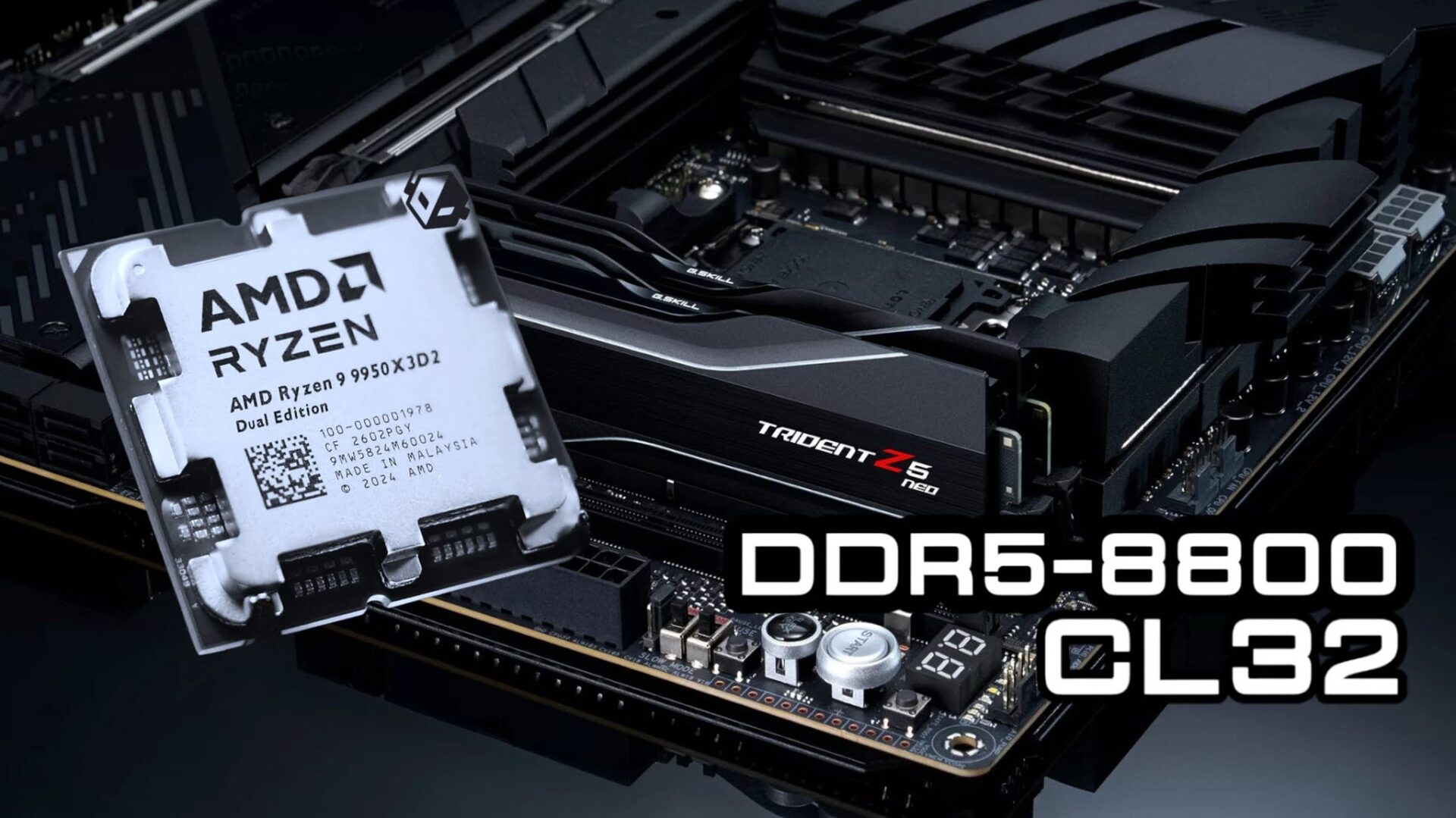
ROG X870E APEX is quickly becoming the name to watch among high-end AM5 PC builders, after ASUS successfully tested DDR5-8800 CL32 on a Ryzen 9 9950X3D2 Dual Edition. The number is impressive for more than its clock speed. The CL32 timing is the bigger story, sitting well below the CL40 that DDR5-8000 typically landed on in many earlier overclocking setups. For high-performance desktop users, that means the AM5 platform is getting closer to a point where it offers very high memory bandwidth without giving up too much latency. Gamers who like to tune, benchmark enthusiasts and AM5 workstation users all care about this kind of change, because it opens up real room for system optimization.
What does DDR5-8800 CL32 on AM5 mean for PC builders?
According to the test data, a system using the ASUS ROG Crosshair X870E APEX motherboard, a Ryzen 9 9950X3D2 Dual Edition CPU and 32 GB of DDR5 RAM reached DDR5-8800 CL32 on the AGESA 1.3.0.1 2201 beta BIOS. In practical terms, this is a significant step. AM5 has already improved RAM stability across many BIOS generations, and our earlier article on how AMD EXPO 1.20 improves DDR5 RAM overclocking also showed the platform steadily raising its memory ceiling. DDR5-8800 delivers roughly 46.6% more bandwidth than the DDR5-6000 base kit of the memory used in the test, while CL32 keeps latency very tight for an overclock like this. In short, this is not just a story about showing off a ZenTimings screenshot. It is a sign that a two-DIMM-slot, overclocking-focused board like the APEX is doing exactly what it should on AM5. For anyone building a rig for eSports games, emulation, benchmarking or memory tuning for latency-sensitive workloads, this headroom is clearly more valuable than overclocks that hit high clocks but run loose timings.
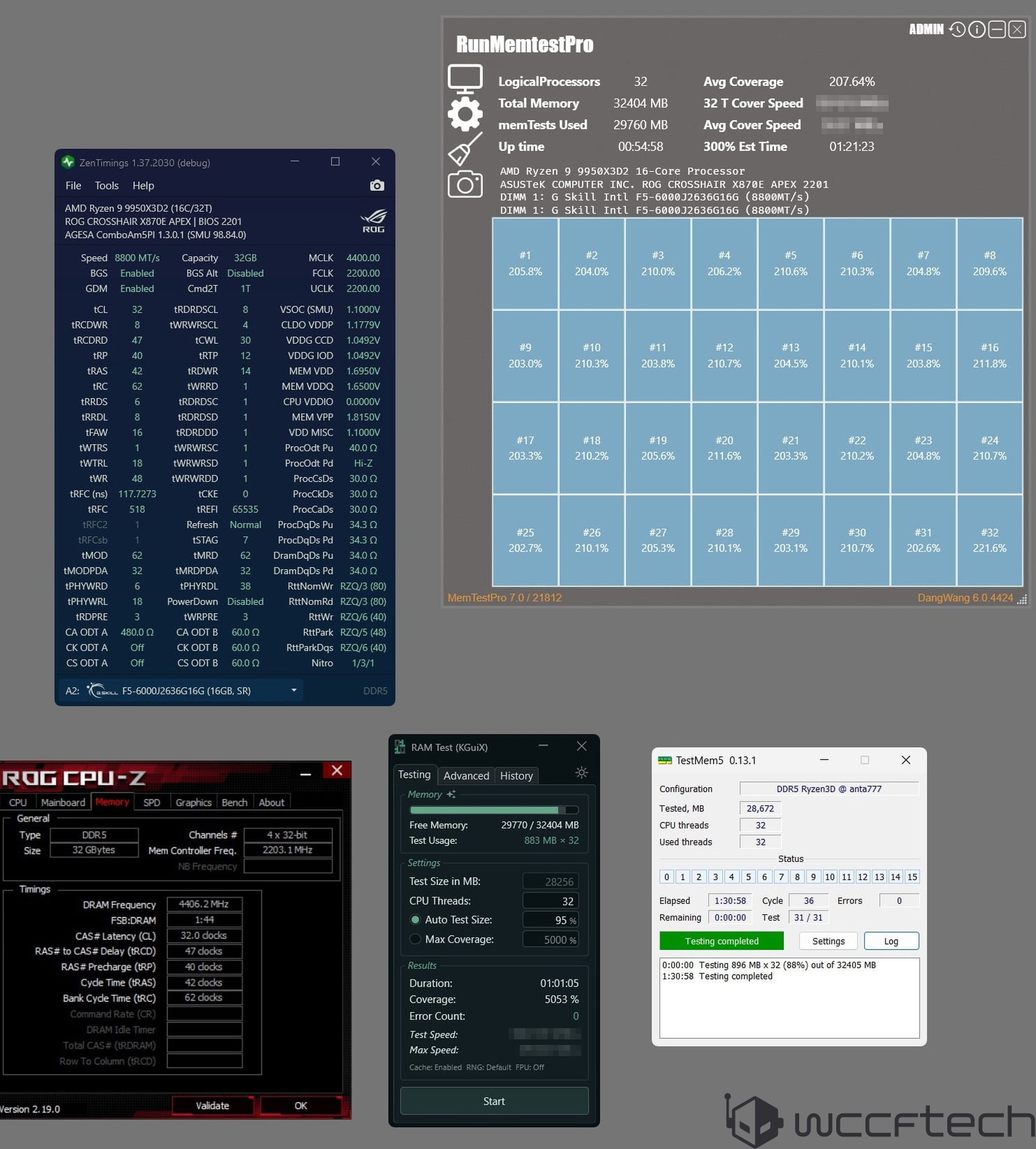
From a hardware standpoint, the ROG Crosshair X870E APEX was designed by ASUS for users who like to push their systems to the limit, with 18+2+2 power phases, an AM5 design, WiFi 7, two PCIe 5.0 x16 slots and three PCIe 5.0 M.2 slots on the board. Paired with the Ryzen 9 9950X3D2, the test becomes even more noteworthy, because this chip has 16 cores and 32 threads, a maximum boost clock of 5.6 GHz, 208 MB of total cache and a 200 W TDP, making this a platform that lacks neither CPU power nor memory bandwidth. It shows that the DDR5-8800 CL32 result did not come from a light configuration, but from a true enthusiast system where the motherboard, BIOS and IMC all have to be up to the task. Not everyone needs to run right at that edge, but a platform reaching this level often brings a positive side effect: speeds like 7600, 8000 or 8200 MT/s in everyday use can become easier to reach and less of a struggle. That is the most important part of this news for the AM5 community.
What is the real-world impact on high-end AM5 gaming desktops?
Ryzen 9 9950X3D2 is not merely a technology showcase. It is the next step for the X3D line on AM5, following the leaks around the Ryzen 9 9950X3D that previously appeared on Hung Phat Laptop. With a CPU that has 208 MB of cache and a RAM platform moving toward DDR5-8800 CL32, builders of high-end gaming desktops have another reason to invest in a dedicated overclocking board instead of settling for a merely adequate premium motherboard. In games, faster RAM does not always turn into a big FPS gain in every title, but the benefit can be clearer in memory-sensitive games, at low resolutions used to push extremely high frame rates, or in 1% low tests. For heavy workloads, high RAM bandwidth also helps with some compression, scene rendering and virtual machine tasks, or workflows that require constant data transfer between the CPU and memory. In other words, AM5 is gradually moving past the stage where "stable at 6000 is enough" and into one where serious high-end users have far more room to tune.
| Item | Details |
|---|---|
| Motherboard | ASUS ROG Crosshair X870E APEX |
| CPU | AMD Ryzen 9 9950X3D2 Dual Edition |
| Memory | 32 GB DDR5 G.Skill Trident Z5 Neo |
| OC result | DDR5-8800 CL32 |
| BIOS | AGESA 1.3.0.1 2201 beta |
Even so, this is still enthusiast territory, not a "plug and play" configuration for the masses. APEX boards generally prioritize memory overclocking and manual tuning, and the 9950X3D2 has a 200 W TDP, so it calls for a suitable power supply, cooler and setup experience, not to mention that the DDR5-8800 CL32 result in the test was achieved with a liquid cooler and a beta BIOS. So the biggest value of this information is that it shows the technical ceiling of AM5 has been raised, rather than promising that every AM5 system will hit 8800 easily. If ASUS keeps refining the BIOS and RAM makers expand their lists of kits optimized for this platform, high-end AM5 configurations over the next few months could become noticeably more appealing to gamers who like overclocking RAM. Detailed source reference from Wccftech.