

While many Large Language Models (LLMs) require powerful hardware and consume significant resources, Microsoft's Bitnet emerges as a breath of fresh air, bringing an ultra-lightweight, accessible, and exceptionally energy-efficient AI solution. Developed by Microsoft, Bitnet not only attracts attention with its ability to run smoothly on standard CPUs but also opens up opportunities to democratize AI for millions of personal devices and edge devices that previously relied on the cloud or specialized GPUs.
What is Bitnet? The Ternary Quantization Technology Breakthrough
Bitnet b1.58 2B4T, the latest product from Microsoft, is a Large Language Model (LLM) with 2 billion parameters that requires only 400MB of memory-significantly smaller than competitors like Gemma 3 1B (1.4GB). Notably, Bitnet can operate entirely on standard CPUs, including power-efficient chips like the Apple M2, without the need for expensive GPUs. This makes AI more intimate and accessible to individuals, small businesses, IoT devices, and ultra-thin laptops.
The standout innovation of Bitnet is the use of ternary quantization technology, where each weight only takes the values -1, 0, or +1 instead of the traditional 16/32-bit float. As a result, each parameter occupies only 1.58 bits, drastically reducing storage capacity and increasing computational efficiency. Unlike post-training model compression methods, Bitnet is trained directly with ternary weights from the start, ensuring performance is not degraded during conversion.
The bitnet.cpp framework is specifically optimized for this model, allowing for fast, lightweight operation on CPUs, and currently supports ARM and x86 chipsets. Microsoft has also released Bitnet under the MIT open-source license, making it easy for the community to access, experiment with, and develop AI applications across various platforms.
Comparing Bitnet with traditional AI models and practical applications
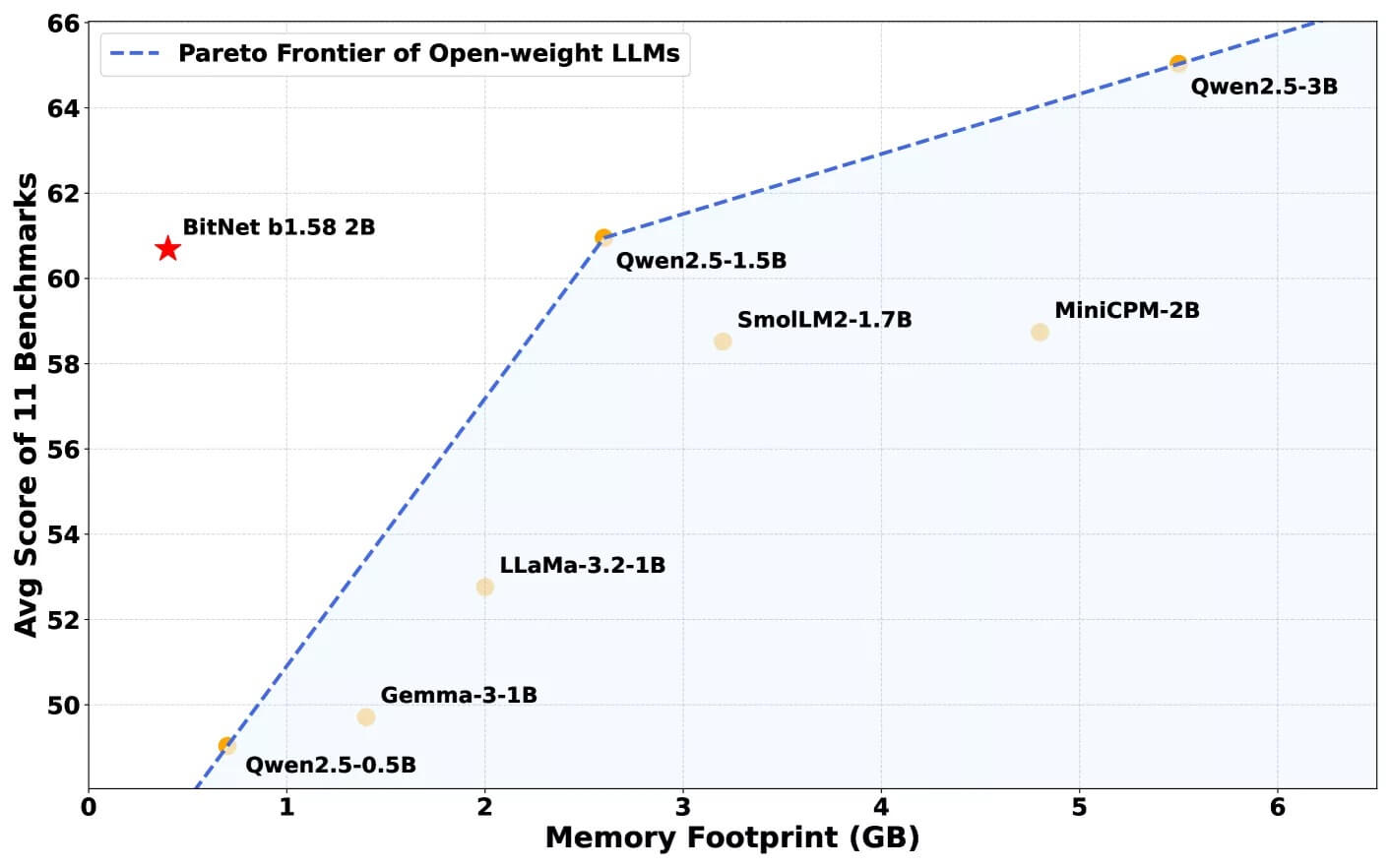
Compared to models like Llama 3.2 1B, Gemma 3 1B, or Qwen 2.5 1.5B, Bitnet offers several superior advantages:
- A size of only 400MB, many times smaller than models in the same segment, helping to save memory and reduce hardware costs.
- Real-world performance on mathematics and general reasoning benchmarks is equivalent to or even surpasses competitors, despite running only on standard CPUs.
- No GPU required, significantly reducing operating costs and energy consumption, making it suitable for personal devices, edge devices, ultra-thin laptops, or IoT systems.
- Consumes 85-96% less energy than full-precision models of the same scale, contributing to a reduced environmental impact.
- Open-source, making it easy to access and convenient for the development community to integrate AI into new products and services.
Bitnet also marks a major difference from traditional model compression methods: this model is trained directly with ternary weights, avoiding performance loss caused by post-training conversion.
However, Bitnet still has certain limitations. Currently, the model only supports running on CPUs and requires the customized bitnet.cpp framework. Additionally, the context window is smaller than that of the most advanced models, limiting the ability to process long texts. Microsoft has stated they will continue to develop the model to expand hardware support, increase the context window size, and add more languages in the future.
In summary: Bitnet is opening a new era for resource-efficient AI, helping to bring the power of artificial intelligence to every device-from phones and laptops to edge devices-without the need for expensive hardware infrastructure. With its unique ternary quantization technology, competitive performance, energy-saving capabilities, and open-source nature, Bitnet is an ideal choice for individuals, small businesses, and the modern AI development community. Despite some current limitations, the potential for development and practical application of Bitnet is immense, promising to drive the trend of Green AI and the widespread democratization of AI globally.