

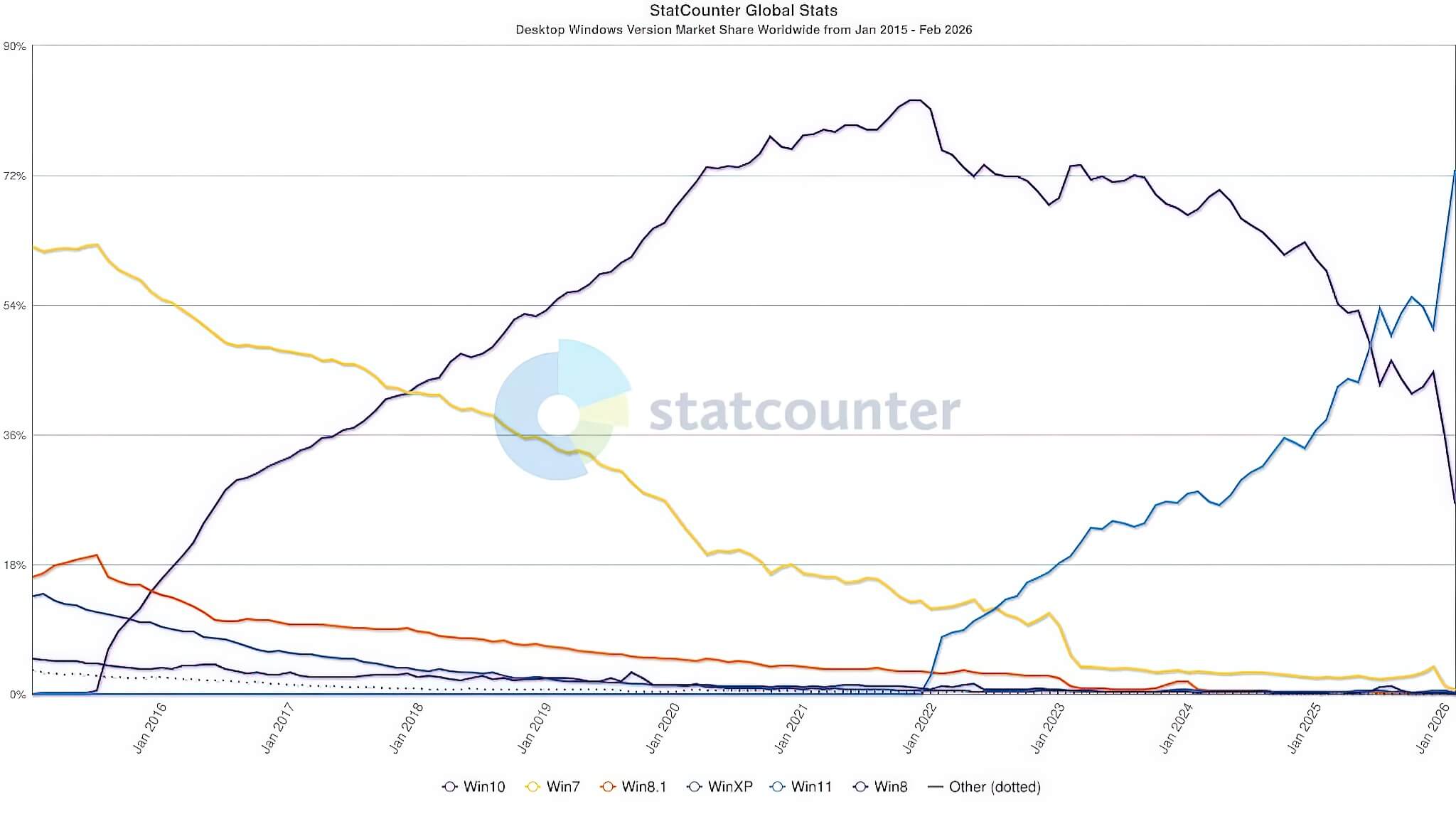
The Windows 11 operating system has finally risen to dominate the desktop market, but this victory does not seem to have unfolded in the way Microsoft most expected. According to the latest data from StatCounter, Windows 11 is currently running on nearly 3/4 of all personal computers globally with a rate of 72.78%, while Windows 10 has retreated to the 26.27% mark. In reality, this represents a rapid leap forward when looking back at the end of 2025, when Windows 11 was still struggling at the 50% threshold. However, behind the glory of these growth figures lies a dramatic story of coercion, strict technical barriers, and the fraying trust of the loyal user community.
Windows 11 and the forced march driven by hardware policies
The massive shift from Windows 10 to Windows 11 does not necessarily stem from excitement for the new, but rather resembles a forced march under the pressure of end-of-support deadlines. Microsoft has established an extremely strict system of technical barriers, completely redefining what a PC is allowed to run. These include mandatory requirements for the TPM 2.0 security chip, Secure Boot, newer CPU generations, and the UEFI firmware system. Furthermore, the requirement for users to have a Cloud identity has tightened the link between hardware, the operating system, and Microsoft's cloud services. If you are someone who loves freedom and absolute control over your device, these policies can be viewed as a burden rather than an upgrade.
The most valuable aspect of Windows 11 lies in its modernity, but this very modernity has pushed many professional users into a corner. In fact, many tech-savvy users have had to find all sorts of ways to bypass the rules using registry editing tools or custom installation media to install Windows 11 on machines that do not support TPM 2.0 or older CPUs. However, Microsoft is gradually closing these loopholes, turning the game into a harsh choice: either spend money on new hardware that meets Copilot+ PC standards, or stay with Windows 10 and accept the risk of being cut off from all future security patches. In fact, a significant portion of users has decided to abandon Windows entirely to switch to macOS or Linux as a way to protest this increasing control.
Security power accompanied by risks and the user trust problem
Theoretically, the security architecture of Windows 11, with names like BitLocker or Windows Recovery Environment (WinRE), is a major step forward in keeping your computer safe from cyberattacks. However, reality shows that a series of recent buggy updates has eroded user trust in the system itself. Rare incidents where the BitLocker encryption feature automatically triggers Recovery mode have left thousands of users in a frustrating situation, forced to search for recovery keys they didn't even know existed. When a software update is faulty and leaves a computer stuck on the BitLocker screen, all arguments about ultimate safety and security become meaningless in the face of the fear of data loss.
Furthermore, the emergence of the Copilot+ PC generation combined with Qualcomm chips is creating a new wave of hardware that is both promising and full of skepticism. Windows 11 requires users to trust a tightly integrated ecosystem between hardware, firmware, and the operating system, where everything must operate in sync like a perfect machine. If Microsoft cannot improve the stability of its patches, the vision of a solid platform for the next decade will be severely shaken. The long-term value of an operating system lies not just in flashy AI features, but in absolute reliability every time a user presses the power button. If this trust continues to be tested by elementary errors, it is very possible that the current 72% market share is merely a peak before a large-scale exodus begins.