


Today, many businesses are racing to implement Artificial Intelligence (AI) with the expectation of bringing speed, efficiency, and innovation. However, the reality is much more complex. Instead of increasing productivity, a new phenomenon called "workslop" is causing many companies to waste time and money.
AI creates polished content that lacks value
Large language models are capable of writing fluent sentences with standard grammar, but they frequently stumble when it comes to accuracy and clarity. Without human review, these outputs create more confusion than benefit. Harvard Business Review (HBR) calls this phenomenon "workslop" - results that appear useful but actually slow down the workflow.
According to research from HBR's BetterUp Labs and the Stanford Social Media Lab, many AI-generated documents look professional but lack the practical content needed to complete a task. An ongoing survey of full-time employees in the US shows that 40% of respondents received such outputs just in the past month. On average, every time such an incident occurs, employees spend nearly two hours editing or reinterpreting the work. When accumulated in large organizations, this figure is equivalent to thousands of wasted man-days per year and millions of dollars in hidden costs.
Impact on both efficiency and employee morale
A retail executive quoted by HBR stated that his company's AI implementation has actually cost him more time: from re-checking information and conducting independent research to arranging additional meetings with colleagues to resolve issues. Ultimately, he has to redo the entire task that the AI originally performed incorrectly.
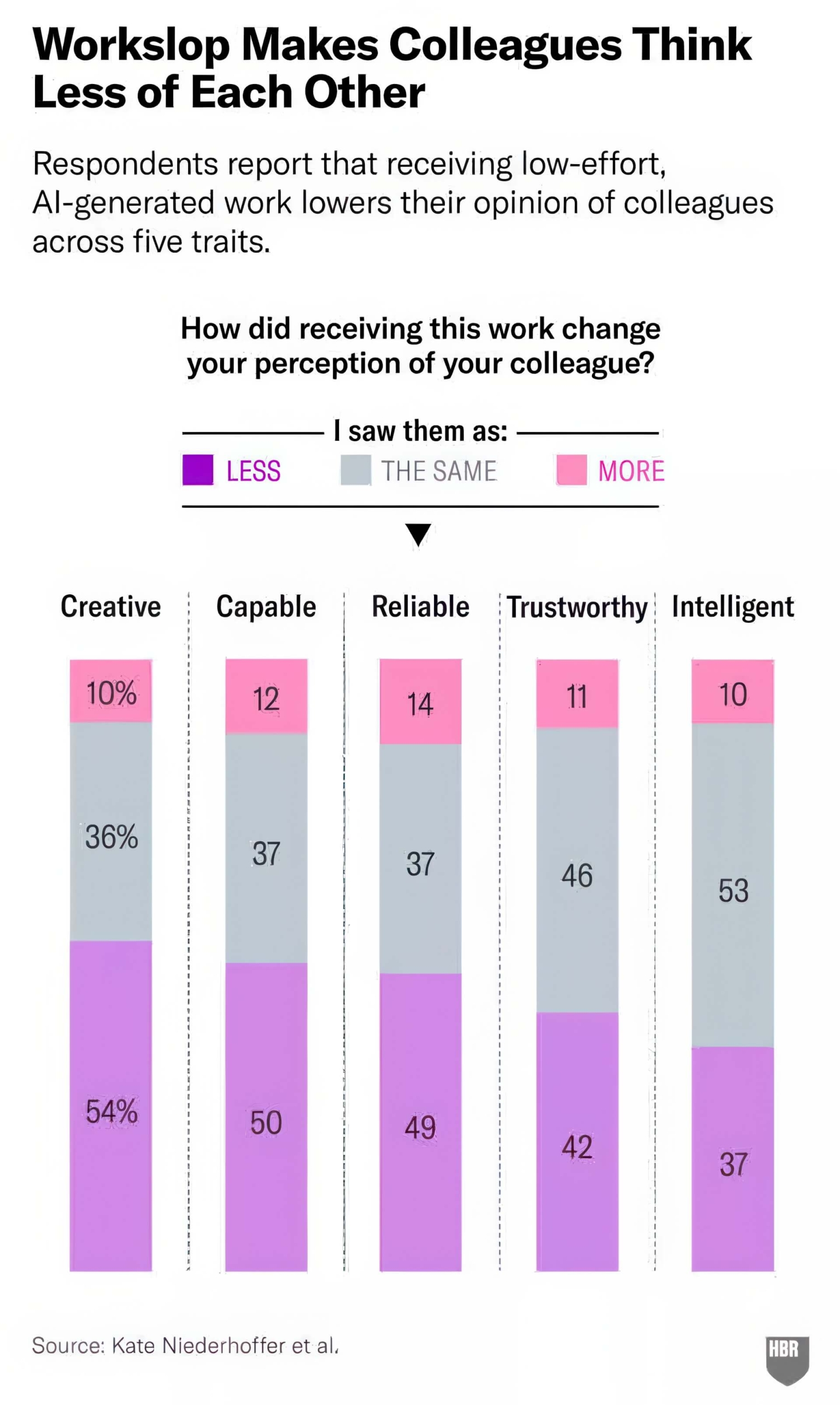
This frustration stems not only from extra work but also affects employee psychology. More than half of the survey participants (53%) reported feeling frustrated when receiving low-quality AI outputs, while nearly a quarter (22%) even felt insulted. Furthermore, colleagues who send out such documents are judged as incompetent and unreliable, showing a ripple effect on team cohesion.
Many AI projects fail to create real value
Although the rate of AI adoption in businesses is increasing sharply - according to Gallup, the number of US employees using AI at least a few times a year has nearly doubled - many pilot programs are not delivering expected results. A study from MIT Media Lab shows that less than 1/10 of AI projects generate actual revenue, warning that up to 95% of organizations do not see a return on investment from this technology.
The cause lies not only in the technology itself but also in how it is implemented. Forcing employees to apply AI at every stage often leads to a formulaic, indiscriminate copying approach rather than thoughtful usage. Researchers recommend the need for clear principles, reasonable processes, and especially leadership by example in AI usage. This includes clearly defining the scope where AI should participate - such as assisting with initial drafts or summarizing simple documents - while maintaining human supervision over final products.
In short, AI certainly brings many great opportunities, but if misused or used without direction, it will become a burden rather than a supporting tool. The lesson learned is that businesses should not apply AI indiscriminately but need a clear strategy, focusing on stages that can bring real efficiency. Only with a proper combination of AI power and human supervision can AI truly fulfill its role in enhancing productivity and creativity.