

On June 30, 2026, Anthropic launched Claude Sonnet 5, a Sonnet version that the company claims is the best at agentic workflows in this lineup to date. It can self-plan, use browsers and terminals, and run autonomously at a level that, just a few months ago, would have required larger and more expensive models. According to Anthropic, Sonnet 5 approaches Opus 4.8 but at a much more affordable price. For coders and those who frequently delegate tasks to AI, this is a version worth trying. Hung Phat summarizes everything you need to know.
What is Claude Sonnet 5 and how does it improve compared to Sonnet 4.6
Anthropic positions Sonnet 5 as the most distinctly agentic version of the Sonnet line: it knows how to plan, call tools like browsers and terminals, and execute multiple steps without needing step-by-step guidance. The Sonnet line previously ushered in the agentic era with 3.5, 3.6, and 3.7. Recently, the most significant advancements have come from the Opus line, so the fact that a Sonnet version is closing the gap with Opus 4.8 is catching the attention of developers.
Compared to its predecessor Sonnet 4.6, Sonnet 5 is superior in almost every important agentic aspect: reasoning, tool use, programming, and knowledge processing. The benchmark scores released by Anthropic show specific improvements, placed alongside Opus 4.8 for easy comparison.
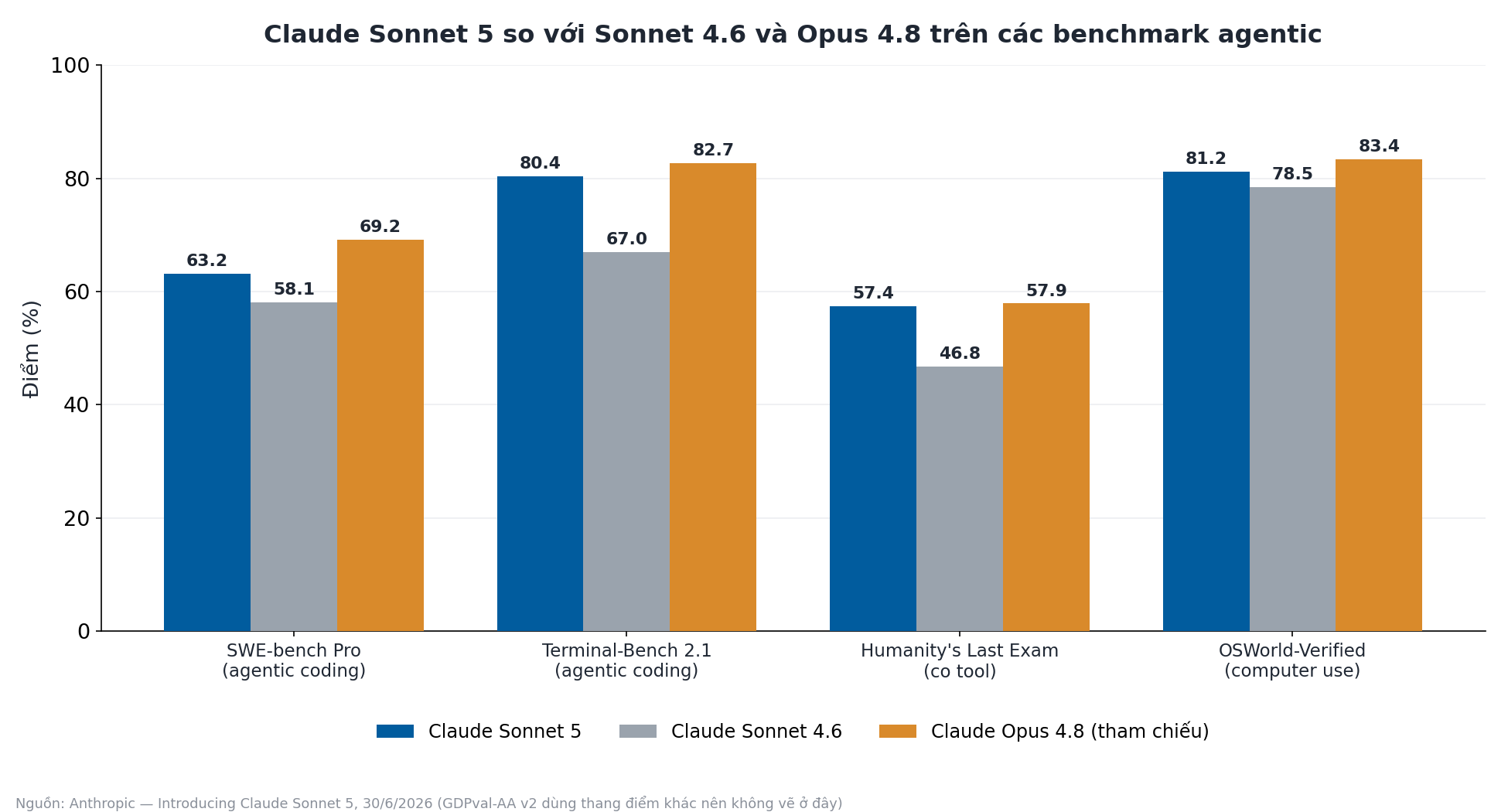
A few notable figures. In Terminal-Bench 2.1 (command-line programming), Sonnet 5 achieved 80.4% compared to 67.0% for Sonnet 4.6, nearly touching the 82.7% of Opus 4.8. In SWE-bench Pro, it reached 63.2% compared to 58.1%. The computer use OSWorld-Verified benchmark reached 81.2% compared to 78.5%, closely trailing Opus 4.8 at 83.4%. Humanity's Last Exam with tools reached 57.4% compared to 46.8%, nearly equal to Opus 4.8 (57.9%). For the knowledge-based GDPval-AA v2 which uses a different scale, Sonnet 5 scored 1618 points, surpassing the 1615 of Opus 4.8.
The general sentiment is that you get near-Opus quality at a Sonnet price. You can view the full announcement in Anthropic's Claude Sonnet 5 introduction, along with a more detailed System Card.
Working with Sonnet 5: self-planning, tool use, and autonomous execution
The biggest selling point of this version is its autonomous work capability. Anthropic measures this on two familiar benchmarks: BrowseComp for agentic search tasks, and OSWorld-Verified for computer operations. Sonnet 5 shows solid improvement over Sonnet 4.6, while Opus 4.8 still leads when you require the highest precision.
The model also allows for adjustable effort levels, including a very high level called xhigh. For the same task, you can lower the effort level to save costs, or push it up in exchange for higher accuracy. This method helps balance cost and quality for each project, rather than being stuck with a fixed level.
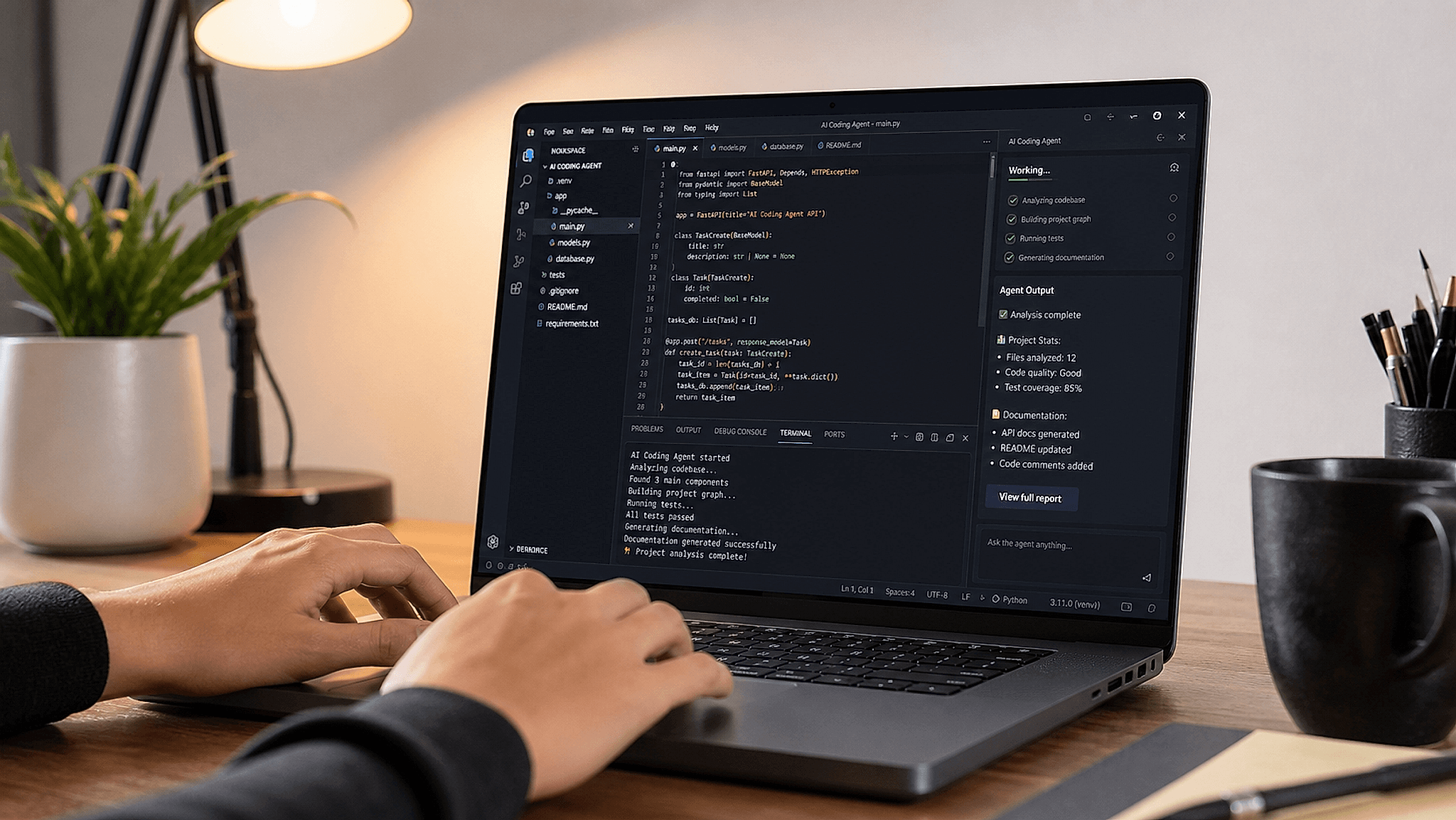
Feedback from early adopters has been quite consistent: Sonnet 5 follows tasks through to completion in scenarios where the older Sonnet version often gave up, and it self-checks results without needing reminders. One partner assigned a two-part task: updating account tiers on Salesforce and then sending launch notifications to enterprise customers; Sonnet 5 completed it from start to finish. Another engineer asked it to investigate a bug; the model wrote a reproduction test, fixed the bug, and then removed the fix to confirm the bug returned-all in one go.
Other groups mentioned debugging legacy code with significant technical debt (race conditions, hidden tests), legal research and analysis, or running insurance processes via computer operations. The common denominator is completing multi-step tasks at an affordable cost-exactly what a true agent should be able to do.
Safety evaluation and cybersecurity capabilities of Claude Sonnet 5
Regarding safety, Anthropic states that Sonnet 5 is generally better than Sonnet 4.6. The model is better at refusing malicious requests, more resistant to prompt injection attacks, and exhibits less hallucination and sycophancy than the previous version.
In automated behavior tests, which scan for many types of non-standard behaviors, Sonnet 5 scored lower than 4.6, meaning it is safer. However, this level is still higher than the two more powerful versions, Opus 4.8 and Mythos Preview, so Anthropic does not hide that limitation.
There is one point to clarify regarding cybersecurity. Anthropic did not specifically train Sonnet 5 for this domain. In a test to generate exploit code for a Firefox 147 vulnerability (done in collaboration with Mozilla; the bugs were patched in Firefox 148), both Sonnet 5 and 4.6 had a 0.0% success rate in generating complete exploit code. Sonnet 5 only slightly improved in partial success, likely due to increased general intelligence rather than specialized training. Its cybersecurity capability is significantly lower than Opus 4.8 and Mythos 5.
Because it is slightly better than 4.6, Sonnet 5 comes with real-time cybersecurity protection enabled by default, using mechanisms similar to Opus 4.7 and 4.8 to block dangerous usage patterns as soon as they are detected. For security work that requires loosening guardrails, Anthropic recommends choosing Opus 4.8 for those tasks.
Pricing, plans, and what laptop users should care about
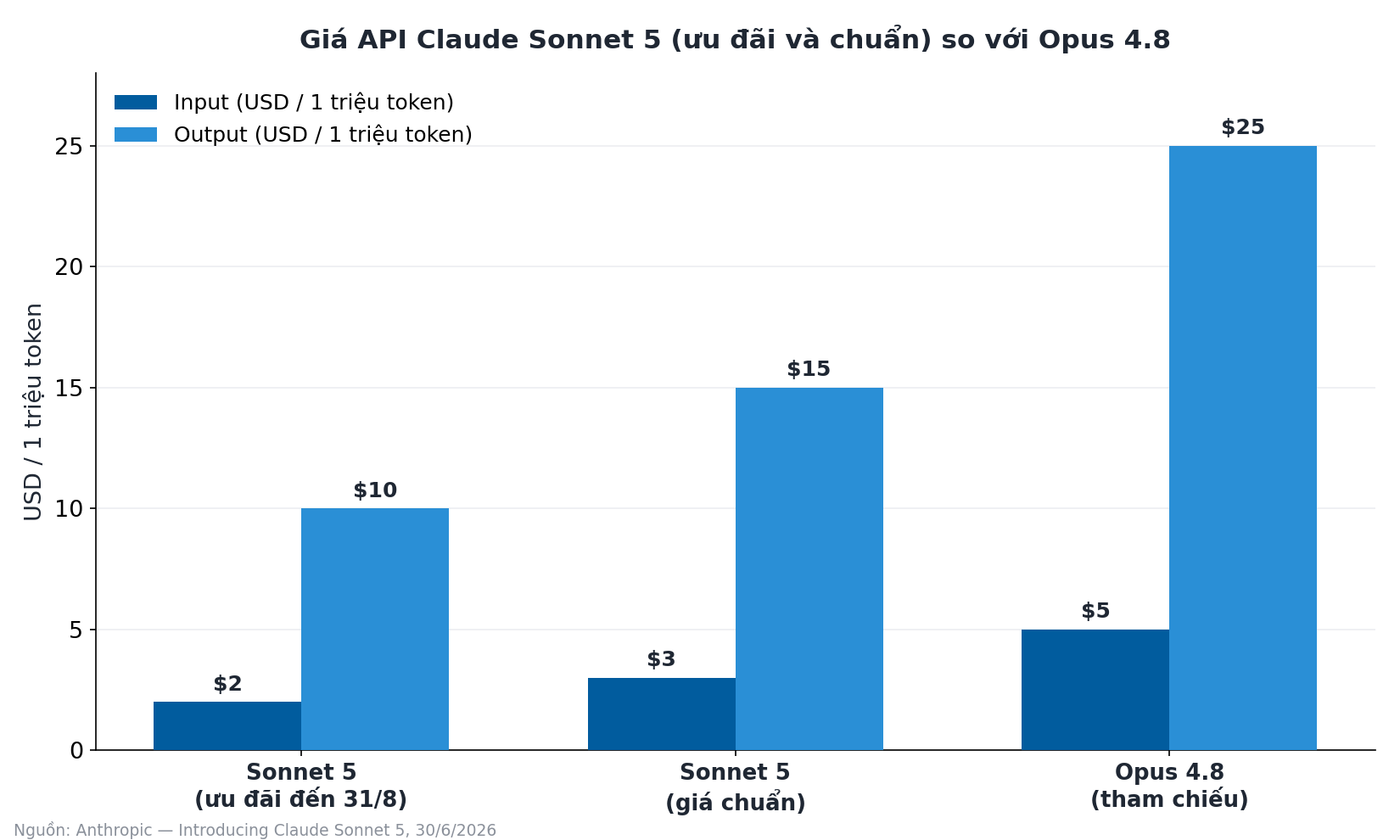
Regarding pricing, Anthropic is offering Sonnet 5 at a promotional rate until August 31, 2026: $2 per 1 million input tokens and $10 per 1 million output tokens. After that milestone, the standard price will be $3 and $15. For comparison, Opus 4.8 is currently at $5 and $25.
The chart clearly shows that Sonnet 5 is significantly cheaper than Opus 4.8 for both token directions. There is one technical note: Sonnet 5 has switched to a new tokenizer, which means the same content might be counted as more tokens, approximately 1.0 to 1.35 times depending on the content type. Anthropic set the promotional price so that the transition phase results in almost no additional cost.
Sonnet 5 is available in all plans starting from the launch day. It is the default model for Free and Pro plans, and is available for Max, Team, and Enterprise users. It runs in Claude Code and on the Claude Platform under the name claude-sonnet-5, and is also available in Cowork. Anthropic has also increased usage limits to accommodate higher token volumes when you increase the effort level.
What about those sitting at a keyboard? Sonnet 5 runs in the cloud, so you don't need a high-end machine just to call it. However, when using it for agentic work via Claude Code-opening terminals, running tests, building projects, and performing multi-step operations-it is your laptop that determines whether everything runs smoothly or stutters. A machine with 16GB of RAM or more, a multi-core CPU, and a fast NVMe drive will make the write-and-test loop significantly smoother. If you are planning to buy a machine to work with AI and Claude Code effectively, Hung Phat can advise on configurations that fit your budget and programming needs; we invite you to browse our available high-performance laptop models.
Where is Claude Sonnet 5 stronger than Sonnet 4.6?
Sonnet 5 is superior to 4.6 in reasoning, tool use, programming, and knowledge processing. For example, Terminal-Bench 2.1 is 80.4% vs 67.0%, OSWorld-Verified is 81.2% vs 78.5%, and Humanity's Last Exam with tools is 57.4% vs 46.8%.
How much does Claude Sonnet 5 cost?
The promotional price until August 31, 2026, is $2 for input and $10 for output per 1 million tokens, then returning to the standard $3 and $15. Opus 4.8 is more expensive, at $5 and $25.
Do I need a high-spec laptop to use Claude Sonnet 5?
The model itself runs in the cloud, so you don't need a powerful machine just to call it. However, when running agentic tasks via Claude Code (terminal, tests, builds), a laptop with 16GB of RAM or more, a multi-core CPU, and a fast NVMe drive will make the workflow much smoother.
Is Sonnet 5 safe for agentic tasks?
Anthropic rates Sonnet 5 as safer than 4.6: it is better at refusing malicious requests, better at resisting prompt injection, and exhibits less hallucination and sycophancy. Its cybersecurity capability is lower, and the company has enabled real-time cybersecurity protection by default.