

In the early hours of June 26, 2026, OpenAI unveiled the GPT-5.6 Sol preview, alongside its siblings Terra and Luna. This time, the company is not releasing it to the general public. Instead, they are conducting a limited trial via API and Codex for a group of trusted partners, following a presentation of the model's capabilities to the US government. A preview that requires such caution certainly suggests something significant is happening. For developers who use AI for coding, this is news to watch. Hung Phat breaks down everything you need to know.
The GPT-5.6 Sol, Terra, and Luna Trio: Three Levels of Capability and a New Naming Convention
OpenAI is simultaneously releasing three models in the GPT-5.6 lineup. Sol is the flagship version, handling the most difficult tasks. Terra is the balanced version for daily work; the company states it offers performance competitive with GPT-5.5 but at half the price. Luna is the fastest and cheapest version, designed for those needing to process large volumes at a low cost.
The three-tier division is closely aligned with usage purposes. For long-term planning assistants, complex debugging, or heavy computational problems, choose Sol. For daily tasks like writing documentation, summarizing, or fixing short code snippets, Terra is sufficient and economical. When running thousands of repetitive requests, Luna keeps the bill at its lightest. As they belong to the same generation, the underlying quality is similar, differing only in capability levels and price.
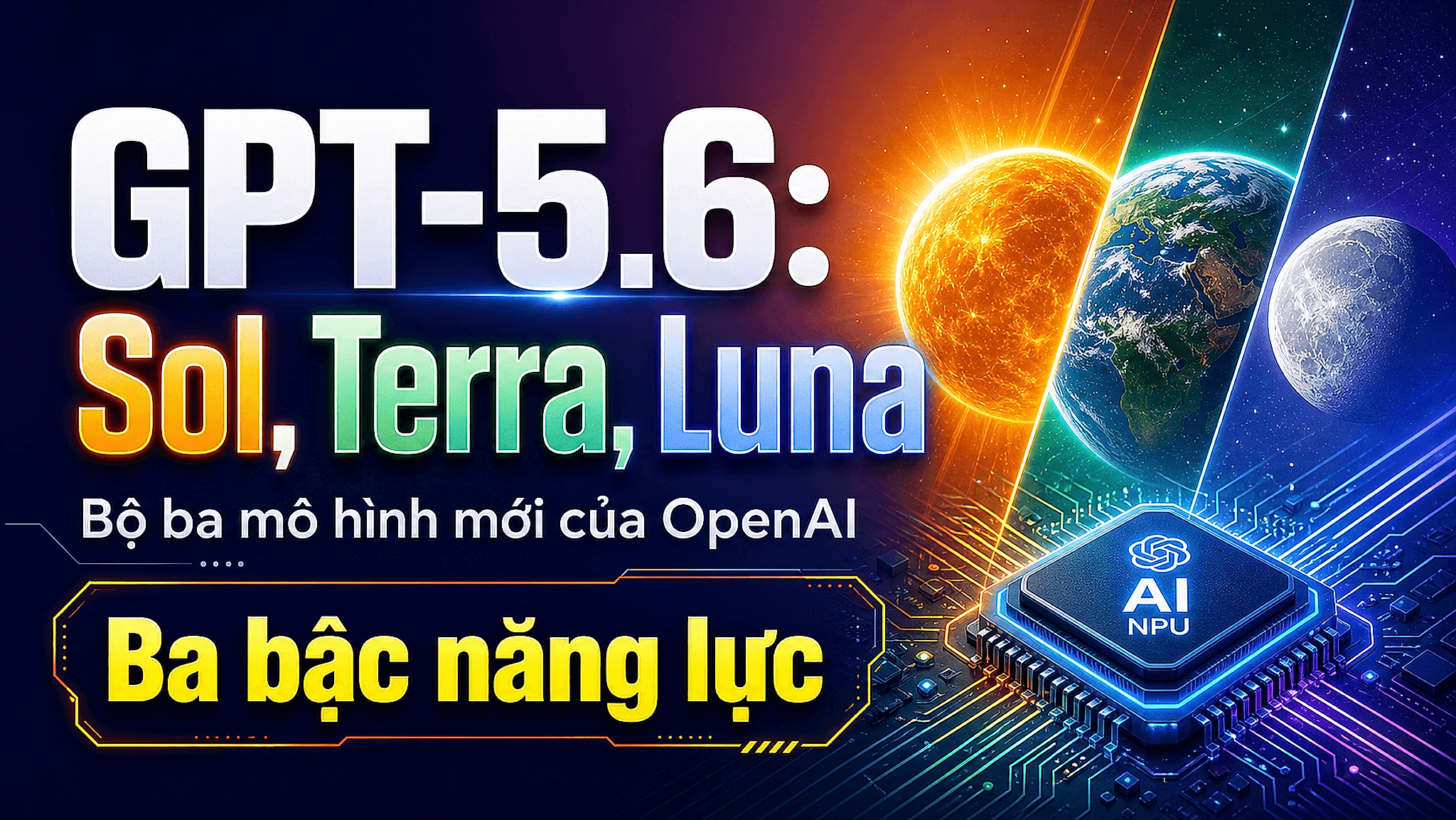
GPT-5.6 also introduces a new naming convention. The number represents the generation, while Sol, Terra, and Luna represent three sustainable levels of capability that can evolve at their own pace. In other words, in the future, there might be a new, more powerful Sol while still retaining the name "Sol," rather than generating a hard-to-remember sequence of numbers. For users, you simply balance the three axes of intelligence, speed, and cost under a single name, saving you from checking specification tables.
Accompanying this are two new modes. The max reasoning level for Sol allows for more deep thinking time before responding, making it suitable for multi-step problems. The "Ultra" mode goes beyond the limits of a single agent, mobilizing subagents to run in parallel to accelerate complex tasks. This is a sign that OpenAI wants to transform the model into an engine capable of self-delegating tasks, rather than just responding faster.
You can read the original announcement in the GPT-5.6 preview from OpenAI. For long workflows, such as building a software project from scratch, the multi-agent execution method often significantly reduces time compared to sequential processing.
How powerful is GPT-5.6 Sol: coding, biology, and cybersecurity
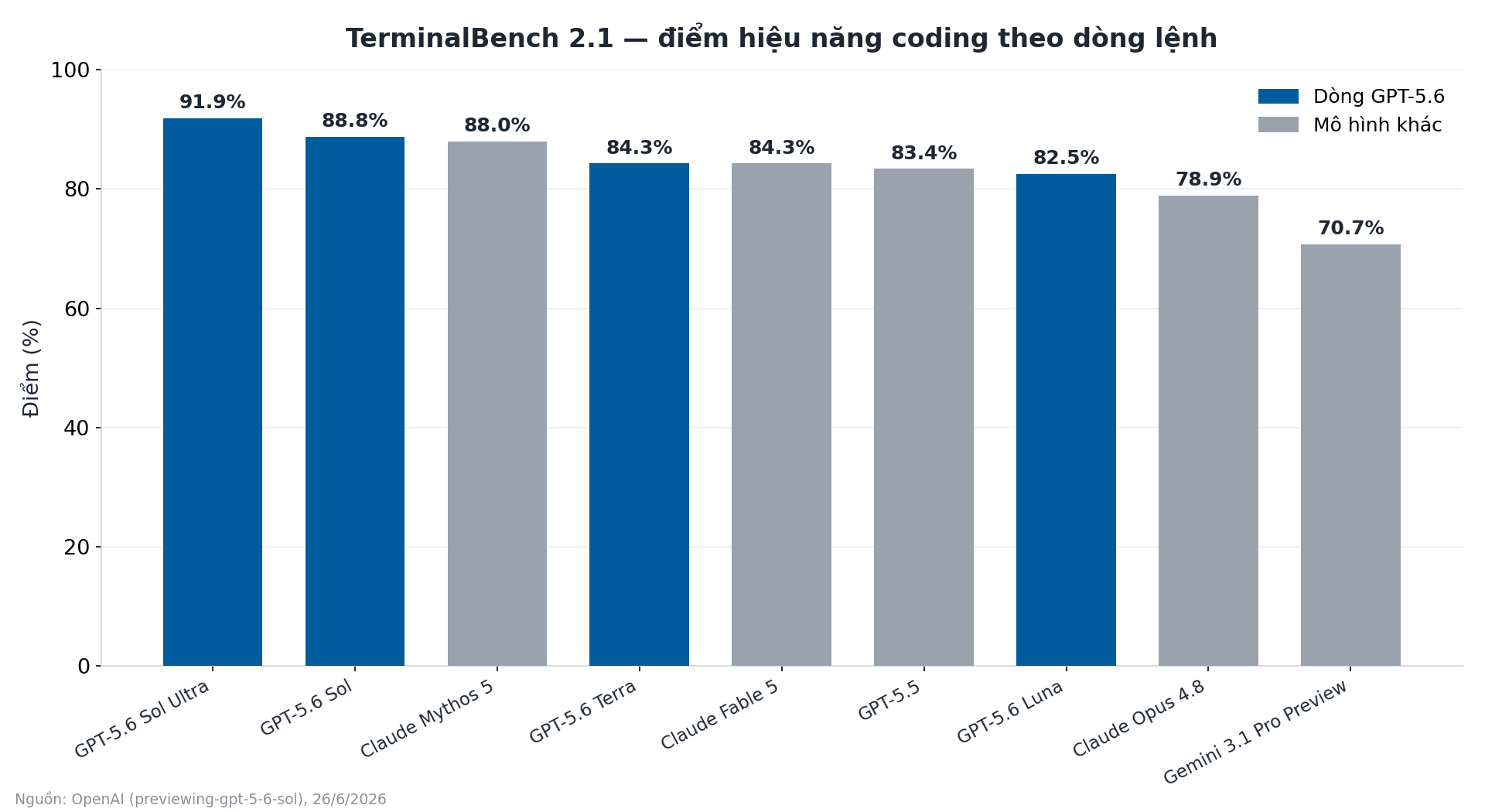
Regarding programming, OpenAI states that Sol set a new record on Terminal-Bench 2.1, a benchmark for command-line operations that require planning, iteration, and tool coordination. This is exactly the kind of work a true coding assistant must excel at, rather than just generating a few disconnected snippets of code.
Looking at the scores, the gap is quite clear. The GPT-5.6 Sol Ultra version achieved 91.9%, GPT-5.6 Sol achieved 88.8%, slightly edging out Claude Mythos 5 at 88.0%. Meanwhile, the previous generation GPT-5.5 scored 83.4%, Claude Opus 4.8 was 78.9%, and Gemini 3.1 Pro Preview was 70.7%. The chart below ranks nine names to help you visualize the landscape.
In the field of biology, Sol achieved better results than GPT-5.5 on GeneBench v1-an evaluation suite for long-term genomic and quantitative biological analysis-while consuming fewer tokens. Using fewer tokens means it is both faster and cheaper for the same problem, a practical advantage for research groups.
In cybersecurity, the company claims this is their most powerful model for finding and patching vulnerabilities. On ExploitBench, GPT-5.6 Sol is competitive with the Mythos Preview version while using only about one-third of the output tokens. On ExploitGym, a benchmark developed by a group from UC Berkeley alongside OpenAI and several other pioneering research labs, Sol, Terra, and Luna all showed significant improvements when their reasoning levels were increased.
Taken together, the capability landscape represents a true leap forward, especially in coding and security. However, that very leap is the reason why OpenAI is not rushing to open it to everyone, as explained in the next section.
Why OpenAI is rolling it out gradually: Cyber Critical thresholds, multi-layer safety, and red-teaming
The unusual aspect is that OpenAI has not opened it to everyone. They are only allowing a group of trusted partners to use it first, and this list has been shared with the US government. The company states this is a short-term step while working with the administration to establish a cybersecurity regulatory framework and a repetitive process for future releases.
The reason lies in the surge in cybersecurity capabilities. In tests on Chromium and Firefox, Sol identified bugs and exploit fragments but could not yet construct a complete attack chain under testing conditions. OpenAI asserts that the model has not yet reached the "Cyber Critical" threshold in their Preparedness Framework, yet they have chosen a gradual rollout because the capability level is vastly different from before.
OpenAI itself has stated they do not want requesting government permission before every release to become a long-term default, as that would keep powerful tools away from the users, developers, and cyber-defense teams who need them. This is a difficult balance between expanding access and controlling risk.
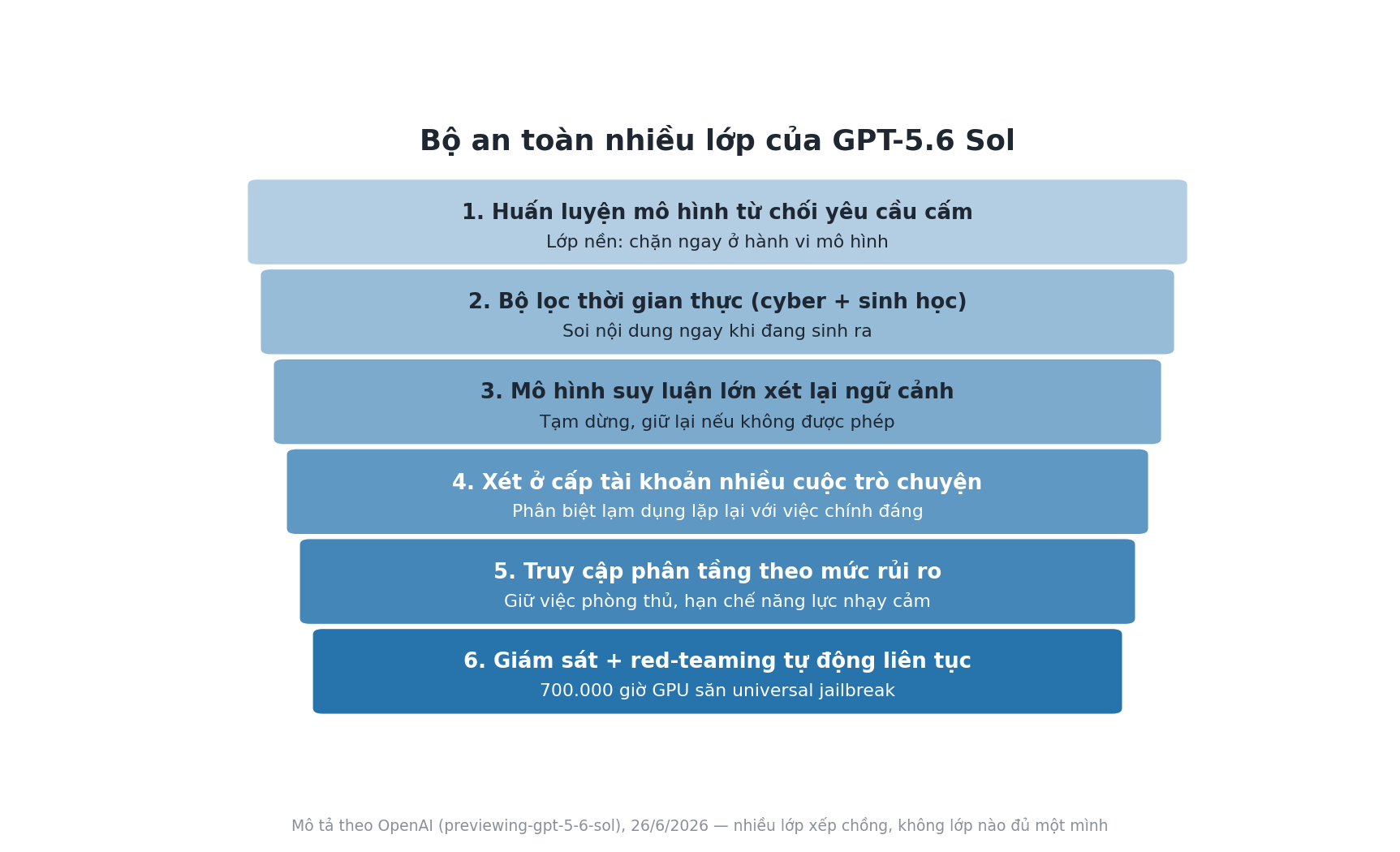
Regarding protection, the company uses multiple stacked layers as shown in the diagram above. The foundation layer involves training the model to refuse prohibited requests, even if users disguise their intentions or attempt to jailbreak. Above that are real-time filters for both cybersecurity and biology, scanning content as it is being generated. In high-risk scenarios where a violation is suspected, the response may be paused for a larger reasoning model to review the context, and it will be withheld if not authorized.
Even higher is the account-level review layer, which looks across multiple conversations to distinguish repetitive malicious behavior from legitimate security work. OpenAI admits that during the preview phase, filters may occasionally block valid tasks, and they are using user feedback to gradually reduce these false positives. To ensure safety measures do not break against new tactics, the company has dedicated over 700,000 A100-equivalent GPU hours to automated red-teaming to hunt for universal jailbreaks, combined with external expert groups and a rapid response process to patch new vulnerabilities.
GPT-5.6 API pricing, prompt caching, Cerebras speed, and availability
GPT-5.6 is billed per one million tokens and is divided into three tiers based on the model version. This pricing applies to both input and output tokens, so actual costs depend heavily on the length of the responses you request.
Looking at the pricing chart, the gap between the three versions is quite large, especially for output tokens. Sol is the most expensive, Luna is the cheapest, and Terra sits in the middle and is perhaps the best value: comparable to GPT-5.5 but twice as cheap, making it likely the most popular version when the rollout expands.
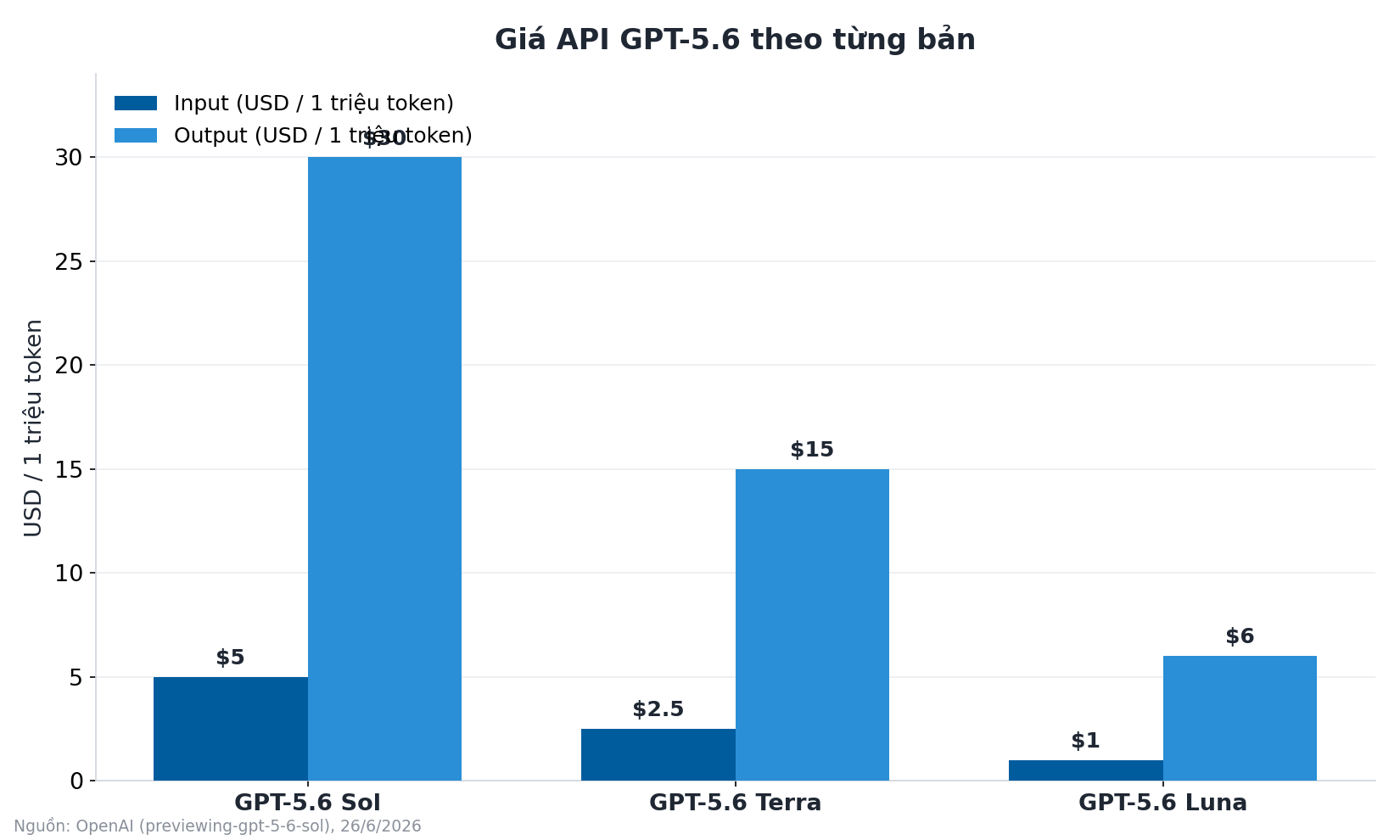
The table below details the role and price of each version for easy comparison.
| Version | Role | Input Price (per 1M tokens) | Output Price (per 1M tokens) |
|---|---|---|---|
| Sol | Flagship, difficult tasks | 5 USD | 30 USD |
| Terra | Balanced, daily tasks | 2.50 USD | 15 USD |
| Luna | Fast, low cost | 1 USD | 6 USD |
GPT-5.6 also introduces more predictable context caching, allowing for explicit cache cut-off points and a minimum cache duration of 30 minutes. Writing to the cache is charged at 1.25x the standard input rate, but reading from the cache is discounted by 90%, which is highly beneficial when repeating the same context.
Regarding speed, OpenAI stated they will run GPT-5.6 Sol on Cerebras hardware at speeds of up to 750 tokens per second in July, initially limited to certain customers. As for availability, these versions will first arrive via API and Codex for selected groups, then will be opened to ChatGPT, Codex, and API users within the next few weeks. For enterprises, the company is developing additional features such as privacy-preserving violation detection and risk-based access control.
What laptop users gain from GPT-5.6
It is important to clarify one thing to avoid misunderstanding. GPT-5.6 runs in the cloud. You call it via API or use it within Codex and ChatGPT; you do not download the model to run directly on your machine. This means you do not need a supercomputer just to use GPT-5.6.
However, whether your workflow is smooth or stuttering depends on the machine you are typing on. When you open ChatGPT or Codex in a browser and put it to real work, the experience depends heavily on your computer's configuration.
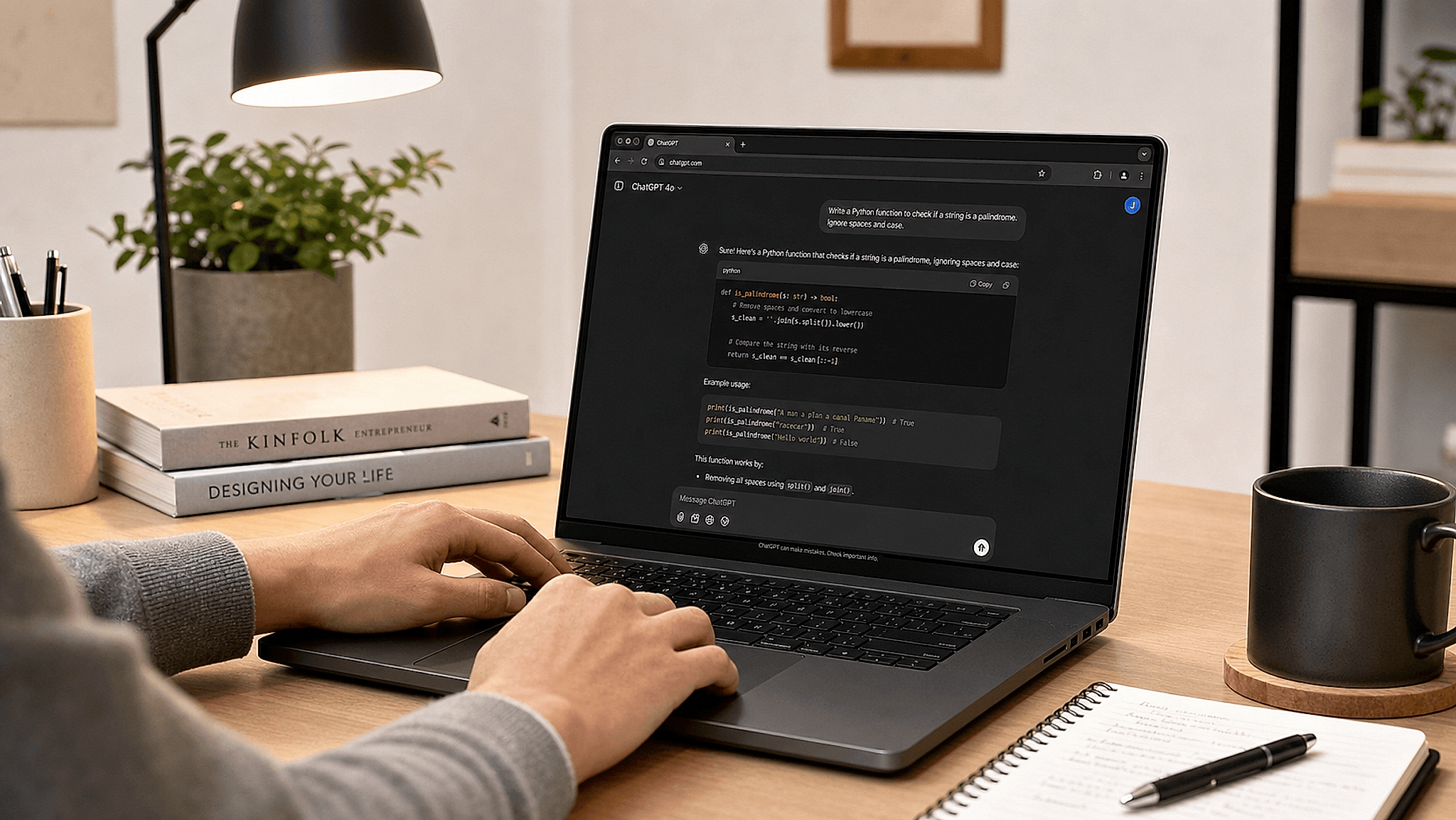
Specifically, when you have Codex deploying subagents in Ultra mode, opening multiple terminals, building projects, and running containers in parallel, the resources being consumed are your machine's RAM, multi-core CPU, and high-speed SSD. A laptop with 16GB of RAM or more, a multi-core CPU, and a fast NVMe drive will help the loop of writing code and testing it run without lag. A wide screen and good battery life also make long coding sessions more comfortable.
If you are planning to buy a machine to work effectively with AI and Codex, Hung Phat can advise on a configuration that fits your budget and your specific programming needs. Visit our selection of mobile workstations and high-performance laptops to find the one that best matches your workflow.
When can I use GPT-5.6 Sol?
Currently, Sol, Terra, and Luna are only in limited trial via API and Codex for a group of trusted partners. OpenAI stated they will expand access to ChatGPT, Codex, and API users within the next few weeks.
Does GPT-5.6 run offline on a laptop?
No. This is a cloud-based model; you access it via API or through Codex and ChatGPT. Your computer only needs to be powerful enough to code and run the accompanying tools, not to run the model locally.
Which version should I choose: Sol, Terra, or Luna?
Choose Sol for difficult tasks requiring deep reasoning, Terra for daily work due to its balance of price and power, and Luna when you need to process large volumes at a low cost. They are from the same generation with similar foundations, differing only in capability and price.
How is GPT-5.6 priced?
It is priced per one million tokens. Sol is 5 USD for input and 30 USD for output, Terra is 2.50 and 15 USD, and Luna is 1 and 6 USD. Additionally, there is a caching mechanism that reduces costs when repeating the same context.


![5 Claude Prompts To Master The Memory Feature: How To Maximize Utility And Prevent Hallucinations Claude'S &Quot;Memory&Quot; Feature Is A Powerful Tool For Maintaining Context, But Without The Right Instructions, It Can Lead To &Quot;Memory Drift&Quot; Or The Ai Misremembering Key Details. To Get The Most Out Of This Feature While Ensuring Accuracy, You Need To Provide Structured Guidance. Here Are Five Strategic Prompts Designed To Help You Leverage Claude'S Memory Effectively And Prevent It From Making Mistakes. ### 1. The &Quot;Contextual Anchor&Quot; Prompt **Goal:** To Establish A Foundational Set Of Facts That Claude Must Prioritize Over Any New Information Provided During A Session. **Prompt:** &Quot;I Want To Establish A Set Of Core 'Permanent Contexts' For Our Future Interactions. Please Store The Following Facts In Your Memory As High-Priority Anchors. If Any New Information I Provide Later Contradicts These Facts, Flag The Contradiction To Me Immediately Rather Than Updating Your Memory With The New Data. [Insert Your Core Facts/Preferences Here, E.g., 'I Am A Python Developer,' 'I Prefer Concise, Technical Explanations,' 'Always Use Us English.']&Quot; ### 2. The &Quot;Memory Audit&Quot; Prompt **Goal:** To Prevent &Quot;Memory Bloat&Quot; And Ensure Claude Isn'T Holding Onto Outdated Or Incorrect Information. **Prompt:** &Quot;Before We Proceed With This New Task, Please Provide A Brief Summary Of The Key Preferences, Project Details, And Stylistic Constraints You Currently Have Stored In Your Memory Regarding My Work. I Want To Ensure Your Internal 'Knowledge Base' Of My Needs Is Accurate And Up To Date. If Anything Seems Outdated Or Incorrect, I Will Provide Corrections.&Quot; ### 3. The &Quot;Explicit Update&Quot; Prompt **Goal:** To Prevent Claude From Making Assumptions. This Forces The Ai To Ask For Permission Before Committing New Information To Long-Term Memory. **Prompt:** &Quot;From Now On, Do Not Automatically Update Your Long-Term Memory Based On Our Casual Conversation. Instead, If You Identify A Detail That Seems Important For Our Future Sessions (Such As A Change In My Project Goals, A New Coding Preference, Or A Shift In My Writing Style), Please Ask Me: 'Should I Add This To My Permanent Memory?' I Will Then Explicitly Confirm Or Deny The Update.&Quot; ### 4. The &Quot;Conflict Resolution&Quot; Prompt **Goal:** To Handle Situations Where New Data Clashes With Old Data, Preventing The Ai From &Quot;Hallucinating&Quot; A Hybrid Of The Two. **Prompt:** &Quot;I Am Providing New Information That May Conflict With What You Previously Know About [Project Name/Topic]. Please Treat This New Information As A 'Temporary Override' For This Specific Conversation. Do Not Update Your Permanent Memory With These Changes Unless I Explicitly Instruct You To Do So At The End Of This Session. If You Detect A Conflict Between This New Data And Your Stored Memory, Point It Out Before Proceeding.&Quot; ### 5. The &Quot;Style &Amp; Format Guardrail&Quot; Prompt **Goal:** To Ensure That Claude'S Memory Of Your &Quot;Voice&Quot; Or &Quot;Formatting Requirements&Quot; Remains Consistent And Doesn'T Degrade Over Time. **Prompt:** &Quot;I Want To Lock In A Specific Output Format For All My Technical Documentation. Please Store The Following Structural Requirements In Your Memory: [Insert Format Details, E.g., 'Always Use Markdown Headers,' 'Always Include A 'Key Takeaways' Section At The Top,' 'Never Use Emojis']. Whenever I Ask You To Write Documentation, Cross-Reference This Stored Format To Ensure 100% Consistency. If A Prompt I Give You Seems To Deviate From This Format, Remind Me Of My Established Preference.&Quot;](https://hungphatlaptop.com/wp-content/uploads/2026/09/5-prompt-claude-khai-thac-memory-featured-480x300.jpg "5 Prompt Claude Khai Thac Memory Featured")