


Nvidia has been developing a new method to compress textures and save GPU memory for years. Although this technology is still in the beta stage, a newly released demo has shown how AI-based solutions can help overcome VRAM limitations on modern GPUs.
Nvidia Neural Texture Compression - The VRAM Optimization Solution
Nvidia's Neural Texture Compression (NTC) technology offers massive VRAM savings when rendering complex 3D graphics, even though it has not yet been widely applied. This technology was tested by the YouTube channel Compusemble through an official demo, demonstrating its potential for game developers in the near future.
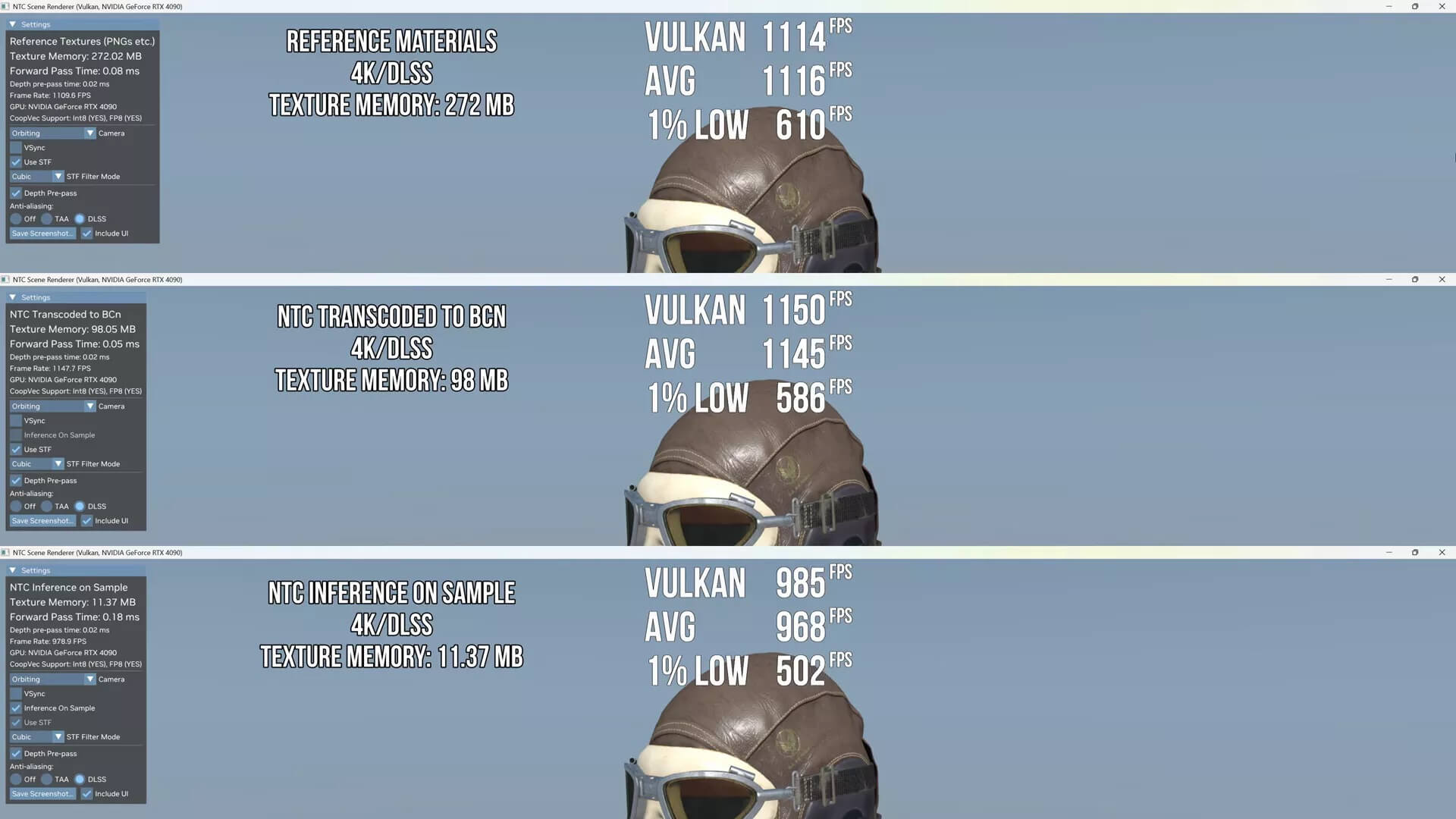
According to Compusemble, RTX Neural Texture Compression uses specialized neural networks to dynamically compress and decompress textures. Nvidia's demo provides three different rendering modes:
- Reference Material: Textures remain in their original state without using NTC, resulting in high VRAM and disk space consumption.
- NTC Transcoded to BCn (BCn block-compressed format): Textures are transcoded upon loading, significantly reducing storage capacity but only providing moderate VRAM savings.
- Inference on Sample: Textures are decompressed only when necessary during the rendering process, providing maximum VRAM and disk space savings.
Real-world Performance Testing
https://www.youtube.com/watch?v=Z9VAloduypg
Compusemble tested the demo at 1440p and 4K resolutions, with DLSS and TAA options. The results show that NTC not only significantly reduces VRAM usage but also affects frame rates (FPS). Specifically:
- At 1440p resolution with DLSS, the NTC Transcoded to BCn mode helped reduce texture memory usage by 64%, from 272MB down to 98MB.
- The NTC Inference on Sample mode reduced texture memory to just 11.37MB, equivalent to a 95.8% reduction compared to not using AI compression technology.
Impact on GPU Performance
The test was run on a GeForce RTX 4090 GPU, where DLSS and high resolutions add load to the Tensor Cores, affecting performance depending on the settings. However, newer generations of GPUs may optimize performance and minimize frame rate drops when using this technology.
The Importance of Cooperative Vectors in Graphics Rendering
The demo also highlights the role of Cooperative Vectors in modern rendering pipelines. As Microsoft has explained, Cooperative Vectors help accelerate AI tasks in real-time by optimizing vector operations. These algorithms play a crucial role in training and fine-tuning AI models, while simultaneously enhancing rendering performance for games.
With Nvidia's heavy investment in AI-based rendering technologies like NTC, the future of the graphics industry will witness major advancements in VRAM optimization, giving developers more creative space in game design.