
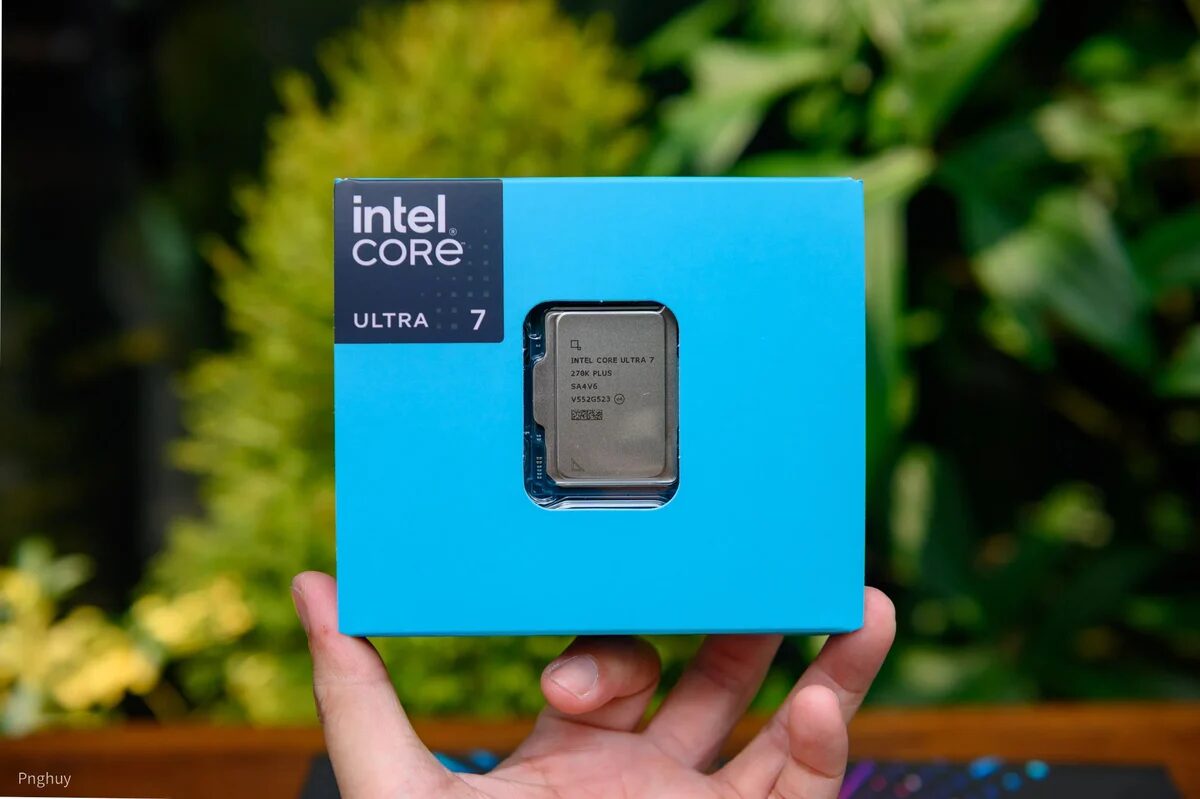
On the night of March 23 (Vietnam time), the review embargo for the Intel Core Ultra 7 270K Plus-Intel's latest desktop chip-was lifted simultaneously, followed by a wave of reviews from Tom's Hardware, Digital Trends, and many other major tech channels. The general consensus is "Intel is Back," but it comes with significant caveats that enthusiasts need to understand before considering an upgrade to Intel Core Ultra 7 270K Plus. Below are the 5 key points emphasized by reviews on its first day on the market, ranging from real-world performance and power consumption to the question of whether this is the right time to upgrade your Intel PC.
Stronger than the 285K and outperforming the 265K, but AMD X3D still leads in gaming
Benchmark results confirm that the Intel Core Ultra 7 270K Plus outperforms the Core Ultra 9 285K in productivity and multi-threaded tasks, with differences of up to 12% in certain specific tests. Compared to the Core Ultra 7 265K, the gap is even larger, representing a substantial improvement rather than a mere refresh. In gaming, the new chip also improves by approximately 6-12% compared to the 285K, partially addressing the weaknesses of the Arrow Lake generation that faced heavy criticism. However, the AMD Ryzen 9 9850X3D remains the king of gaming with a performance lead of up to 25%, especially in esports titles and games that rely heavily on CPU cache bandwidth rather than pure GPU power. AMD's 3D V-Cache technology remains a weapon for which Intel does not yet have a convincing answer, and this is something competitive gamers need to weigh carefully before making a decision.

The second point to note is power consumption. The Intel Core Ultra 7 270K Plus consumes up to 40W more than the Core Ultra 9 285K-an 11% increase in power-while multi-core performance only increases by an average of 4%. This trade-off is not ideal for users who prioritize system temperatures or want to optimize long-term operating costs. The practical consequence is that you will need to invest in a better-than-average cooling solution to ensure the Intel Core Ultra 7 270K Plus operates stably without throttling. On the plus side, Intel provides the Intel Binary Optimization Tool, which helps optimize processing performance for officially supported games, partially bridging the gaming gap with X3D chips.
Competitive at $299, but the Z890 platform and LGA1851 socket require careful consideration
The $299 price point in the US market is a surprising and competitive figure, on par with the Ryzen 7 9700X and significantly lower than Intel's previous flagship segment. For the first time, the Intel Core Ultra 7 270K Plus provides a compelling reason for mainstream users to consider it instead of defaulting to AMD. However, the actual cost picture is more complex than the $299 figure. The LGA1851 platform used by the Intel Core Ultra 7 270K Plus requires a Z890 motherboard to fully exploit all features, with prices starting from $200 upwards. More importantly, the LGA1851 socket will not be compatible with the Nova Lake CPU generation expected to launch in late 2026 or early 2027, meaning a system built today cannot be upgraded to the next generation without replacing the entire motherboard. The official price of the Intel Core Ultra 7 270K Plus in Vietnam has not yet been announced, but it is expected to be higher than the international price due to import and distribution costs. Source: Tom's Hardware.