

Intel is preparing to launch a new processor lineup called Intel Nova Lake-S, promising a leap in performance, power efficiency, and local AI support. With a flexible design ranging from mainstream to high-end, this CPU series brings significant improvements in both hardware and connectivity, meeting all needs from gaming and intensive work to trendy AI applications.
Powerful Multi-core and Integrated AI Technology on Intel Nova Lake-S
According to leaked information, Intel Nova Lake-S will feature a significant increase in core counts compared to the previous generation, ranging from 12 to 52 cores depending on the segment. Specifically:
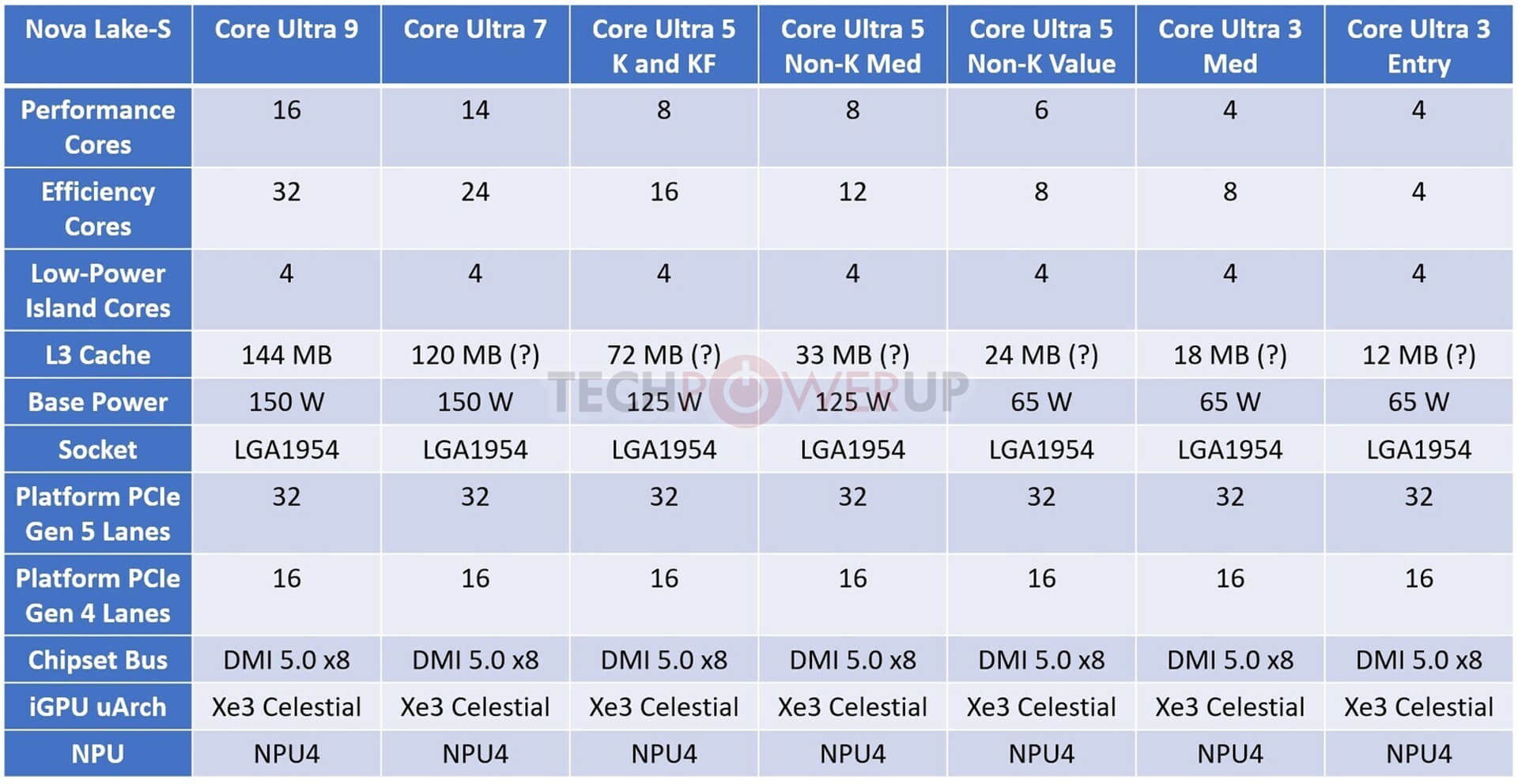
- Core Ultra 9: Up to 52 cores (16 high-performance Coyote Cove cores, 32 efficient Arctic Wolf cores, 4 ultra-low-power LPE cores), L3 cache up to 144MB, TDP 150W.
- Core Ultra 7: 42 cores (14 P-cores, 24 E-cores, 4 LPE cores), with a TDP of 150W.
- Core Ultra 5: Ranging from 18-28 cores, suitable for the mid-range segment with various configuration options.
- Core Ultra 3: 12-16 cores, aimed at compact, energy-efficient computers.
A major highlight of this generation is the LPE (Low Power Island) cores - which support background tasks without consuming much power, significantly improving background processing and optimizing usage time.
Additionally, Intel is integrating a Neural Processing Unit (NPU) to support local AI tasks, especially as operating systems and applications increasingly leverage Microsoft Copilot+ features.
High-Speed Connectivity and Expanded Hardware Platform
Intel Nova Lake-S also marks a significant upgrade in hardware connectivity:
- Supports up to 32 PCIe 5.0 lanes and 16 PCIe 4.0 lanes, helping to expand bandwidth for GPUs and high-speed SSDs.
- Communicates with the chipset via DMI 5.0, achieving speeds equivalent to PCIe 5.0 x8 on high-end motherboards, helping to reduce bottlenecks.
- Integrated graphics use Xe3 “Celestial”, promising stable performance for light gaming and basic graphics processing.
A notable point is the multi-tile design using the TSMC 2nm process for certain core clusters, combined with technologies such as Turbo Cells, Foveros Direct 3D stacking, and PowerDirect - all aimed at increasing transistor density, high performance, and maximum power efficiency.
Application Potential and Challenges to Overcome
Intel Nova Lake-S does not only serve individual users but also opens new options for workstations, enterprise computers, edge AI devices, and content creators. Impressive multi-threaded performance helps effectively handle tasks such as video editing, AI, complex programming, or heavy gaming.
However, high-end models still have a relatively high TDP (150W), requiring commensurate cooling systems and power supplies. Additionally, the Xe3 integrated GPU on desktop is not as powerful as the mobile version, making it suitable only for basic needs.
Many specifications are still rumors and may change before the official announcement. But if realized, Intel Nova Lake-S will be one of Intel's most breakthrough CPU lineups, ready to compete with AMD Ryzen Zen 6 and maintain its position in the computing chip industry.