
CPPC HighestFreq Ryzen is a new firmware-level change from AMD, but its impact addresses a question many Ryzen users often wonder about: why the boost clock listed on the box sometimes doesn't match the clock read by the operating system. Instead of relying on indirect metrics, Windows and Linux can now more accurately read the actual maximum clock speed reported by the CPU. For Ryzen desktops and gaming laptops using AMD chips, this difference helps reduce discrepancies in task allocation and clock monitoring. This isn't an update that will cause FPS to skyrocket, but it is a crucial piece of the puzzle that helps the scheduler stop "guessing" on CPUs with complex boost behaviors.
CPPC HighestFreq Ryzen fixes a long-standing blind spot for Windows and Linux
According to an analysis from WCCFtech, AMD is introducing the CPPC HighestFreq mechanism so that firmware can report the actual maximum boost clock directly to the operating system, rather than forcing Windows and Linux to interpolate from abstract performance metrics as before.
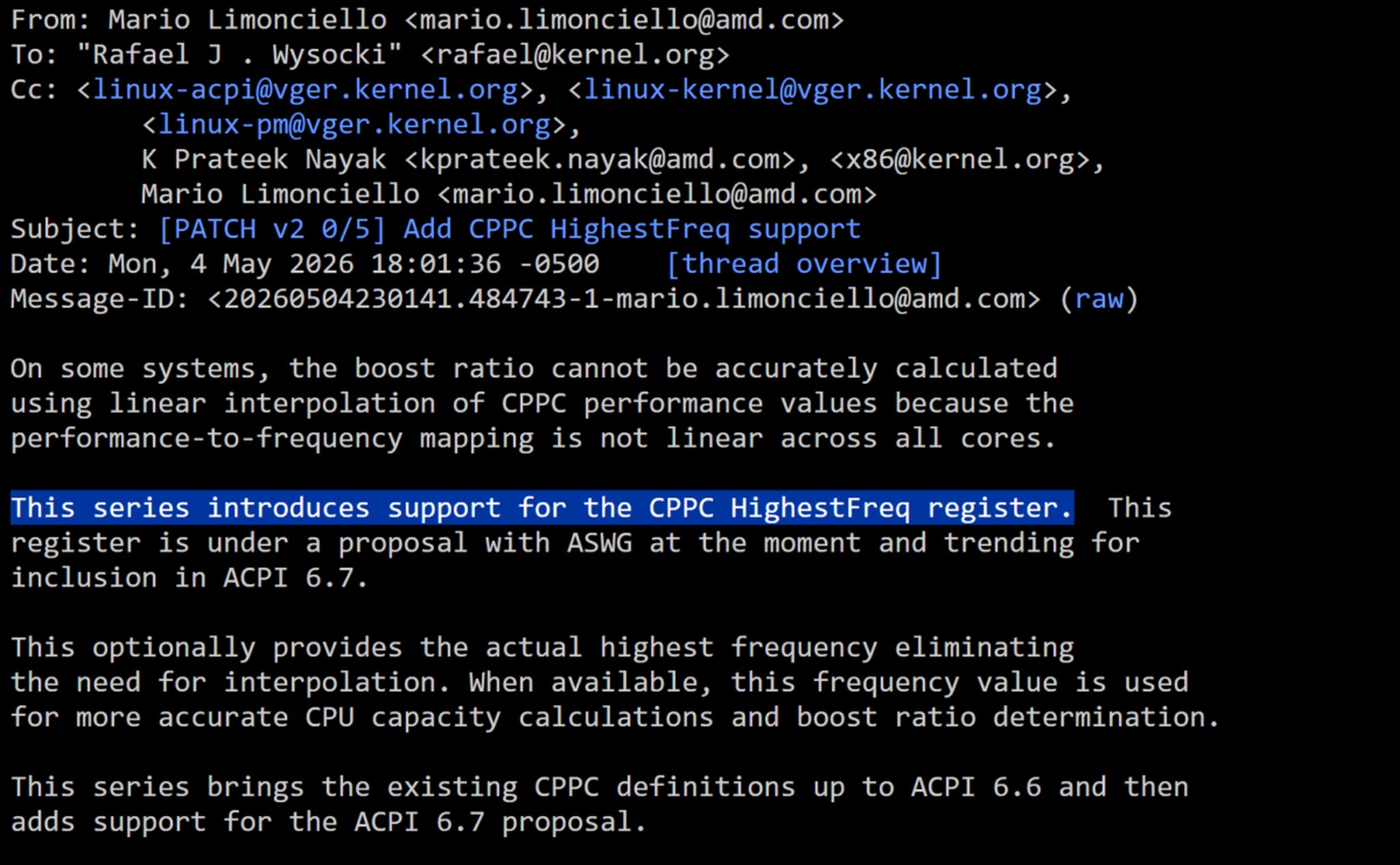
The old limitation didn't necessarily make Ryzen run slower, but it made it difficult for the scheduler to correctly distinguish between cores in complex boost scenarios. On modern CPUs, not all cores increase their clock speed in the same way, and monitoring software does not always accurately reflect the maximum clock ceiling that a specific core can reach.
In the Linux kernel amd-pstate documentation, CPPC is described as the foundation that allows the operating system to know the order of cores capable of achieving the highest performance. When this information is more accurate, the scheduler has a better basis to push heavy workloads to the correct preferred core.
For real-world users, the most obvious benefit lies in gaming, foreground tasks, and short but latency-sensitive processes. A Ryzen gaming laptop might not see an immediate jump in FPS thanks to this change alone, but the operating system's correct understanding of which core has more boost headroom will help the machine respond more stably to heavy loads.
Why a small change in ACPI is still worth Ryzen users' attention
The essence of CPPC HighestFreq Ryzen is a change at the communication layer between firmware and the operating system, tied to the ACPI specifications managed by the UEFI Forum. While it may sound distant from the average user, this is the layer that determines how accurately Windows or Linux understands the hardware before allocating tasks or displaying parameters in monitoring software.
This is even more noteworthy as AMD expands the Ryzen ecosystem across various device types, from traditional desktops to platforms like Ryzen AI MAX 495. When a CPU must share resources between AI, integrated graphics, and system loads within the same chip package, an OS misunderstanding the clock ceiling or misordering high-performance cores could lead users to misinterpret the machine's actual performance.
This also relates to high-performance systems like the Ryzen AI MAX 395, where AMD pursues compact designs while maintaining fast responsiveness for mixed workloads. In this context, CPPC HighestFreq Ryzen is not a flashy feature, but a foundational refinement that helps software keep pace with hardware.
The table below provides a quick summary of the practical impact of this change for Ryzen users.
| Change Point | Practical Significance |
| OS reads near-accurate boost clock ceiling | Reduces the need to guess from indirect data, making clock monitoring figures less misleading |
| Scheduler understands preferred cores better | Heavy tasks have a better chance of running on cores with higher boost potential |
| Applicable to both Windows and Linux | Both operating systems have a better foundation to handle new-generation Ryzen more consistently |
| Relates to ACPI and firmware layers | This is a foundational change with more long-term value than a temporary optimization trick |
This is the kind of update that isn't flashy but is highly valuable for AMD PC buyers. As AMD completes the integration of CPPC HighestFreq Ryzen into new firmware, drivers, and system standards, users will gain a more realistic view of Ryzen performance.