
The Thermalright AI HydroNous R1 has emerged as a very unique way to harness Strix Halo: packing a Ryzen AI Max+ 395 into a 2.6-liter mini PC and pushing the power limits to levels that laptops with the same chip struggle to maintain long-term. This approach makes the AI HydroNous R1 stand out as a highly noteworthy hardware experiment. The highlight is not just the use of the most powerful 16-core, 32-thread processor in the Ryzen AI Max lineup, but also the choice of liquid cooling for a chassis originally designed for compactness. With the AI HydroNous R1, Thermalright is clearly aiming to prove that mini PCs can still pursue extreme performance. Looking at the overall configuration, the AI HydroNous R1 is positioned as a machine to test the thermal and power limits of Strix Halo. For those following the new AI PC wave, this model shows that Strix Halo is not only suitable for high-end laptops but is also capable of opening up a category of ultra-small desktops that prioritize heavy performance. If Thermalright maintains the stability they have announced, the AI HydroNous R1 will be the type of product that shifts the image of mini PCs away from being just small office machines.
How is the Thermalright AI HydroNous R1 different from most mini PCs today?
What sets the AI HydroNous R1 apart from the majority of mini PCs is how the company handles the challenge of sustainable performance. Instead of using power-saving chips and accepting clock speed throttling under prolonged heavy loads, Thermalright integrates the Ryzen AI Max+ 395 into a 2.6-liter chassis and combines it with a dedicated liquid cooling system to boost the TDP up to 176W. This figure is significantly higher than the 120W maximum announced by AMD for the SoC, so the practical benefit is not just better benchmark scores, but the ability to maintain higher clock speeds during rendering, running local AI models, or playing heavy games for extended periods.
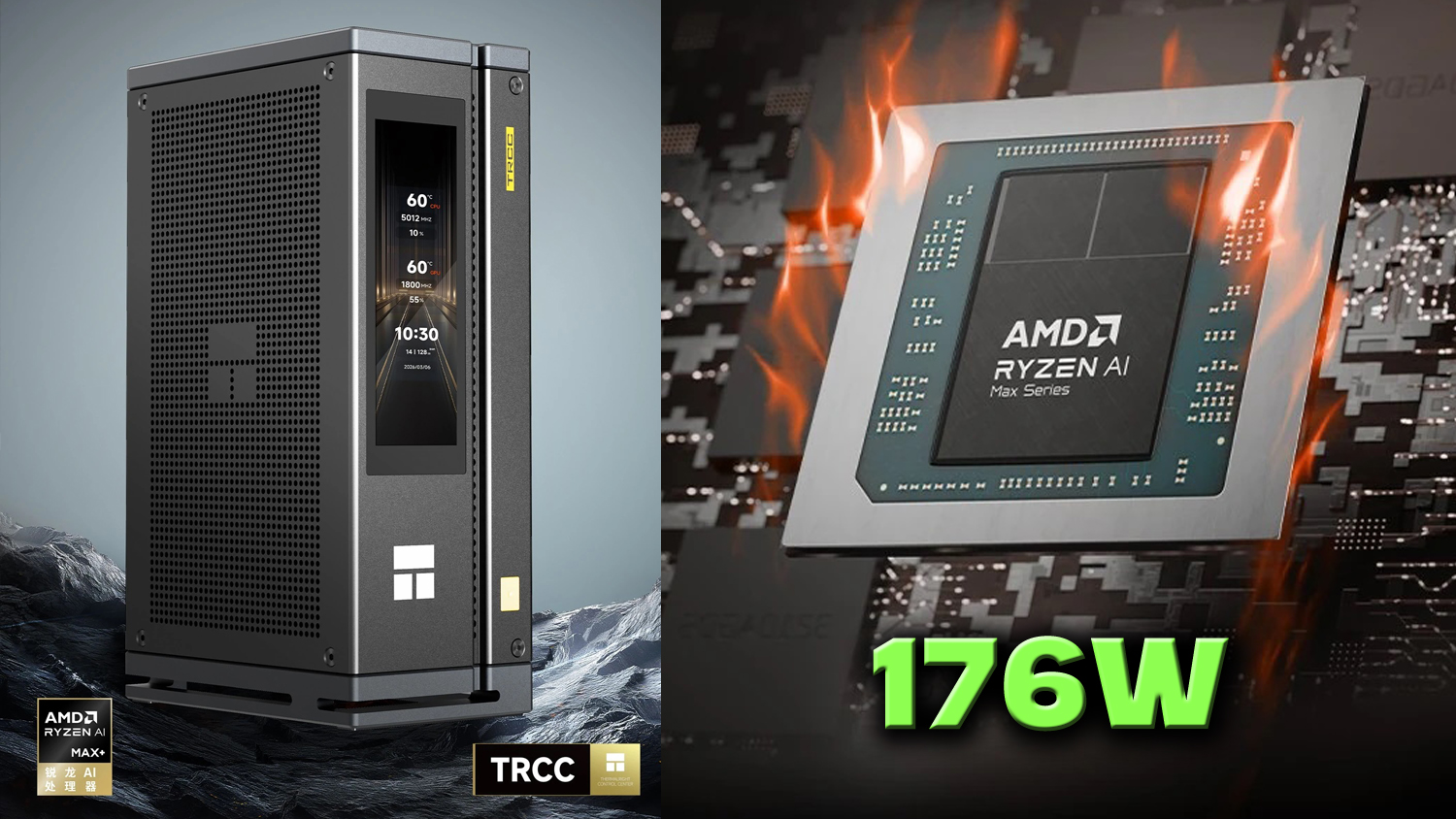
The internal hardware also shows that this is not a mini PC designed with compromises for the sake of form factor. The machine uses integrated Radeon 8060S with 40 CU RDNA 3.5, paired with the highest-end 128GB LPDDR5X memory and a 1TB or 2TB PCIe 4.0 SSD. This combination makes the AI HydroNous R1 feel closer to a compact workstation laptop than a typical office mini PC. While many manufacturers are trying to exploit Ryzen AI Max in thin and light devices, Thermalright's approach opens a different direction for those who need high performance but still want to keep their desk tidy. This is also the type of machine that could appeal to those following Ryzen AI AMD to find a configuration that breaks past laptop limits.
What does this liquid-cooled Strix Halo mini PC mean for buyers and the AI PC market?
For buyers, the AI HydroNous R1 is a signal that Strix Halo is starting to move beyond the role of a chip used merely for benchmark demonstrations. Appearing in a liquid-cooled mini PC, the Ryzen AI Max+ 395 shows that the potential for this platform is even broader than high-end laptops. Instead of choosing between a powerful but hot laptop or a powerful but bulky desktop, users now have an intermediate device category: small and compact, yet capable of handling heavy workloads. This is particularly noteworthy for creators, engineers, or those running local AI in small workspaces.
From a market perspective, Thermalright's product also puts pressure on traditional mini PC manufacturers who have long focused primarily on power efficiency and office optimization. When a 2.6-liter machine can push Strix Halo to 176W, the question is no longer whether mini PCs can be powerful, but how many manufacturers dare to follow this design direction. If the reception is positive, the AI HydroNous R1 could open a high-performance small-form-factor branch that competes directly with low-profile discrete GPU mini desktops and certain high-end laptops.
What buyers should continue to monitor is the actual noise levels, long-term temperatures, the ease of maintaining the liquid cooling system, and the retail price when it hits the shelves widely. These will be the deciding factors in whether this machine is truly worth the investment or just a technical demonstration. Nevertheless, the appearance of the AI HydroNous R1 is highly significant as it shows the AI PC race is no longer confined to Copilot+ laptops or office mini PCs. Thermalright mini PC is attempting to pull ultra-small desktops into a new performance realm, and this is a direction that many practical users may find more interesting than generic AI promises.