
Nvidia RTX 5050, 5060, and 5060 Ti: Minor Upgrades in the Blackwell Lineup
Following the somewhat underwhelming debuts of the Nvidia RTX 5090, 5080, 5070 Ti, and 5070, the mainstream and mid-range GPU models of the Blackwell series are expected to appear soon. According to leaked information, these products feature more CUDA cores, higher power consumption, and an upgrade to GDDR7 VRAM while maintaining the same memory capacity, except for the RTX 5050, which has a configuration quite similar to the RTX 3050.
Reputable leaker Kopite7kimi recently revealed the specifications of the RTX 5050, 5060, and 5060 Ti models, GPUs that Nvidia may announce this week. Similar to previous Blackwell GPUs, these three GPU models appear to be only minor upgrades over their predecessors.
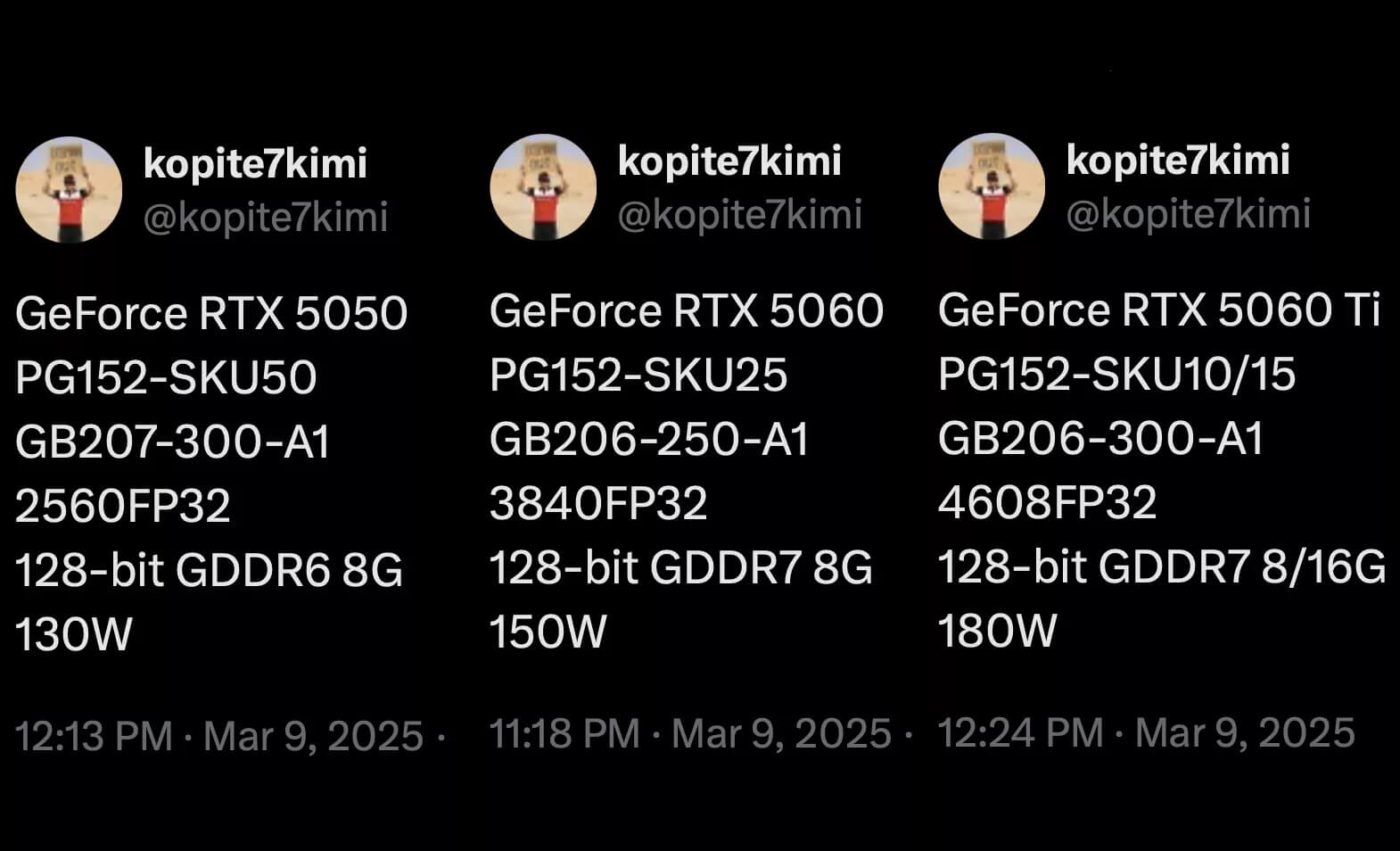
The most notable point is that the RTX 5060 and 5050 still only feature 8GB of VRAM. In the context of 2025, Nvidia continuing to maintain this VRAM level could be disappointing for gamers. Meanwhile, the RTX 5060 Ti offers a 16GB option, confirming that the RTX 5090 remains the only Blackwell model with higher VRAM capacity compared to its predecessor.
Specifications: Slight Increase in CUDA Cores and Power Consumption
Nvidia may position this product line as a budget graphics solution for high-refresh-rate 1080p monitors (460Hz and 500Hz). However, even in the mainstream segment, some users may be dissatisfied that Nvidia has maintained only 8GB of VRAM for three consecutive generations, especially when competitors like Intel Arc B580 have already provided 12GB of VRAM.

Compared to the RTX 40 series, the RTX 5060 and 5060 Ti have slightly more CUDA cores. Specifically:
- RTX 5060 upgrades from 3,072 to 3,850 CUDA cores.
- RTX 5060 Ti increases from 4,352 to 4,608 CUDA cores.
The increase in core count leads to higher power consumption. The RTX 5060 has a TDP of 150W (up from 115W), while the RTX 5060 Ti has a TDP of 180W (up from 165W).
Meanwhile, the RTX 5050 is not much different from the RTX 3050, which was released in 2022. This GPU maintains 2,560 CUDA cores, a power consumption of 130W, and 8GB of GDDR6 VRAM, while all other Blackwell models have transitioned to GDDR7. Currently, the specific clock speeds of these three GPU models have not yet been revealed.
Are the RTX 5060 and 5060 Ti Worth Buying?
Based on the released Blackwell GPUs, the performance of each model tends to show less improvement compared to higher-end models within the same lineup. For instance, the RTX 5070 has performance nearly equivalent to, or sometimes even lower than, the RTX 4070 Super. This leads many to question whether mainstream and mid-range GPUs are truly worth upgrading to.
However, despite the unimpressive technical specifications, history shows that the RTX 5060 and 5060 Ti may still be Nvidia's best-selling product lines. The "60" series GPUs always dominate Steam hardware surveys thanks to their reasonable pricing and sufficient performance for the vast majority of users. Nevertheless, the appeal of the RTX 5060 and 5060 Ti will depend on how they compare to competitors from AMD, particularly the Radeon RX 9060 and 9050.
According to previous sources, Nvidia may announce the RTX 5060 and 5060 Ti on March 13. However, these GPUs might not be available for sale immediately, as they may have to wait until next month to hit the shelves.