
SanDisk breaks SSD speed barriers while maintaining low power consumption
Typically, the faster an SSD is, the higher its power consumption. However, SanDisk has broken this limit with its new PCIe 5.0 SSD lineup, achieving the maximum speeds of the current interface while consuming only as much power as modern Gen4 drives.
At an investor event last week, SanDisk - Western Digital's flash storage division - announced two new SSD platforms that balance performance and value.
PCIe 5.0 SSD - Pushing Performance Limits
Leading the high-end segment is the PCIe 5.0 SSD, which is expected to push this interface's speeds to the maximum. According to Tom’s Hardware, the 2TB version of this SSD reaches sequential read speeds of up to 14,500 MB/s and sequential write speeds of 14,000 MB/s. Notably, it only consumes 7W of power, an impressive figure in the high-speed SSD segment.
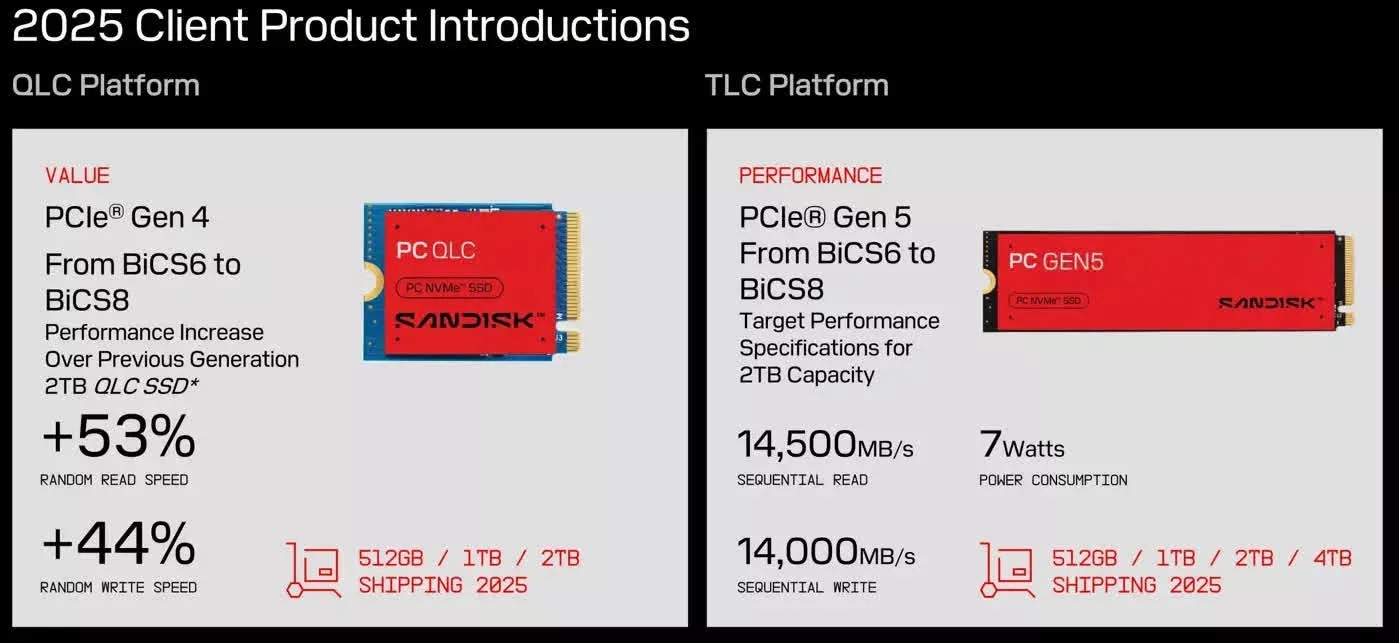
For comparison, most current Gen4 SSDs also consume around 7W, while the fastest Gen5 SSD models on the market can consume nearly 10W at peak load. Many sources suggest this SSD may use the Silicon Motion SM2508 controller, which is renowned for its ability to optimize performance per watt.
This new SSD lineup belongs to SanDisk's high-performance TLC NAND platform, sharing technology with the WD Black - premium gaming SSD series. Launching in Q2 2025, it will offer capacity options ranging from 512GB to 4TB, catering to needs from gamers to professional users.
SanDisk also expands affordable SSDs with QLC Gen4 platform
In addition to the high-end PCIe 5.0 SSD line, SanDisk is also launching an affordable SSD platform using QLC NAND that maintains PCIe 4.0 connectivity, with a maximum capacity of 2TB. One product in this platform is the Western Digital PC SN5100S, which features 53% higher random read speeds and 44% higher random write speeds compared to the previous SN5000S generation.
SanDisk has high ambitions for QLC NAND - a type of memory with high storage density but a shorter lifespan than TLC. The company aims to have 75% of its product portfolio using QLC NAND by 2028, while simultaneously preparing for a complete transition from PCIe Gen4 to PCIe Gen5 within the same timeframe.
Leveraging advanced 3D BiCS8 NAND technology
Both new SSD lines will utilize the latest 3D BiCS8 NAND flash technology from Western Digital to optimize performance and storage capacity.
Despite branding changes, SanDisk continues to demonstrate a clear commitment to innovation in the flash storage sector. With powerful, power-efficient PCIe 5.0 SSDs and a strategy to popularize QLC, SanDisk is making steady strides in shaping the future of the SSD market.