
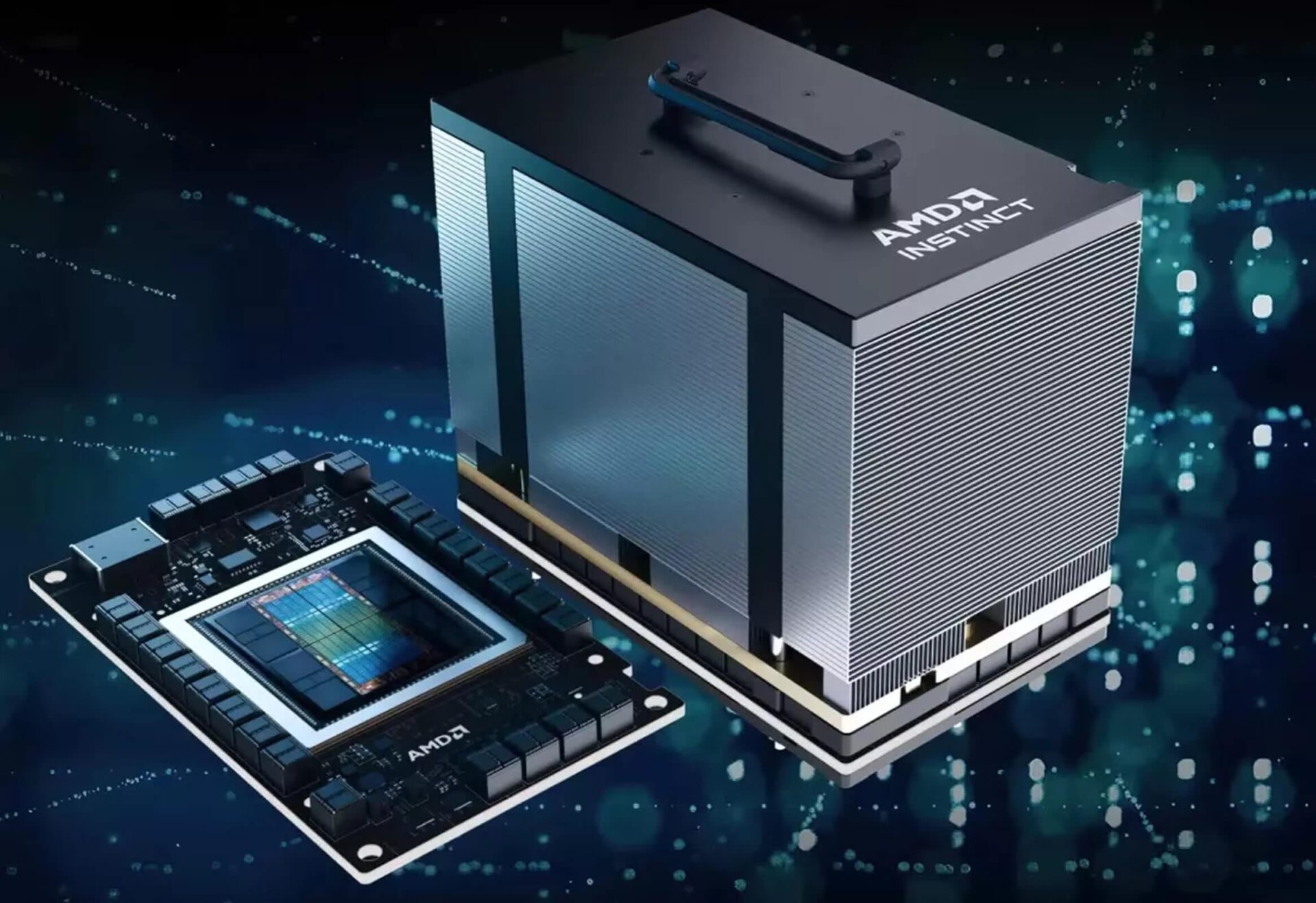
AMD's Instinct MI300 has quickly asserted its important position in the AI accelerator market, contributing significantly to revenue growth. While it cannot be compared to Nvidia's dominant position, AMD's advancements show promising prospects in the AI hardware sector.
The Instinct MI300 graphics card, recently launched by AMD, has become a major revenue stream for the company, competing strongly with the total revenue from its CPU products. This is a significant milestone for AMD in the highly competitive AI hardware market, where the company has often lagged behind industry leader Nvidia.
In a recent earnings call, AMD CEO Lisa Su stated that the data center GPU segment, primarily driven by the Instinct MI300, has exceeded initial expectations. "We are seeing our [AI] GPU business scale toward the size of our CPU business," she said.
This achievement is particularly impressive because AMD's CPU segment includes a wide variety of products serving servers, cloud computing, desktops, and laptops.
The Instinct MI300, introduced in November 2023, represents AMD's first true competitive graphics card for AI inference and training workloads. Despite being a recent release, the MI300 has quickly captured market attention.
Financial analysts estimate that revenue from AMD's AI GPUs exceeded $1.5 billion this past September, with the potential for even stronger performance in the coming months.
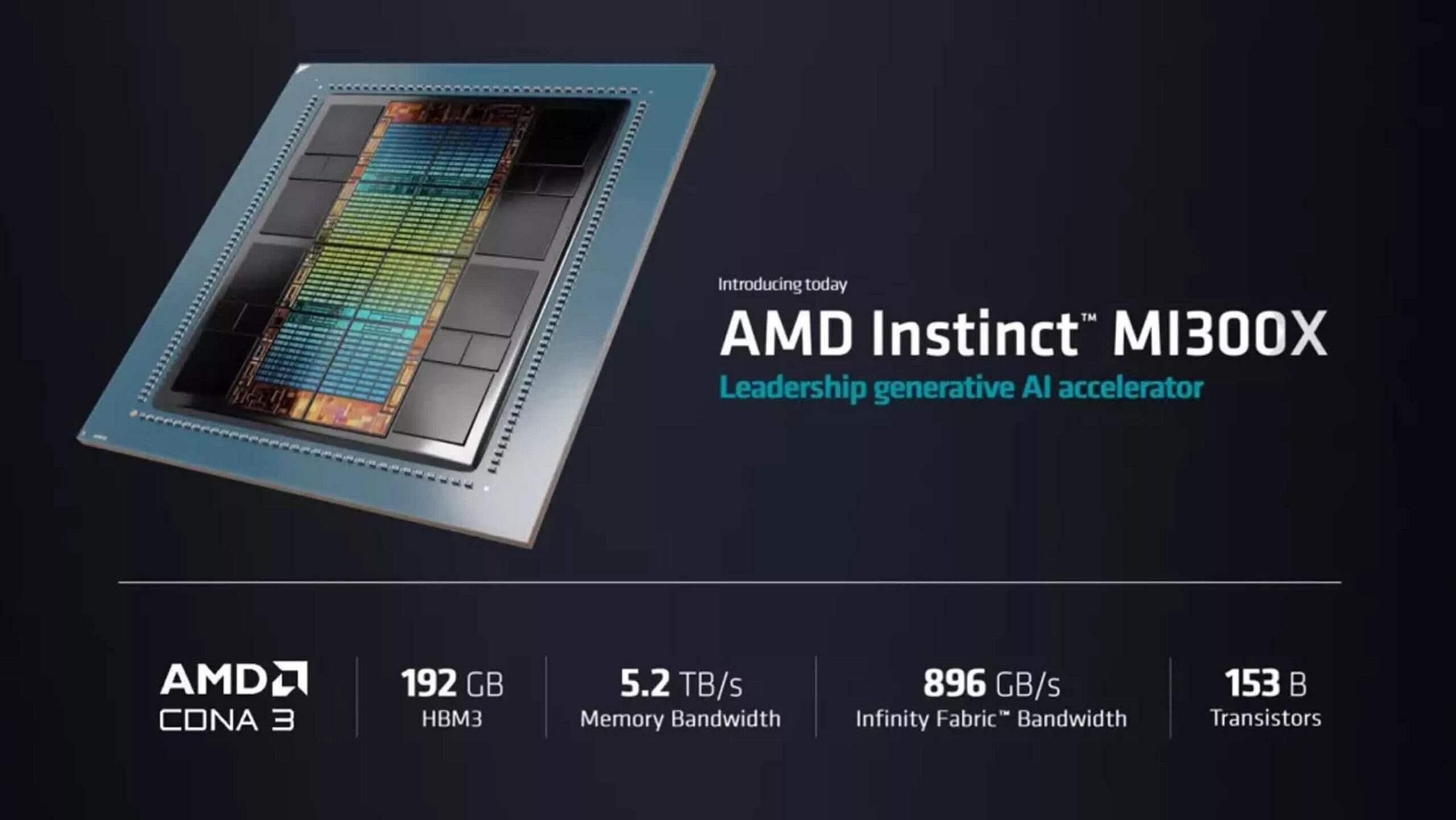
The MI300's technical specifications are highly competitive in the AI accelerator market, offering significant improvements in memory capacity and bandwidth.
The MI300X GPU features 304 GPU compute units along with 192 GB of HBM3 memory, delivering a maximum theoretical memory bandwidth of up to 5.3 TB/s. It achieves a peak FP64/FP32 matrix compute performance of 163.4 TFLOPS and a peak FP8 performance of up to 2,614.9 TFLOPS.
The MI300A APU integrates 24 Zen 4 x86 CPU cores with 228 GPU compute units. It features 128 GB of unified HBM3 memory and achieves a maximum theoretical memory bandwidth equivalent to the MI300X at 5.3 TB/s. The MI300A's peak FP64/FP32 matrix compute performance reaches 122.6 TFLOPS.
The success of the Instinct MI300 has attracted interest from major cloud providers like Microsoft. The Windows giant recently announced availability for its ND MI300X VM series, featuring eight AMD MI300X accelerators. Earlier this year, Microsoft's Executive Vice President of Cloud and AI, Scott Guthrie, stated that AMD's accelerators are currently the most cost-effective GPUs based on their performance in Azure AI Services.
While AMD's growth in the AI GPU market is impressive, the company has yet to catch up to Nvidia in overall market share. Analysts predict that Nvidia could reach $50 to $60 billion in AI GPU revenue by 2025, while AMD may reach a maximum of $10 billion.
However, AMD CFO Jean Hu pointed out that the company is working with over 100 customer relationships for the MI300 product line, including tech giants like Microsoft, Meta, and Oracle, as well as a wide array of enterprise customers.
The rapid success of the Instinct MI300 in the AI market raises questions about AMD's future direction for consumer graphics cards, as higher revenue from AI accelerators could influence the company's resource allocation. However, AMD has reaffirmed its commitment to the consumer GPU market, with Su announcing that the next-generation RDNA 4 architecture, likely to debut on the Radeon RX 8800 XT, will be unveiled in early 2025.
According to Techspot