At CES 2026, a California-based graphics processor (GPU) startup called Bolt Graphics drew plenty of attention by showing off its latest GPU platform, Zeus. The product targets gaming, engineering design (CAD), and high-performance computing (HPC) simulations. First announced a year ago, Zeus is built on the open RISC-V instruction set architecture and makes a remarkably bold promise: path tracing performance up to 10 times higher than Nvidia's "monster" RTX 5090. The tech world is still waiting for real-world evidence to back up that startling claim, however.
Hardware Specs and Connectivity of the Zeus Platform
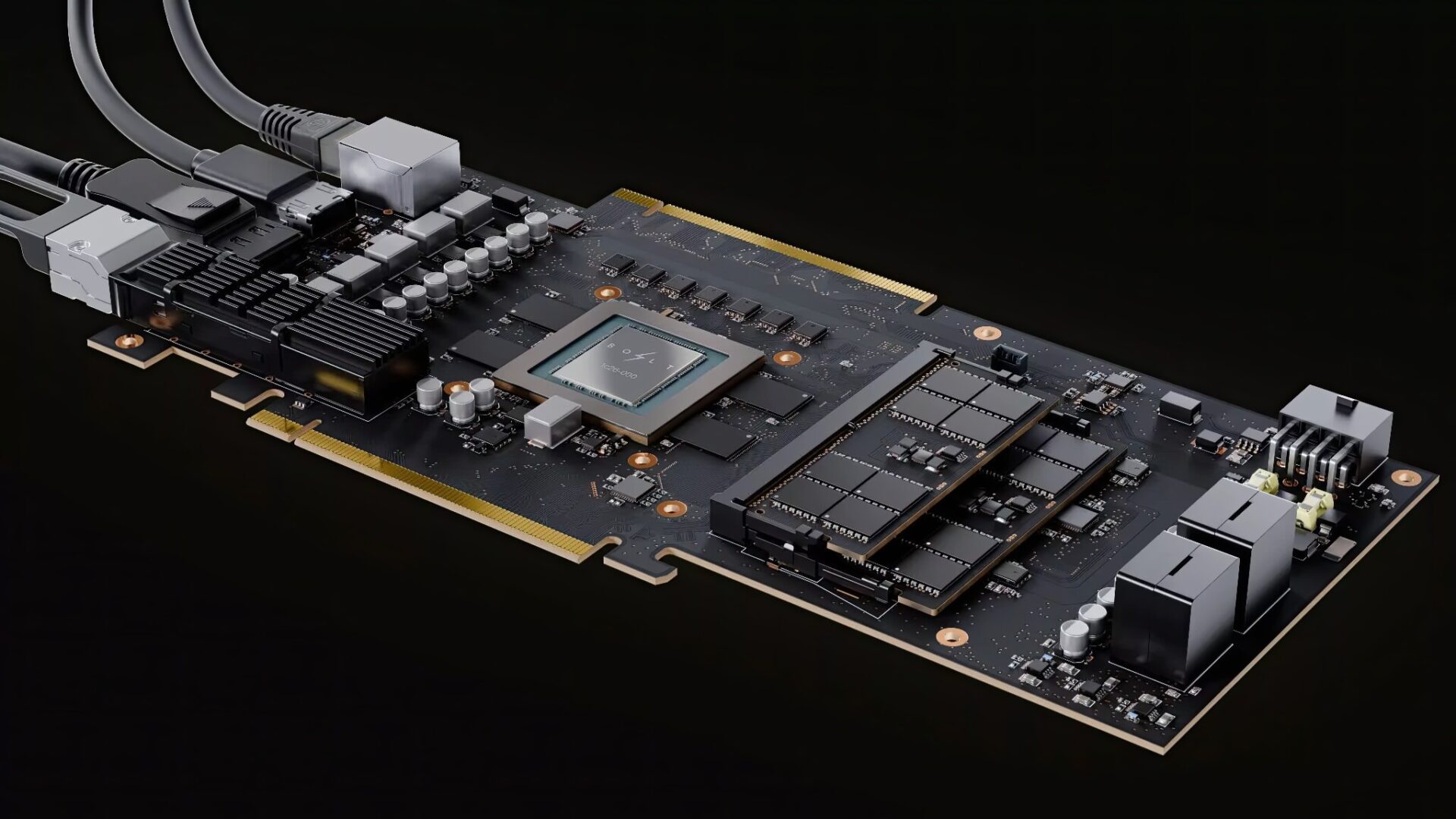
The prototype card on display at CES stood out for its huge combined memory support of up to 384GB, covering both LPDDR5X and DDR5. Of that, the video memory (VRAM) soldered directly to the board can reach 128GB. On top of that, the device has up to four DDR5 SO-DIMM slots for flexible memory expansion, plus a high-speed 800Gbps memory interface. Despite such a "monster" configuration, the card's maximum power consumption is only 225W, delivered through a single 8-pin PCIe connector.

For expansion and connectivity, the Bolt Zeus has two PCI-Express 5.0 x16 slots that support the modern CXL 3.0 standard. Display outputs include one DisplayPort 2.1a port and one HDMI 2.1b port, which cover high-resolution video output needs well. Notably, the card also integrates ultra-fast networking ports, including 400GbE and 800GbE QSFP-DD. This hardware provides advanced network connectivity that suits large-scale rendering tasks and complex data simulation.

In addition, an onboard BMC/IPMI controller lets data centers easily deploy multiple GPU units in rackmount servers or dedicated workstations. Bolt Graphics also confirmed that the Zeus architecture includes Texture Mapping Units (TMUs) and Raster Operations Units (ROPs), although the company has not yet disclosed the exact specifications of these components.
Real-World Performance and the Different Configurations
According to FP64 math benchmarks published by Bolt Graphics itself, the entry-level Zeus 1C, with a single processing unit, can deliver path tracing performance 2.5 times higher than a single RTX 5090. This version comes with 32GB of LPDDR5X memory offering 273GB/s of bandwidth, and it can be expanded with up to 128GB of additional DDR5 memory through two SO-DIMM modules running at 80GB/s.

In the higher tier, the Zeus 2C uses dual silicon with up to 128GB of LPDDR5X memory and is claimed to deliver five times the path tracing performance of Nvidia's top GPU. Meanwhile, the top-end Zeus 4C uses four silicon dies and is designed as a server platform rather than a standalone discrete card. It can deliver ten times the performance. The 4C configuration includes four I/O chiplets, up to 256GB of LPDDR5X memory, and a massive 2TB of DDR5 memory.
Bolt's FP64 electromagnetic (EM) simulation benchmarks show the Zeus 4C running up to 300 times faster than Nvidia's B200 Blackwell GPU under controlled test conditions. That is an extremely impressive figure for compute-intensive workloads. Still, it's worth noting that Bolt Graphics has not published any benchmarks for rasterization (the process of converting vector images into pixels) or traditional rendering workloads. The company has not announced an exact release date either, though it previously said Zeus was expected to reach the market sometime in 2026. As a result, users and industry professionals will need more time to verify whether the real product lives up to the enormous expectations the company has set.