

At the recently concluded CES 2026 technology event, Intel dedicated significant time to showcasing its latest advancements in integrated graphics, a market segment characterized by intense competition. The spotlight fell on the Core Ultra 3 Series processors (codenamed Panther Lake) featuring the flagship integrated graphics (iGPU) known as Arc B390. According to official data, Intel claims that its new graphics solution not only surpasses but "crushes" its best competitor in the low-power segment from AMD. With superior performance, Intel also confirmed ambitious plans to build a new handheld device platform alongside many reputable manufacturers.
Intel Arc B390 Performance Power vs. AMD
Based on benchmarks provided by Intel itself, the new Core Ultra X9 388H equipped with the Arc B390 iGPU has demonstrated incredible power. Specifically, it is on average approximately 73% faster than AMD's Ryzen AI HX 370 chip. To help readers visualize, AMD's Strix Point chip utilizes Radeon 890M integrated graphics, which has recently been considered the gold standard for onboard graphics. Intel also asserted that its new chips outperform the competitor in ray tracing, frame generation, and other heavy graphics tasks.
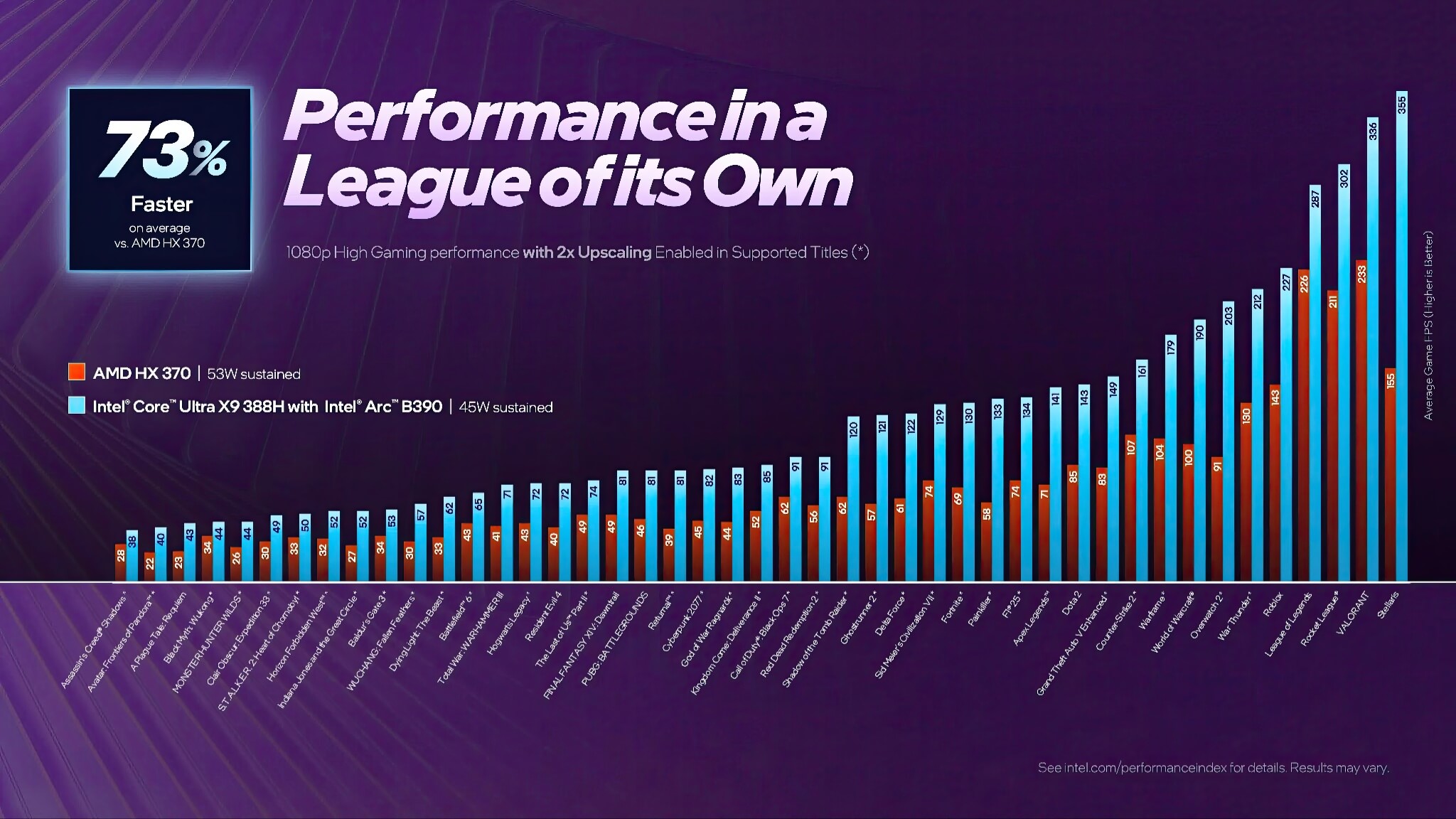
Intel's test results represent an average across 45 titles at 1080p resolution (upgraded from 540p). A notable point is the difference in power consumption: while AMD's chip consumes up to 53W, Intel's processor is limited to 45W and still delivers higher performance. When running at native 1080p resolution, the average performance gap widens to as much as 82%, a truly impressive figure.
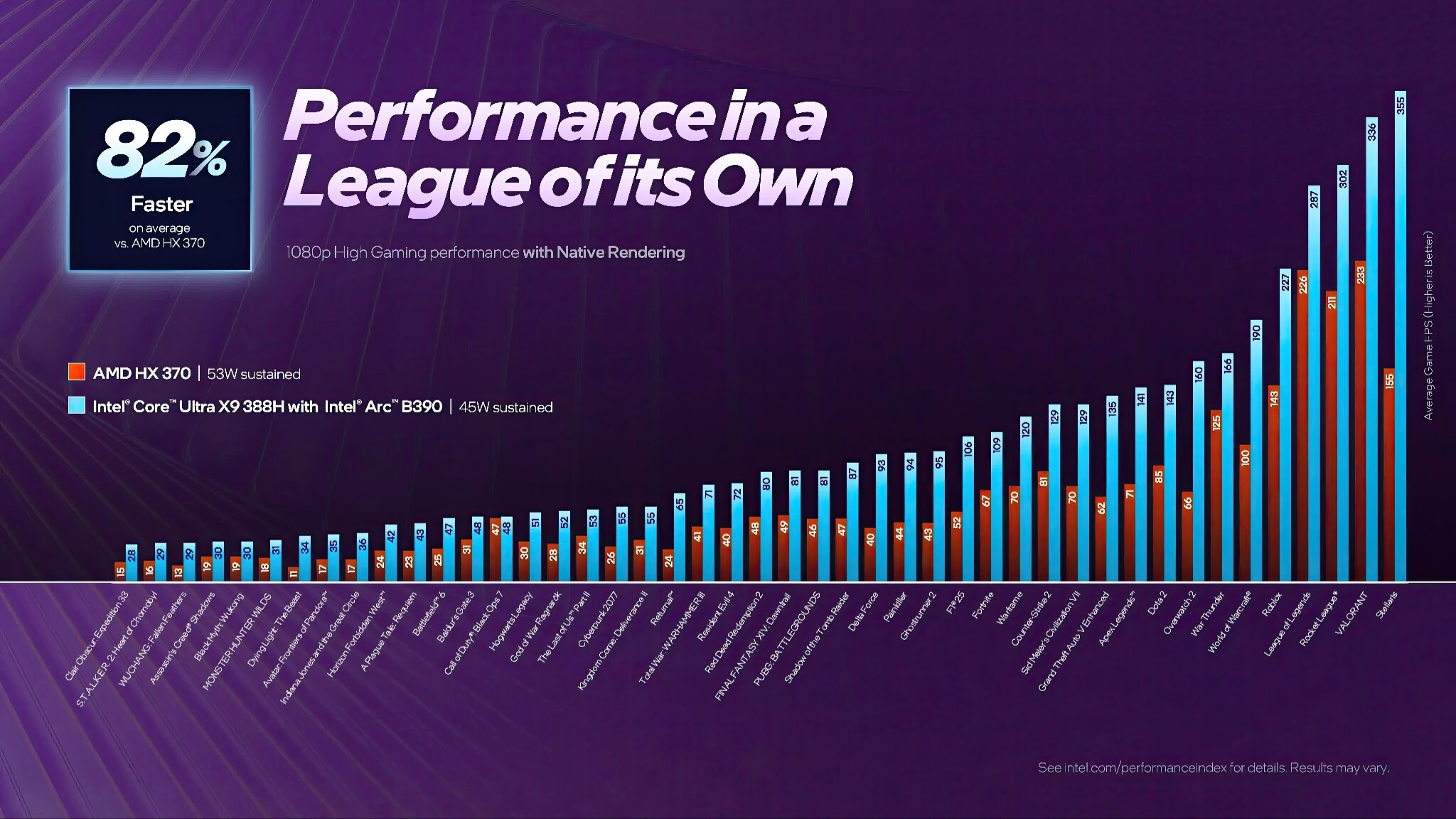
In terms of real-world experience, hardware-intensive games like Assassin's Creed Shadows and Black Myth: Wukong both achieved playable frame rates, ranging between 30 to 40 fps. Meanwhile, lighter eSports titles like League of Legends and Rocket League approached the 300 fps mark without relying on frame generation features. Intel also emphasized that their upcoming XeSS 3 image upscaling technology will further improve AI-based upscaling capabilities for laptops and handheld devices. For the first time, multi-frame generation technology will be brought to mobile hardware, allowing up to three AI-generated frames to be inserted between traditionally rendered frames, similar to DLSS 4 on desktops.
Xe3 Graphics Architecture and Handheld Gaming Ambitions
The power of the Arc B390 comes from 12 Xe cores built on Intel's latest Xe3 Arc Battlemage architecture. Meanwhile, on the other side of the battlefield, AMD also launched the Ryzen AI 400 series at CES this week, but their new mobile chips still use the same type of iGPU as the older Ryzen AI 300 series. AMD also gave a brief introduction to the next generation of Strix Halo, a large-scale APU series that brings mobile CPU and GPU performance to a new weight class approaching PlayStation 5 performance, though the only handheld device currently using it is the GPD Win 5, priced at up to $2,000.
https://www.youtube.com/watch?v=KlIlFt2Fj1c
Although Intel's presentation focused on gaming primarily around laptops, the company also sent signals regarding broader ambitions for the handheld PC market. A presentation slide confirmed strategic partnerships with Microsoft, MSI, Acer, GPD, OneXPlayer, and many other companies. However, one notable thing is that the Asus logo was mysteriously absent from this list.
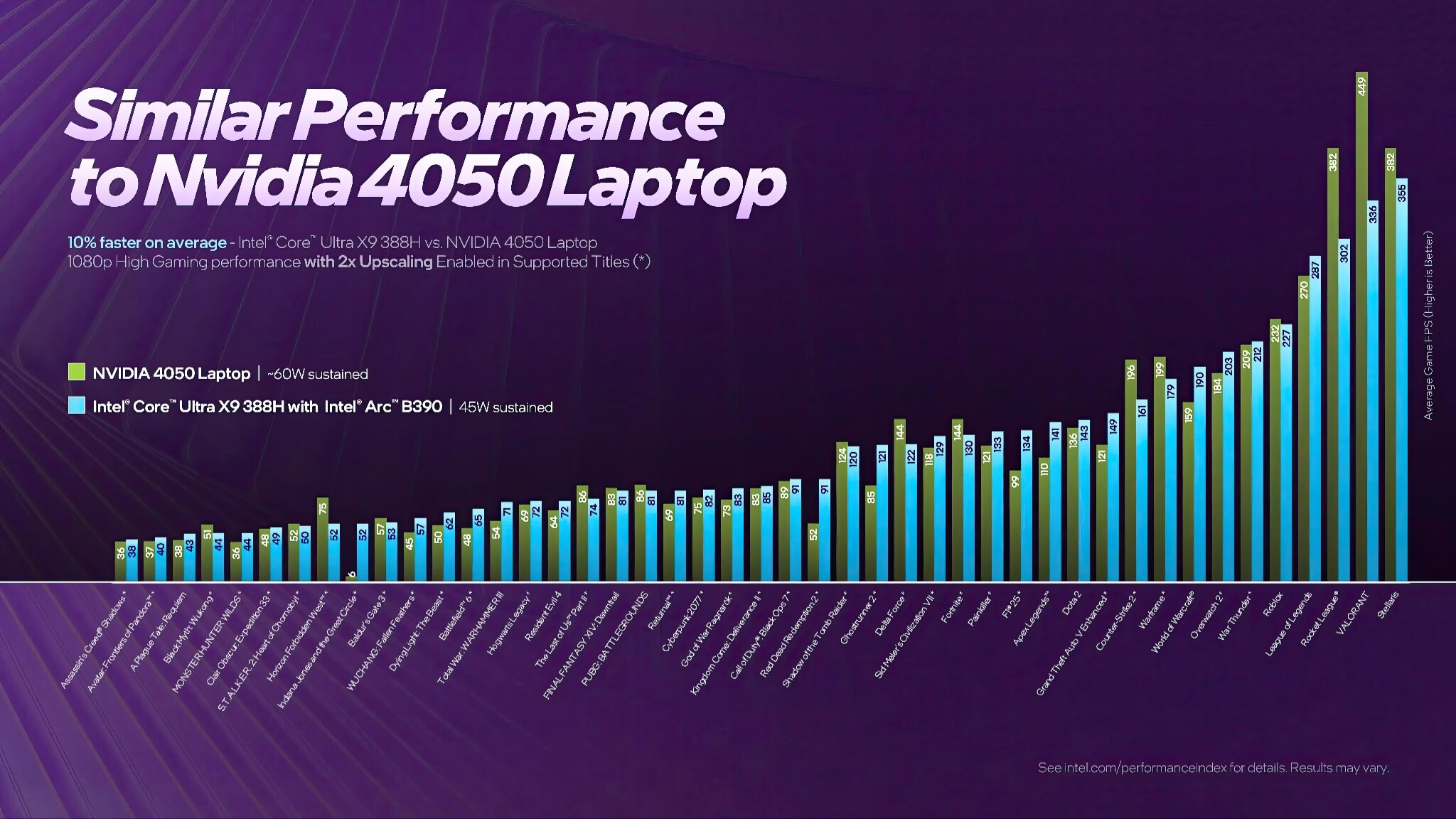
Intel's benchmarks seem to target the Radeon 890M directly, the chip currently powering recent handheld gaming machines like the Asus ROG Ally X, MSI Claw A8, and the 2025 version of the GPD Win 4. Although the numbers are very impressive, experts still have some concerns regarding input latency when using frame generation features and the actual effectiveness of the Arc B390 on handheld devices, which typically operate within low power limits of 15-30W. We will need more time for verification when commercial products officially reach consumers.