

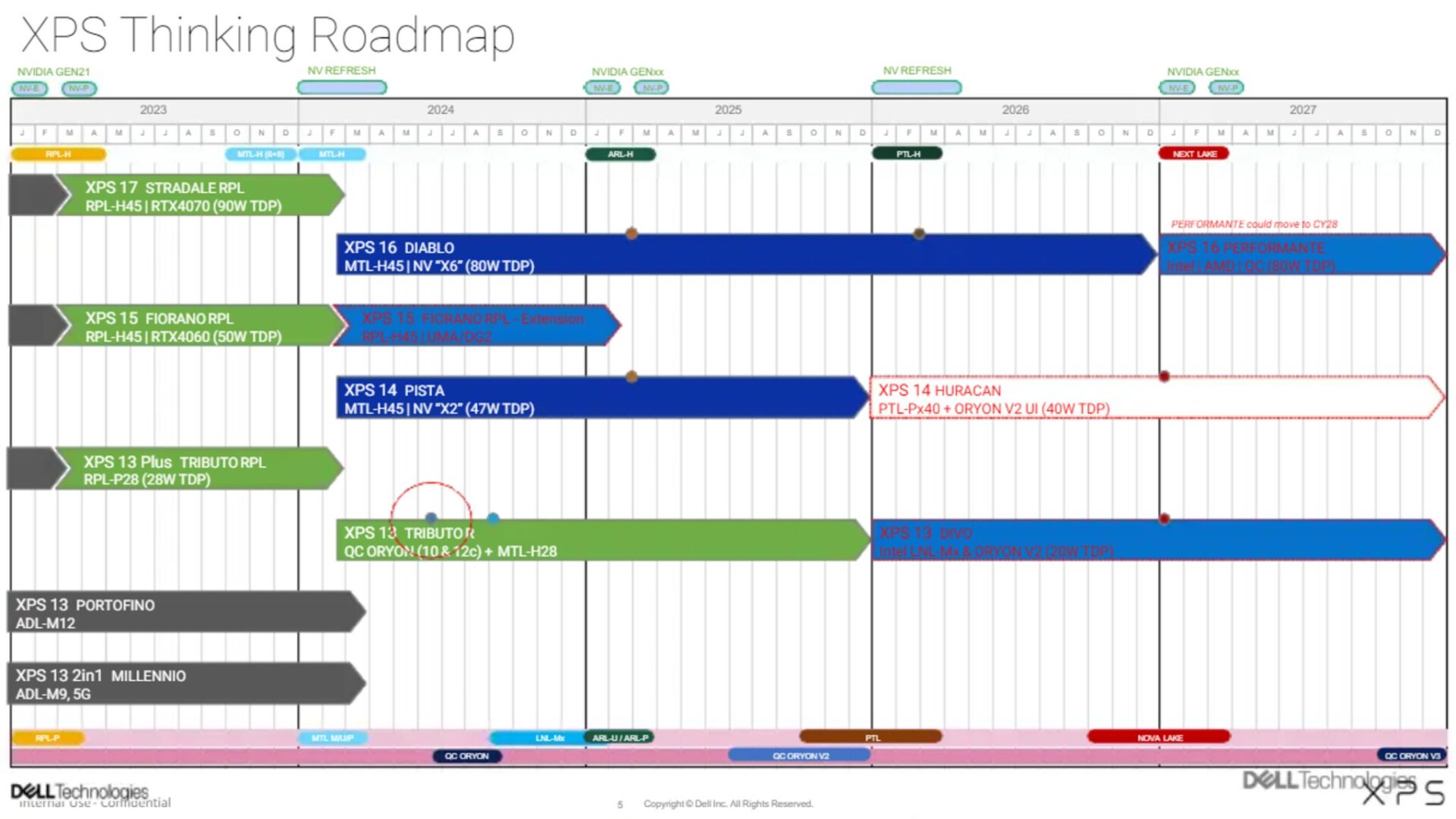
Dell XPS has just become the center of attention following a major leak revealing a laptop chip roadmap extending to 2027. The notable point lies not in a specific model, but in the fact that Dell is reportedly preparing multiple directions with Intel Panther Lake, Nova Lake, and several subsequent Snapdragon X generations. If this information is accurate, the XPS line will undergo significant changes in architecture, power consumption, and how manufacturers segment premium laptops in the coming years. For those following the enterprise and content creation laptop markets, this is a signal worth paying attention to right now.
How does the Dell XPS leak show the changing laptop chip roadmap?
According to a post from Wccftech, the leaked documents clearly describe the sequence of platforms that Dell may bring to the XPS line in upcoming stages. Following Lunar Lake and Arrow Lake, this roadmap mentions the second generation of Snapdragon X around mid-2025, Panther Lake in the 2026 phase, and then Nova Lake and the next generation of Snapdragon X at a further milestone. This scheduling suggests that Dell is no longer betting on a single chip provider but is maintaining multiple parallel options to pivot based on performance, AI, and battery life. For end-users, this could mean that each subsequent Dell XPS generation will have a more distinct product identity rather than just minor annual upgrades.
Regarding Intel, the leak mentions Panther Lake as a significant transition step before Dell moves toward Nova Lake on later XPS models. Panther Lake is expected to bring a new architecture, more flexible power ranges, and better AI capabilities compared to the current generation. Meanwhile, Nova Lake is slated for a later stage, suggesting that Dell may be planning a long-term upgrade cycle rather than rushing frequent releases. Anyone considering purchasing a premium laptop this year might need to think more carefully, as the gap between upcoming platforms will no longer be as small as typical chip rebranding.
What should Dell XPS users care about from the Panther Lake and Snapdragon X roadmap?
The most noteworthy point is that this roadmap suggests Dell XPS is opening doors to both ARM and x86 chips within the same premium product line. If Snapdragon X continues to be pushed in future Dell XPS models, the thin-and-light laptop market will face direct competitive pressure regarding battery life, temperature, and on-device AI processing capabilities. Conversely, Intel Panther Lake and Nova Lake remain logical choices for user groups requiring broad software compatibility, stable workflows, and a balance of power between CPU and discrete GPU. This means choosing a laptop in the future will not just be about picking higher specs, but about choosing the platform that best fits your daily workflow.
| Platform | Mentioned Milestone | Significance for Dell XPS |
|---|---|---|
| Snapdragon X V2 | 2025 | Focusing on thin-and-light, long battery life, and AI |
| Intel Panther Lake | 2026 | A major upgrade for XPS focusing on balanced performance |
| Intel Nova Lake | 2026-2027 | Defining higher-tier XPS generations in CPU and power segmentation |
| Snapdragon X V3 | 2027 | Increasing pressure on premium Windows ARM laptops |
From a buyer's perspective, the safest approach right now is to clearly define your needs rather than chasing leaks. If you need a machine immediately, current generations from Dell are still powerful enough for most office work, programming, and content creation. However, if you are waiting for a major leap in architecture, AI, and battery life, the recently leaked Dell XPS roadmap suggests that 2026 onwards could be much more attractive. Since the information is currently based on leaks, all timelines are subject to change, but it is enough to signal that the high-end laptop chip race is about to get much hotter.
Reference source: Wccftech.