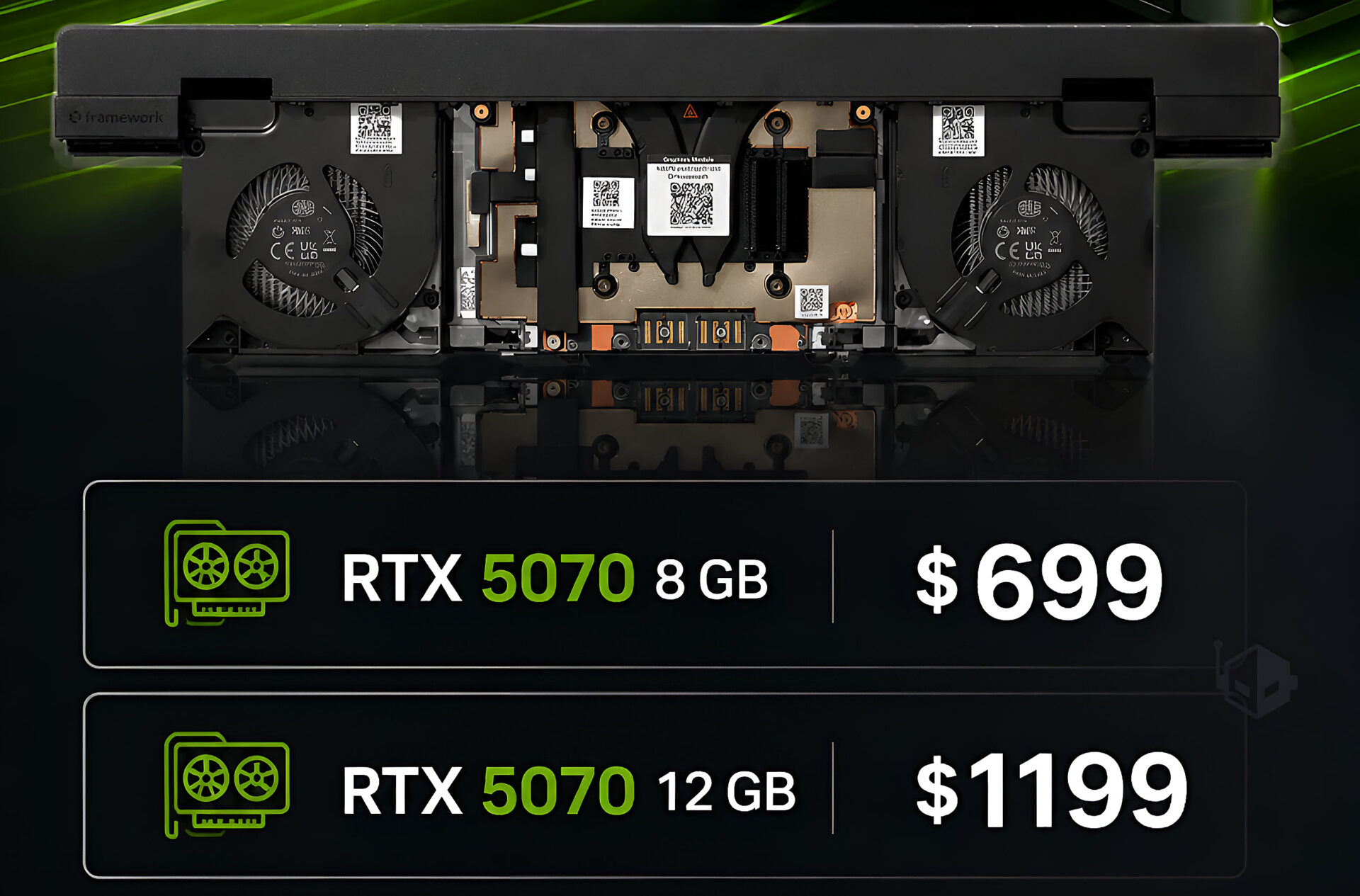
Framework has just opened sales of a new graphics module for the Laptop 16 built around the 12GB GeForce RTX 5070, and the price has given plenty of buyers pause: $1,199 for the module alone, $500 more than the 8GB version, which sells for $699. A 72% gap is hard to ignore, especially when most of the other specs stay nearly the same. For people who pick Framework for its upgrade-one-part-at-a-time philosophy instead of replacing the whole machine, the question now is whether 4GB of extra VRAM is worth that much. It is also a clear example of how the price of graphics memory is directly affecting the cost of upgrading a modular gaming laptop.
The Framework Laptop 16 Gets a New Option, but Upgrade Prices Are Climbing Fast
According to Framework's official announcement, the new variant is open for pre-order and will begin shipping in June 2026. Anyone who already owns a Laptop 16 does not need to replace the whole machine, since the company also sells the graphics module separately as a direct swap, a point that Tom's Hardware also noted in its article Framework's new RTX 5070 12GB graphics module costs a whopping $1,199 - 72% more expensive than $699 8GB version, says pricing is beyond its control. That is a major difference from most gaming laptops today, where the GPU is effectively locked in from the day you buy the machine.

The problem is that the Framework RTX 5070 12GB is priced far above the 8GB version, even though, according to NVIDIA's Compare GeForce RTX Laptops table, the RTX 5070 Laptop GPU keeps the same 4,608 CUDA cores, a maximum TGP of 100W, a 128-bit memory interface and the Blackwell feature set, including DLSS and 9th-generation NVENC. In other words, the biggest difference is the VRAM capacity, which rises from 8GB to 12GB, not a broad leap in architecture.
From a buyer's perspective, this is the kind of upgrade that invites second-guessing. If you have been following the Framework Laptop 13 Pro, you can see the company holding tightly to its promise of repairability and upgradability. But when a GPU module alone hits $1,199, the "buy once, upgrade over time" advantage starts to look less appealing on cost.
The Extra 4GB of VRAM Matters, but It May Not Suit Every Gaming Laptop Buyer
According to the GeForce RTX 50 Series Laptop spec page, the standard RTX 5070 Laptop GPU has 4,608 CUDA cores, 798 AI TOPS, 384 GB/s of memory bandwidth and the familiar 8GB of GDDR7. The 12GB version therefore mainly addresses memory shortages in new AAA games, high-resolution textures, lightweight local AI models and some rendering workloads that easily hit the VRAM ceiling. The benefit is real, but it leans more toward longevity over the next 2-3 years than an instant performance jump in every game.
| Item | RTX 5070 8GB | RTX 5070 12GB |
| Module price | $699 | $1,199 |
| Difference | - | +$500, 72% higher |
| VRAM | 8GB GDDR7 | 12GB GDDR7 |
| CUDA cores | 4,608 | 4,608 |
| Memory bandwidth | 384 GB/s | 384 GB/s |
| Max TGP | 100W | 100W |
| Availability | In stock | Pre-order, ships June 2026 |
The tricky part is that this $500 difference buys almost nothing but extra memory. Given the reports of an RTX 5070 12GB laptop showing up on Lenovo Legion and LOQ models, buyers have reason to wait and see how other manufacturers price the 12GB variant in complete systems. If the price gap on the market is not stretched as much as Framework's, buying a new laptop may sometimes make more sense than upgrading just the module.
In practice, the Framework RTX 5070 12GB still has a clear audience. These are people who already own a Laptop 16, want to keep their chassis, mainboard and existing module ecosystem, but need more VRAM for long-term 1440p gaming or for more GPU-heavy content work than before. If your main use is mainstream gaming and moderate rendering, and you do not often run into the 8GB limit, the $699 version makes far more sense.
The most noteworthy aspect of this story is not whether 12GB is better than 8GB, since the answer is almost certainly yes. What deserves thought is how high the cost of adding 4GB of VRAM to a modular laptop has become. For pragmatic buyers, the Framework RTX 5070 12GB currently looks like an option for very specific needs, not an upgrade the majority should rush to make.