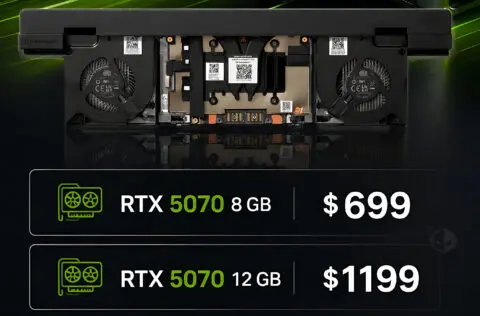
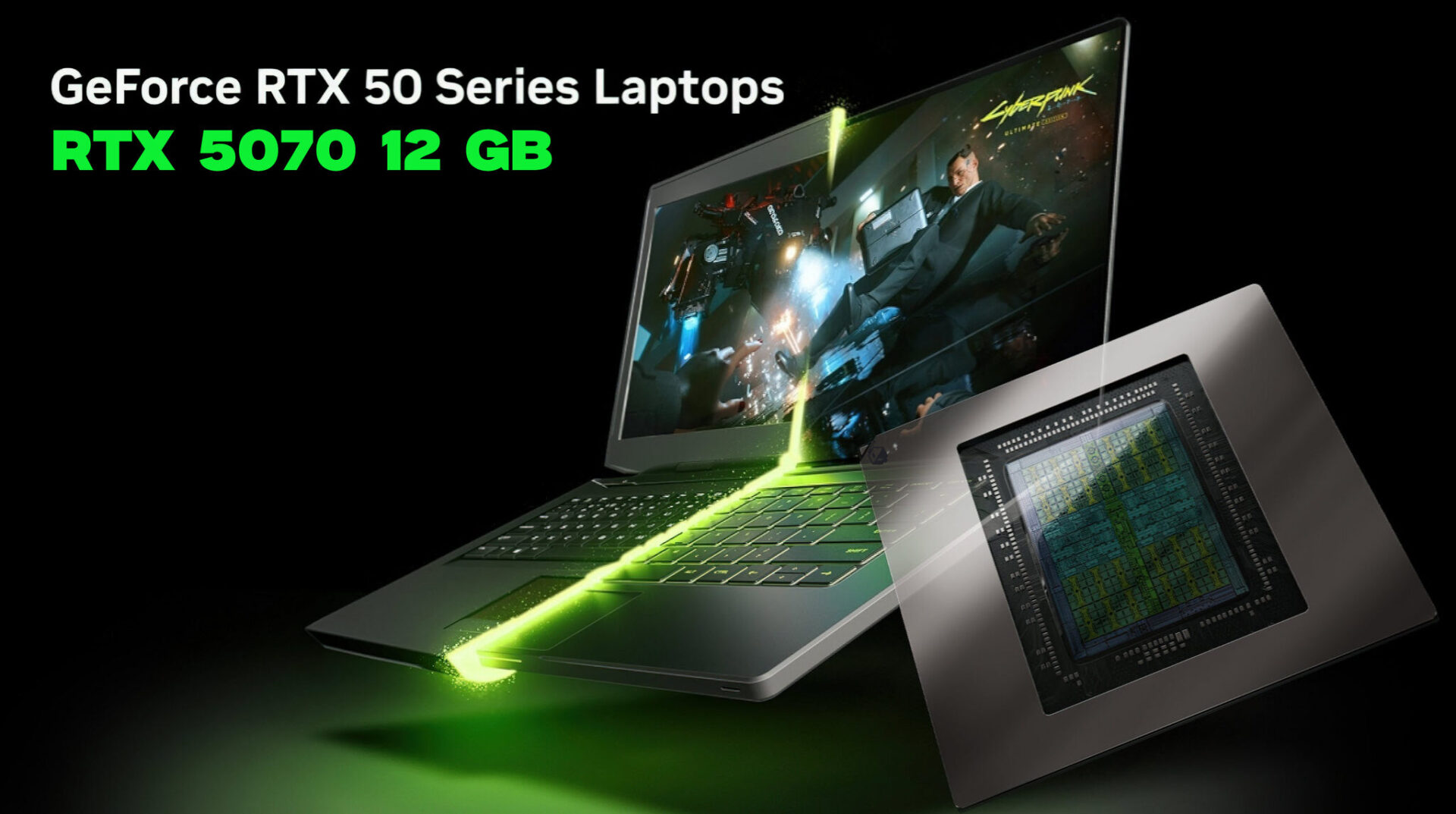
The RTX 5070 12GB laptop GPU has just turned up in a batch of new Lenovo product listings, and the detail is enough to get the gaming laptop market's attention right away. If the information on the retail pages is accurate, the laptop GeForce RTX 5070 will no longer stop at the 8GB of VRAM that has been the familiar configuration so far. Lenovo is attaching a 12GB GDDR7 variant to several Legion Pro 5 and LOQ models, and pushing the TGP up to 115W instead of the usual 50-100W range. What makes this notable is that it is not an anonymous leak: the data appears directly on product listings, so it is more credible than the average forum rumor.
Lenovo Reveals RTX 5070 12GB Laptop Configurations on Legion Pro 5 and LOQ
The data that Wccftech found shows at least four Lenovo models tied to the GeForce RTX 5070 12GB GDDR7 GPU. Two of them belong to the LOQ line, and the other two to the Legion Pro 5 family. The most striking point is that graphics memory goes up by 4GB compared with the 8GB that was previously associated with the RTX 5070 Laptop GPU in known documentation. With demanding games consuming more and more VRAM, especially with high-quality textures enabled at 1440p, the jump from 8GB to 12GB could make a clear difference over the real-world lifespan of a machine, and not just look good on a spec sheet.

Another detail that has hardware watchers interested is the 115W TGP, which Lenovo lists right in the configuration details. If that figure holds when the products launch, the RTX 5070 12GB laptop GPU gets not only more VRAM but also a higher power budget than the current configuration. Wccftech also noted a 2347 MHz boost clock and 798 TOPS of AI performance across many listings, which means Lenovo is describing this as a new variant that sits fairly close to a higher-end configuration, rather than simply a version with swapped memory chips. Compared with what users saw on gaming notebooks earlier this year, this change could help Lenovo create better separation from midrange models that remain limited by 8GB of VRAM.
In terms of product positioning, the move also makes sense as Lenovo pushes its gaming laptop lineup across many price tiers. The LOQ line usually targets users who need solid performance while keeping costs under control, while the Legion Pro 5 serves those who want a better display, better cooling, and more room to upgrade. If both lines get access to the RTX 5070 12GB laptop GPU, Lenovo will have an advantage in communicating real-world value with new AAA games, especially titles that use heavy textures and ray tracing. Readers who followed our article Intel Core Ultra 7 251HX Surfaces on Lenovo Legion 5i 2026 may notice that Lenovo has recently kept expanding its gaming configurations in a very practical direction: adding new options where users need them instead of just renaming products.
Is the RTX 5070 12GB Laptop GPU Really Much Stronger, or Do We Still Need to Wait for Confirmation?
It pays to stay level-headed here, because not every spec in the listings lines up perfectly. One of the Legion Pro 5 16ADR10 models mentioned by Wccftech shows 988 AI TOPS instead of 798 AI TOPS, while the 1425 MHz clock looks more like a base clock than a boost clock. That opens up two possibilities. One is that Lenovo mistakenly put some internal specs on the retail page. The other is that NVIDIA really is preparing another GPU variant, but the data on the product page had not been standardized at the time it was spotted. With gaming laptop launches, listings appearing before the official announcement is not unusual, so for now the most reliable information is still the repeated presence of the RTX 5070 12GB GDDR7 designation across many different models.
| Category | Current RTX 5070 laptop | Lenovo listing variant |
|---|---|---|
| VRAM | 8GB GDDR7 | 12GB GDDR7 |
| TGP | 50-100W | 115W |
| Boost clock | 2347 MHz | 2347 MHz |
| AI TOPS | 798 | 798 or 988 depending on the listing |
If NVIDIA really does allow partners to ship the RTX 5070 12GB laptop GPU, the clearest benefit will be how well the configuration holds up over time. In the upper-midrange gaming laptop segment, VRAM bottlenecks often show up even before a lack of raw shader power does. 12GB would give the machine more breathing room with new-generation games, high-resolution texture mods, and GPU-driven creative workloads such as 4K timeline editing or lightweight AI models on a personal machine. It also puts Lenovo in a strong position to compete with the new Alienware models that just received OLED display upgrades and Arrow Lake-HX Refresh configurations, as covered in the article Alienware Arrow Lake-HX Refresh Gets an OLED Display Upgrade that Hung Phat published earlier.
From a buyer's perspective, this is news worth following, but it should not be treated as final confirmation until Lenovo or NVIDIA makes a full announcement. Even so, the fact that a 12GB variant keeps appearing across different listings suggests the odds of this being a single typo are dropping fairly quickly. If you are waiting to upgrade your gaming laptop in the new wave of machines at the end of April, especially if you want to play at 1440p for the long haul, the RTX 5070 12GB laptop GPU could be a configuration well worth considering. You can also check the standard specs of the current GeForce RTX laptop lineup on the NVIDIA GeForce RTX Laptop page, and as for Lenovo, the upcoming Legion Pro 5 and LOQ launch will likely be the clearest answer on whether 12GB of VRAM becomes the new standard in this segment.