Intel Wildcat Lake has leaked in just the way budget-minded laptop buyers hope to see: new enough to bring AI features, but not pushed up into the premium tier. The leaked documents show a lineup of 6 SKUs, using 1+4 or 2+4 core configurations and running within a 15-35W TDP range. Compared with the Alder Lake-N family, which leans heavily toward cheap machines, Intel Wildcat Lake makes a clear jump in its Xe3 iGPU and its 15-17 AI TOPS NPU. If laptop pricing is reasonable, Intel Wildcat Lake could fill the gap between the older N-series and the more expensive AI PC models.
How Do the 6 Intel Wildcat Lake SKUs Differ?
The leaked configuration table shows Intel Wildcat Lake starting with the Core 3 304, which has 1 P-core + 4 LP-E cores, while the 5 models above it all use 2 P-cores + 4 LP-E cores. The Core 7 360 and 350 both reach 4.8 GHz, keep the 15-35W TDP and use a 2-core Xe3 iGPU rated at 21 AI TOPS. This way of dividing the SKUs suggests Intel is taking the low-power segment more seriously, much like the way it widened its product range with the Intel Core Ultra 200S Plus. The Core 5 330, 320 and 315 step the GPU clock down gradually but still keep 6 MB of L3 cache and a 15-16 TOPS NPU. The Core 3 304 is the lowest configuration, better suited to school laptops or basic mini PCs.
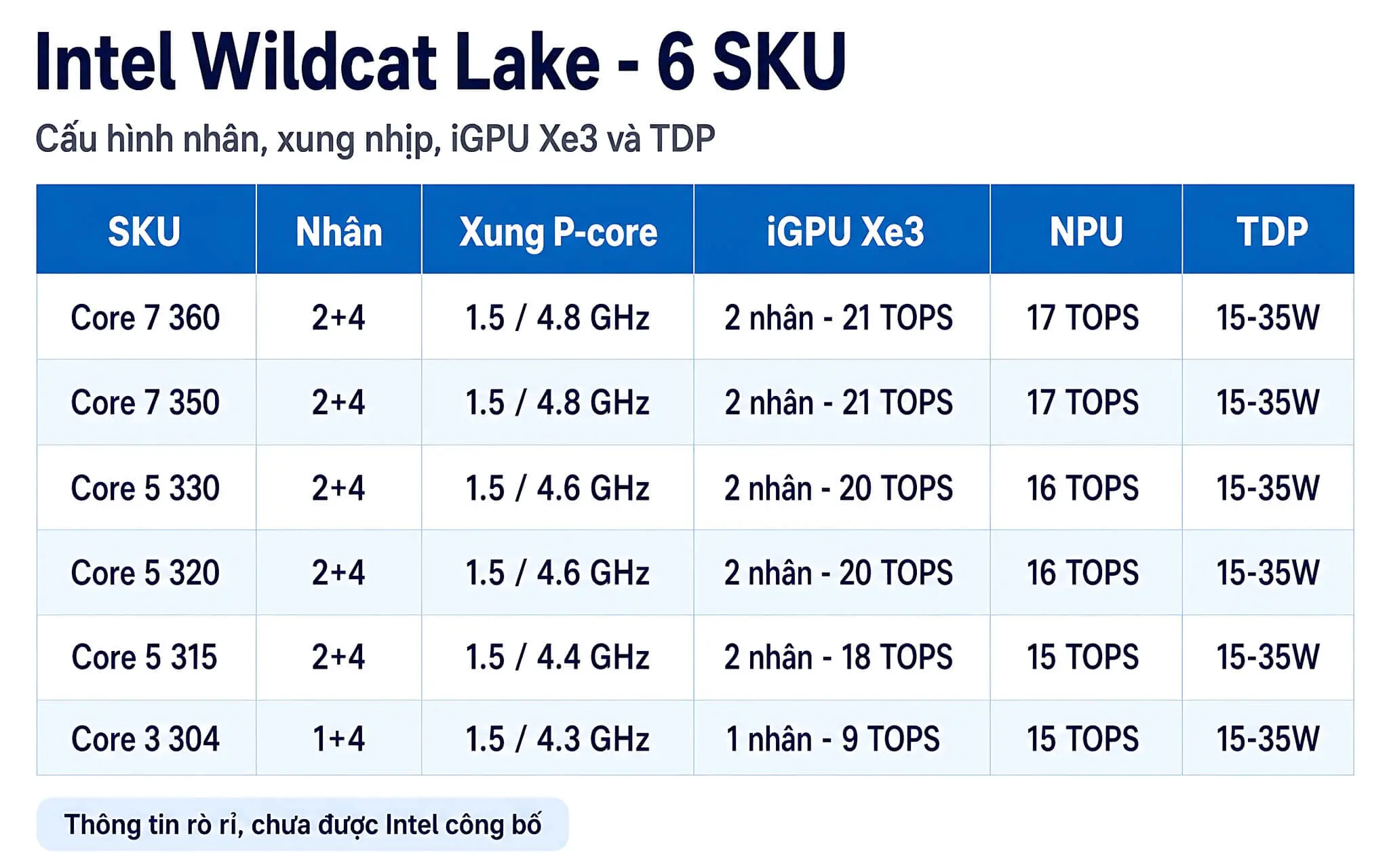
The most notable thing about Intel Wildcat Lake is its 15-35W power range. If 35W turns out to be a real-world turbo limit, this chip family will shake off the image of being good only for basic tasks, as Alder Lake-N and Twin Lake often are. The LP-E cores all idle at 1.4 GHz and can boost to 3.6 GHz on the Core 7 parts, which means Intel still prioritizes power savings without constraining short-term performance too tightly. With a maximum of 2 Xe3 cores, Wildcat Lake is not a gaming platform, but it is enough for 4K media, light photo editing and basic local AI. In short, this raises the ceiling on the experience for thin and light laptops, which have long been held back by low-power chips.
What Does Intel Wildcat Lake Mean for Upcoming Thin and Light Laptops?
From a market perspective, Intel Wildcat Lake matters because it sits below Lunar Lake and Panther Lake yet still brings the new NPU and Xe3 graphics. Manufacturers could use this platform to build more affordable ultrabooks or study laptops, instead of forcing buyers to step up to a high-end configuration just to get AI. That lines up fairly well with the demand seen on the Lenovo ThinkPad X1 2-in-1 Gen 10 Aura Edition 2025, where battery life, thermals and weight are treated as equals to performance. If it arrives on schedule, Intel Wildcat Lake could liven up the 20 to 30 million VND laptop segment. What remains to be seen is real-world battery life, temperatures and pricing once commercial machines hit shelves.
| SKU | Cores | P-core clock | LP-E clock | iGPU / NPU | TDP |
|---|---|---|---|---|---|
| Core 7 360 | 2+4 | 1.5 / 4.8 GHz | 1.4 / 3.6 GHz | 2 Xe3, 21 AI TOPS / 17 TOPS | 15-35W |
| Core 7 350 | 2+4 | 1.5 / 4.8 GHz | 1.4 / 3.6 GHz | 2 Xe3, 21 AI TOPS / 17 TOPS | 15-35W |
| Core 5 330 | 2+4 | 1.5 / 4.6 GHz | 1.4 / 3.4 GHz | 2 Xe3, 20 AI TOPS / 16 TOPS | 15-35W |
| Core 5 320 | 2+4 | 1.5 / 4.6 GHz | 1.4 / 3.4 GHz | 2 Xe3, 20 AI TOPS / 16 TOPS | 15-35W |
| Core 5 315 | 2+4 | 1.5 / 4.4 GHz | 1.4 / 3.3 GHz | 2 Xe3, 18 AI TOPS / 15 TOPS | 15-35W |
| Core 3 304 | 1+4 | 1.5 / 4.3 GHz | 1.4 / 3.3 GHz | 1 Xe3, 9 AI TOPS / 15 TOPS | 15-35W |
Looking at the 6 SKUs, it is clear Intel is not aiming Wildcat Lake at gaming or workstations, but mainly at study, office and basic business machines. Keeping the same 6 MB of L3 cache across the whole range makes it easier for manufacturers to build more price tiers. That is a sensible direction if Intel wants to replace Alder Lake-N with a more modern generation that offers local AI and capable graphics. Even so, the real merit of Intel Wildcat Lake will have to wait for commercial machines. You can also read the original report from Wccftech to cross-check the SKU table.