
This statement partially contradicts events from the past few months regarding the microcode voltage issue causing damage to Intel Core 13th and 14th Gen CPU chips produced by Puget Systems, one of the leading companies in the workstation assembly sector for both individuals and enterprises.
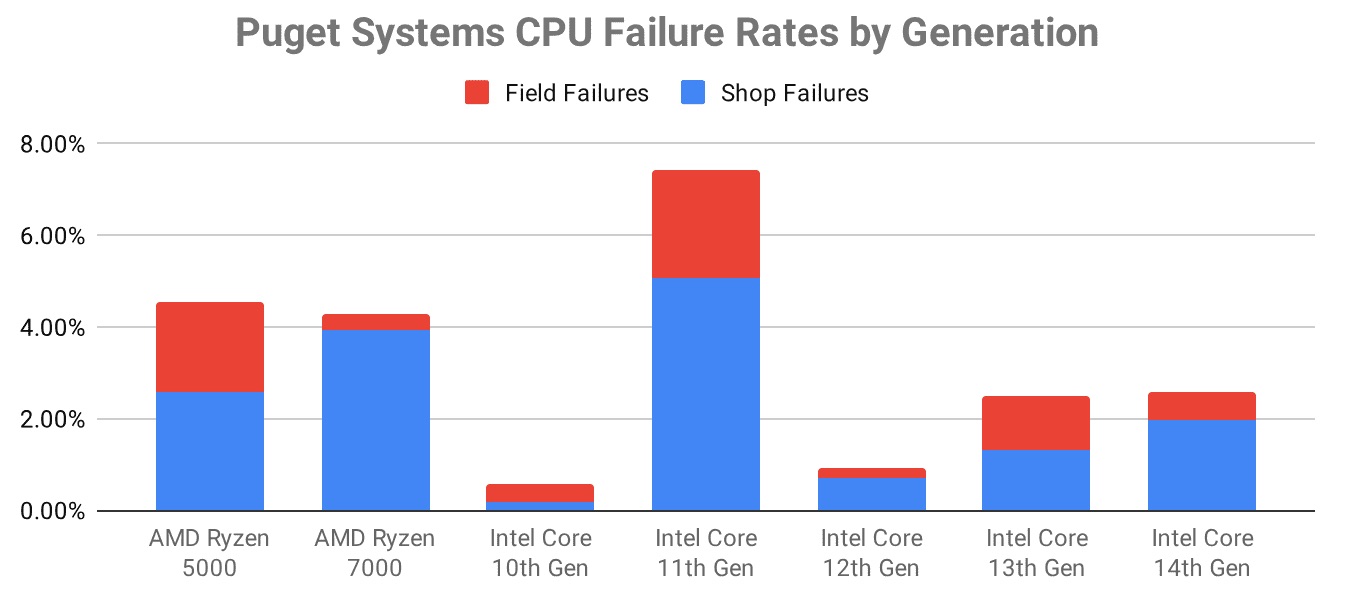
They have just released statistical data showing that the failure rate of the Intel Core 13th and 14th Gen chips they installed in workstations sold was only slightly over 2%. Meanwhile, the failure rate for the two Zen 3 and Zen 4 architecture CPU generations, commercially known as the Ryzen 5000 and 7000 series, was higher at over 4%. However, relying solely on this statement will not provide a comprehensive view of the long-term operational durability of these current high-performance consumer processors.
However, it is clear that the information released by Puget Systems will surprise many, especially in the context of ongoing issues related to 13th and 14th Gen Core chips and 7th and 8th series chipsets that have not yet been fully resolved. Furthermore, for chips with damaged silicon dies, no patch can repair them; the only option is to use the warranty to exchange them for new chips.
In stark contrast is the situation for game developers globally. Game development studios have released error reports from the gaming community's PC systems, showing that when playing games involving data decompression from hard drives to the CPU and GPU, the error rate on Intel Core 13th and 14th Gen chips fluctuates between 50% and 100%, meaning if a game runs on these latest Intel chips, it will almost certainly experience crashes.
An even more surprising piece of information for the gaming community is that Puget Systems stated that data provided by their customers shows that workstations using 11th Gen Intel Core chips, specifically the Rocket Lake architecture, even have higher software and operating system error and crash rates than the 13th and 14th Gen.
The information and data mentioned above were released by Puget Systems alongside an official announcement that they and Intel are extending the CPU warranty to 3 years for systems using 13th and 14th Gen Core chips. Intel's decision to extend the warranty from 2 years to 5 years was announced late last week.
The statement from Puget Systems has somewhat reassured the community, because when Intel issued an official announcement late last week, they only mentioned extending the warranty for retail boxed CPUs for consumers. As for "tray" CPUs-which lack boxes or coolers and are supplied by Intel to PC assembly partners like Puget-there was no information until this entity issued its official statement.
This means it is highly likely that all other PC manufacturers and assemblers will also announce warranty extensions for CPUs in PC builds equipped with 13th and 14th Gen Intel Core chips in the near future.
Returning to the issue related to Raptor Lake, the 11th Gen Intel Core chip line: The information provided by Puget shows that the failure rate of Raptor Lake chips reaches up to 7% in workstation systems used for professional work, which may surprise many. This is because information regarding errors related to this generation of processors is not frequently heard, so it remains unclear what the cause is and whether Intel has fixed the issues related to Raptor Lake in professional workstation systems.
Of course, like any information regarding chip failure rates not provided by the manufacturer, the data provided by Puget Systems should be viewed with caution. Clearly, Intel or AMD will never voluntarily disclose failure rate statistics for chips in computer systems using their CPUs. Therefore, relying on data from Puget or other organizations is necessary. However, the reason to be cautious with information from Puget is that they do not implement the entire product catalog of each chip generation and they also adjust CPU operating clock speeds differently from the original specifications provided by Intel for retail products.
Regarding the first aspect, Puget clarified that they only provide workstations equipped with Core i7-XX700K and Core i9-XX900K chips; therefore, the failure rate is only calculated for these two SKUs within each Intel CPU generation. Interestingly, the failure rate of the highest-end chips in the 13th and 14th Gen Core series is also reported to be the highest based on consumer feedback.
Regarding the operating clock speed of the processors, Puget stated that since 2017, they have no longer trusted the power and clock speed specifications of CPUs from both AMD and Intel. All workstations assembled by Puget use their own custom BIOS, based on the CPU operating guidelines from AMD and Intel, with specifications that are somewhat more conservative than aggressive overclocking options, which helps ensure the durability and reliability of the system during long-term operation. According to Puget, this might be the reason why the error rate of 13th and 14th Gen Core chips is lower than in many other sectors of the tech industry, such as gaming.
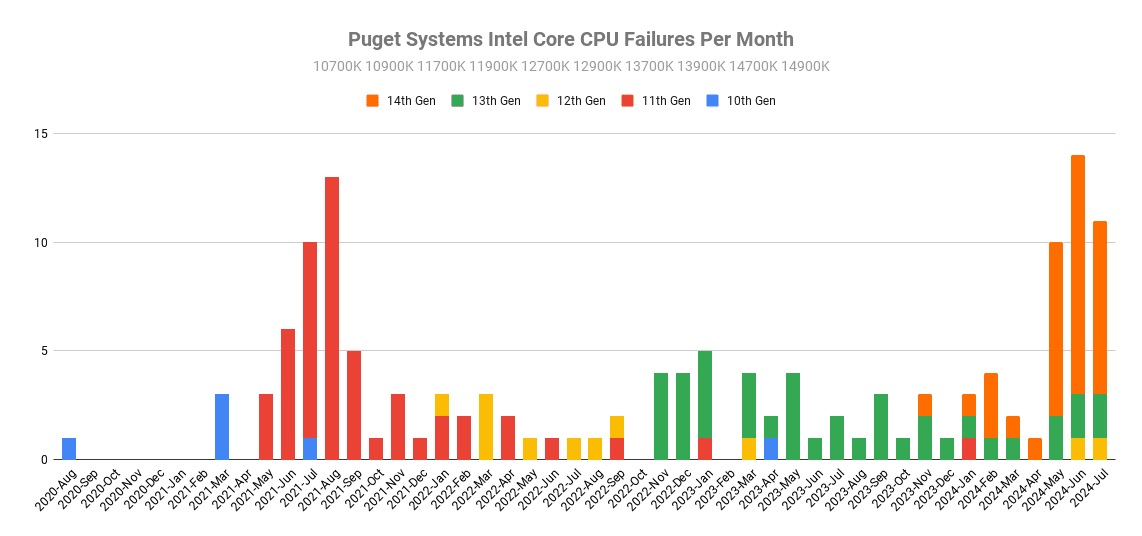
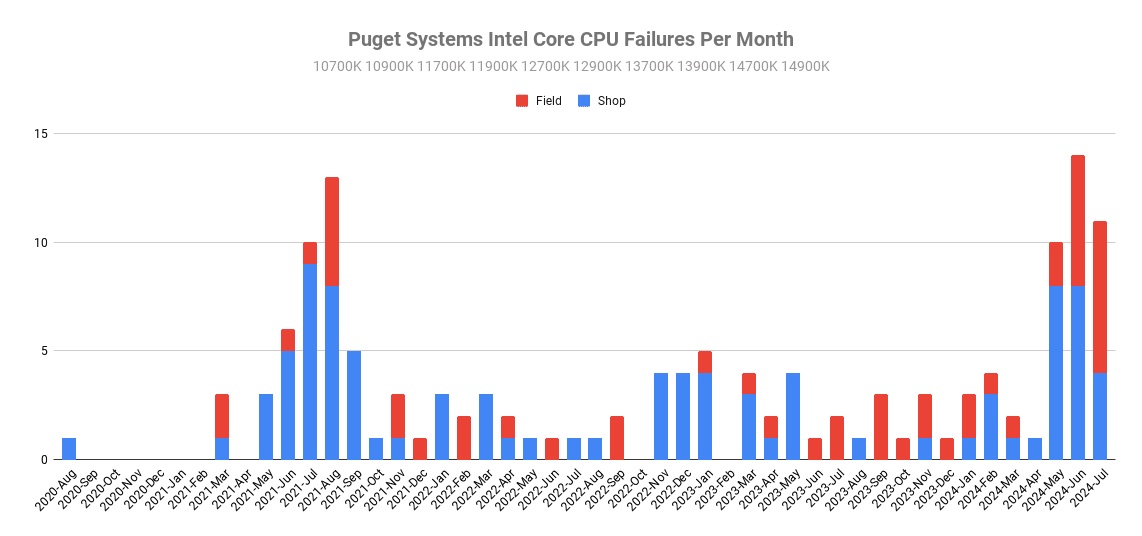
Please pay attention to the chart above. This is a summary of Intel CPU incidents detected by Puget at their headquarters (shop), along with cases reported by customers (field). Puget stated that since the 11th Gen Core chip generation, Raptor Lake, they have recorded an unusually high failure rate of Intel CPUs with the 13th and 14th Gen chips from customers.
Puget Systems President, Mr. Jon Bach, stated: “We have observed that all chip failure incidents occur within 6 months from the time the customer receives the machine, meaning within a short upcoming period, our prediction is that the chip failure rate will increase, even if Intel issues a microcode update to readjust the voltage supplied to the CPU.”
One notable factor is that the failure rate of Ryzen 5000 and 7000 series chips is relatively high, even though they were released in 2020 and 2022, respectively. Due to the large volume of computers sold over a long period, the failure rate has increased accordingly. In contrast, the 13th and 14th Gen Core lines were only introduced in 2022 and 2023, so their time on the market has been shorter.
Recent information shows that 13th Gen Intel CPUs are experiencing a "stable failure rate with an upward trend," while the 14th Gen has recorded a sudden spike in failure levels in recent months.
Mr. Bach emphasized: “If viewed in a specific context, it can be seen that the failure rate of 13th and 14th Gen Core chips is increasing but has not yet reached an alarming level. The issue that needs attention currently is not the recorded failure rate, but the long-term durability of these CPUs. If assessed correctly, the failure rate of 14th Gen CPUs is likely to continue to increase in the future, creating a larger challenge for everyone, and this is something we will monitor closely.”
The issue that PC users equipped with 13th and 14th Gen Core chips are facing is that they are not operating the chips with the custom BIOS settings created and applied by Puget Systems. Instead, most use high-end gaming motherboards with Core i7 and Core i9 CPUs, leading to unusually high input voltage supplied to the CPU to optimize gaming performance, which in turn causes damage to the chip's silicon die.
According to Tom's Hardware