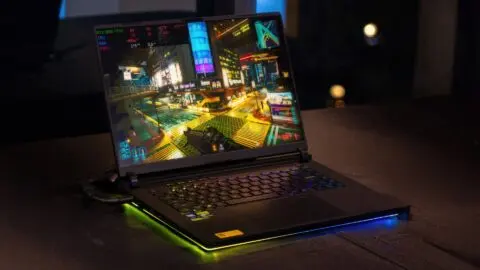

RTX 5090 Laptop GPU has just been launched by NVIDIA, but it doesn't appear to deliver a meaningful performance improvement over its predecessor. According to test results from hardware expert Jarrod Farncomb, who compared the two high-end laptop GPUs, the difference in gaming performance is negligible.
If you're planning to buy a new gaming laptop with an RTX 5090, you may want to think it over more carefully. Benchmarks show the new GPU offers only a small improvement over the RTX 4090 in most popular games today.
Specifically, the laptop with the RTX 5090 averaged about 66 frames per second (FPS) at 4K across 25 popular games, while the RTX 4090 laptop, with an older CPU and slower DDR5 RAM, still managed 65 FPS. That gap is almost meaningless in real-world gaming.
Performance falls short of expectations at different resolutions
The picture is even less flattering at 1080p, where the RTX 4090 laptop actually outperforms the newer machine, hitting 133 FPS versus 132 FPS for the RTX 5090. At 1440p, the two laptops reached 106 and 107 FPS, respectively. The difference in each case is negligible, but the tests show the new GPU delivers no real-world performance benefit over the previous-generation model.
https://www.youtube.com/watch?v=XpG4SBJRx7k
Farncomb notes that the RTX 5090 struggles not only in older games but also in newer titles such as Red Dead Redemption 2, Alan Wake 2 and Stalker 2, where the RTX 4090 is up to 12,5% faster than its successor.
That said, the RTX 5090 has its bright spots, running faster than the RTX 4090 in a few popular games. For example, it holds a 20% advantage over the mobile RTX 4090 in Cyberpunk 2077 and leads by 18% in Warhammer 40,000: Space Marine 2.
Power efficiency: the new generation's main advantage
The main difference between the two GPUs is power efficiency, with the RTX 5090 laptop delivering noticeably longer battery life than the RTX 4090 laptop. However, Farncomb suggests this may be partly due to the newer Arrow Lake-HX CPU, which is designed specifically to be more power efficient than the older Raptor Lake Refresh chip.
Both laptops used in the comparison are the XMG Neo 16s, but with very different hardware. The older XMG Neo 16 (2024) is equipped with an Intel Core i9-14900HX paired with 32 GB of DDR5-5600 RAM and an RTX 4090, while the newer XMG Neo 16 (2025) is powered by an Intel Core Ultra 9 275HX with 32 GB of DDR5-6400 RAM and an RTX 5090.
It's worth noting that the RAM and CPU differences could also affect the benchmark results, but the negligible performance gap between the two GPU generations is still a letdown for many users who were hoping for a big leap in performance from the RTX 50-series.
For those who already own an RTX 4090 gaming laptop, there doesn't seem to be much of a compelling reason to upgrade to the RTX 5090 based on raw gaming performance alone. However, if battery life and power efficiency are your top priorities, the RTX 5090 could be worth considering.
Summary: RTX 5090 Laptop GPU doesn't deliver a significant performance improvement over the RTX 4090 in most popular games. With negligible FPS differences across resolutions, users who currently own an RTX 4090 laptop may not need to rush to upgrade. The main advantage of the RTX 5090 is its better power efficiency, which gives gaming laptops longer battery life. For anyone weighing a new gaming laptop, the choice between these two GPU generations should come down to your specific needs and budget, rather than simply chasing the newest generation.