
The final Battlefield 6 Open Beta kicks off on Thursday and runs through the end of the weekend. Players should keep one important thing in mind, though: if Valorant is also installed on your PC, make sure you run only one of the two games at a time. Many players have found that the notorious anti-cheat systems in these two games can conflict with each other, preventing the game from launching.
Reddit users have shared security violation notices from the Battlefield 6 anti-cheat software, titled "Battlefield 6 and Valorant: System conflict warning," which flag Valorant as the conflicting program. Although the warning might lead some people to think they have to uninstall Valorant, Riot Games says that isn't necessary.
Why Battlefield 6 and Valorant conflict
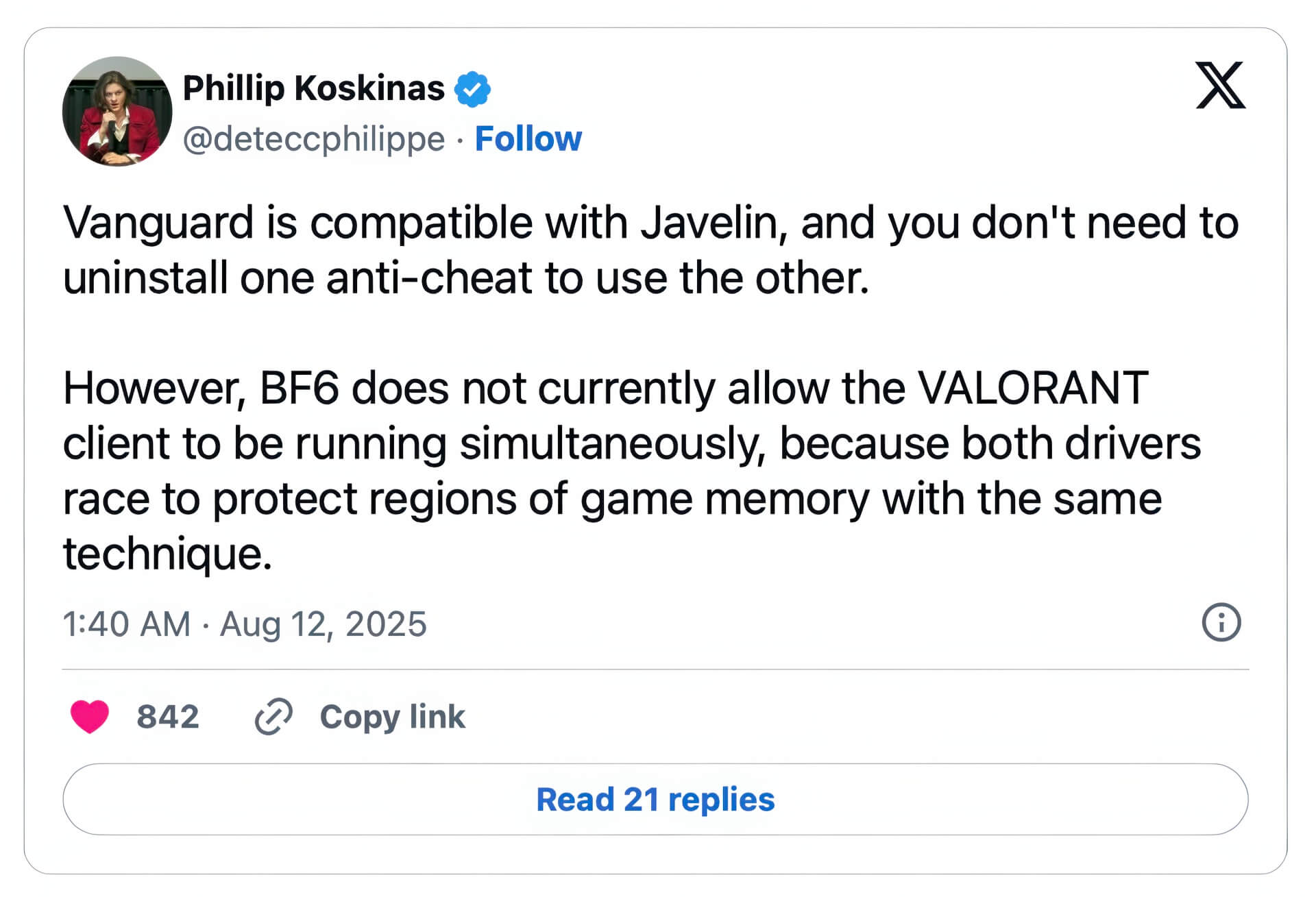
Phillip Koskinas, Riot's head of anti-cheat, explains that players can still keep Valorant installed while taking part in the Battlefield 6 Open Beta, as long as both clients are not running at the same time. The cause comes down to similarities in how the anti-cheat systems of the two games operate.
Riot previously stirred up controversy when Valorant began requiring TPM 2.0 and Windows Secure Boot, checking the entire system at startup to block sophisticated cheating software. Granting kernel-level access to third-party software has always raised concerns, because if it is exploited or hits a bug, the consequences could be serious.
Similarly, Battlefield 6 also requires Secure Boot and uses security methods that can clash with Valorant. According to Koskinas, both games use the same techniques to protect game memory, which means the Battlefield 6 anti-cheat system can mistakenly identify Valorant as a threat. The simple fix is to fully close Valorant when playing Battlefield 6, and vice versa.
The debate over kernel-level anti-cheat
Security-conscious users often worry about kernel-level anti-cheat systems. However, some recent research suggests this approach can make anti-cheat more effective, making cheat development more expensive and complicated. On the black market, simple cheats go for about 10 USD, while methods that get past kernel-level protection can cost hundreds of dollars.
Even so, some YouTubers have shown that extreme cheating methods can still get around anti-cheat systems without touching the PC directly. For example, one person built a device that analyzes the game's video output and controls the muscles in their arm to move the mouse precisely, and another method acts directly on the surface of the mouse.
The final Battlefield 6 Open Beta runs from August 14 to 17, while the official release arrives on October 10. Notably, Call of Duty: Black Ops 7, expected later this year, also requires TPM 2.0 and Secure Boot, so it may run into similar conflicts when run alongside Battlefield 6 or Valorant.