
AI ChipHuawei is struggling to compete with Nvidia due to overheating issues and poorer development tools compared to CUDA. Huawei once hoped to help China reduce its dependence on Nvidia's server GPU chips through its new Ascend 910C product line, but it seems they continue to face significant barriers. The main reasons stem from Nvidia's dominance through the CUDA software ecosystem and Huawei's own internal limitations.
According to a source in a new article from The Information, China's major tech companies, including ByteDance (TikTok's parent company), Alibaba, and Tencent, have not yet placed large-scale orders for Huawei's AI chips.
Barriers making Ascend 910C AI Chips difficult to compete with Nvidia
Several factors have contributed to the stagnation surrounding Huawei's Ascend 910C GPU, which is currently being focused on supplying large state-owned enterprises and local governments due to a lack of momentum from demand-driven technology orders.
First, many leading Chinese tech companies have invested significantly in Nvidia's CUDA ecosystem, and decoupling from Nvidia's cloud server AI chip market control would require a massive investment in both time and resources. The Information also stated that many of these companies expect Huawei to adapt to their platforms, rather than the other way around, by adjusting software development and management to suit Ascend chips.
This issue becomes even clearer when considering that the CANN (Compute Architecture for Neural Networks) computing architecture, Huawei's alternative to the CUDA API, lacks features found in NVIDIA's proprietary software.
Second, most of China's largest tech companies are competitors of Huawei itself and are therefore still hesitant to bet entirely on a competitor's products.
Third, Huawei's Ascend 910C chip faces overheating issues during operation, affecting its reliability assessment among major tech corporations in China. If DeepSeek decides to endorse Huawei's AI chips, it would encourage a massive army of open-source developers to build on Huawei's ecosystem. However, that event has yet to occur.
Fourth, many of China's largest tech companies have pre-ordered and stockpiled large quantities of Nvidia GPUs over the past few years. This inventory remains abundant, leaving corporations and cloud services with little incentive to undergo a costly transition, at least for the time being.
Fifth, the US Department of Commerce made Huawei chips a "sensitive" item in May, when Washington regulators issued broad guidance stating that any company using these chips without prior approval could be considered in violation of US export controls. This guidance significantly impacts Chinese entities with overseas operations.
The AI Tech Race between Huawei and Nvidia
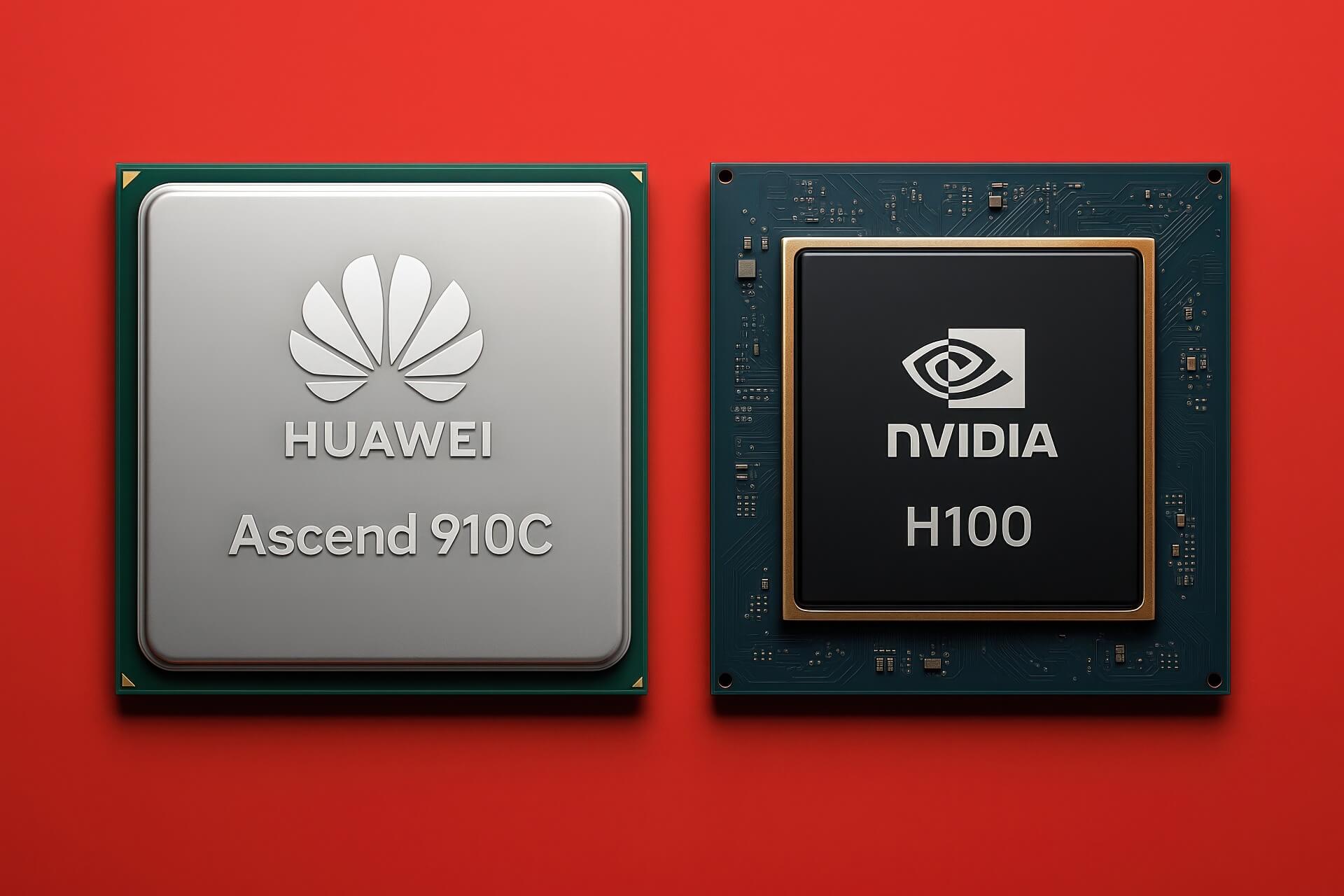
As mentioned in a previous post, Huawei's Ascend 910C combines two older 910B chips to provide approximately 800 TFLOPs of computing power in FP16 precision, with memory bandwidth of up to 3.2 TB/s. This chip is rated as being on par with NVIDIA's H100 GPU.
Recently, to provide an alternative to NVIDIA's supercomputers that combine up to 72 Blackwell chips via proprietary NVLink interconnects, Huawei introduced CloudMatrix 384, which integrates up to 384 Ascend chips to provide equivalent computing power but lacks direct support for memory-optimized computing formats like FP8. AI models trained in FP8 format typically consume significantly less memory. Naturally, Huawei has created a translation tool to simulate FP8 compatibility, but this solution remains unoptimized.
Meanwhile, Nvidia seems to be performing very well even without support from China. For example, UBS recently highlighted Nvidia's statement in its Q1 2026 earnings call that they could see AI infrastructure projects with a total operating capacity of up to tens of gigawatts worldwide. For every gigawatt of AI server computing power, Nvidia is estimated to earn $40 to $50 billion in revenue.
This means that within the next 2 to 3 years, if countries around the world expand Data Center construction, Nvidia could potentially generate $400 billion per year from the cloud server segment alone.
In summary: Huawei's Ascend 910C AI Chip still faces many challenges when competing with Nvidia. Although it can achieve about 60% of the performance of the Nvidia H100 in certain AI inference tasks, overheating issues and a software ecosystem less developed than CUDA remain major hurdles. Additionally, major Chinese tech companies remain hesitant to switch to a competitor's chips, and US policy restrictions also make it difficult for Huawei to expand its market. Meanwhile, Nvidia continues to consolidate its dominant position in the global AI chip market, with revenues expected to reach hundreds of billions of dollars in the coming years.