

Since its launch in 2011, Chromebooks running ChromeOS have become "icons" of simplicity, affordability, and absolute dominance in the education sector. However, no empire lasts forever. After years of speculation regarding platform mergers, a crucial legal document leaked from court has officially confirmed the fate of this cloud-based operating system. Accordingly, Google has detailed a plan to "retire" ChromeOS by 2034, paving the way for a new software revolution called "Aluminium OS" - where the boundary between Android phones and laptops will be completely blurred.
ChromeOS and the Secret Unveiled from the Legal Battle
This shocking information did not come from a glamorous launch event, but rather from dry court transcripts in the antitrust lawsuit between the US Department of Justice and Google. Here, the search giant was forced to admit its long-term roadmap following a ruling that they hold an illegal monopoly in the web search sector. To comply with customer support commitments and minimize legal troubles, Google confirmed it will keep ChromeOS alive for about another decade.
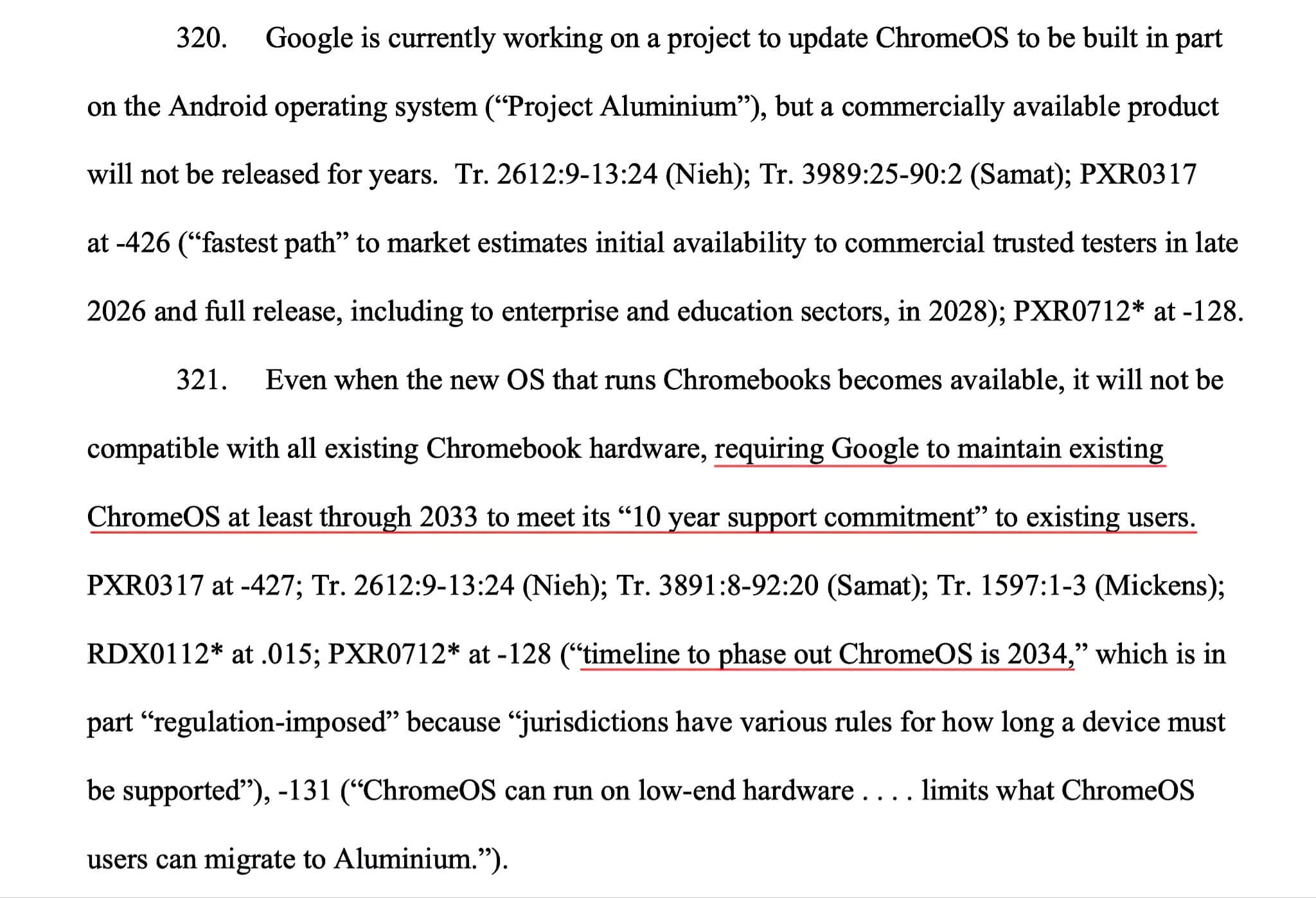
Specifically, Google has committed to supporting current ChromeOS devices for "at least" until 2033. This move aims to respect the 10-year software update policy the company promised to schools and businesses. However, after the 2034 milestone, the name ChromeOS will officially fade into the past. This is a calculated move, as ChromeOS is essentially a sophisticated shell built around the Chrome browser and the Linux kernel. As the tech world shifts toward cross-platform applications, this shell seems to have completed its historical mission.
Current users do not need to worry too much, as the Chromebook you just purchased will still work well and receive security updates for many years to come. But strategically, Google is quietly shifting its focus toward a unified, more powerful platform to compete fairly with Windows and macOS, instead of just being the "king of its own domain" in the budget laptop segment as it is today.
Aluminium OS: When Android "Evolves" for Professional Work
So, what will fill the void left by ChromeOS? The answer is Aluminium OS (internal codename). This is not an entirely foreign operating system, but an ambitious "hybrid" between the flexibility of Android and the powerful productivity of ChromeOS. Imagine having an operating system that possesses the massive app store of an Android phone, but operates on a professional multitasking window interface of a desktop.
The most valuable aspect of Aluminium OS lies in its superior hardware compatibility. It is designed to be the first Android version capable of running smoothly on both of today's most common processor architectures: Arm (commonly found on battery-efficient phones and tablets) and x86 (commonly found on laptops using Intel/AMD chips). This solves a long-standing puzzle: how to make Android run flawlessly on high-performance computers without lagging or poor compatibility.
With Aluminium OS, Google aims to create an unprecedented seamless experience. The apps you love on your phone will automatically scale and optimize their interface when you open them on a laptop, rather than just being a crude enlarged version as before. If this plan goes smoothly, Google could completely establish a new dominant position in the budget device and thin client market in the near future.
In short, the departure of ChromeOS is an inevitable law of evolution. For users, this is actually more good news than bad. Instead of having to choose between an Android tablet for entertainment or a Chromebook for work, in the future, you will have a "2-in-1" device running Aluminium OS - where the best of both worlds converges.