

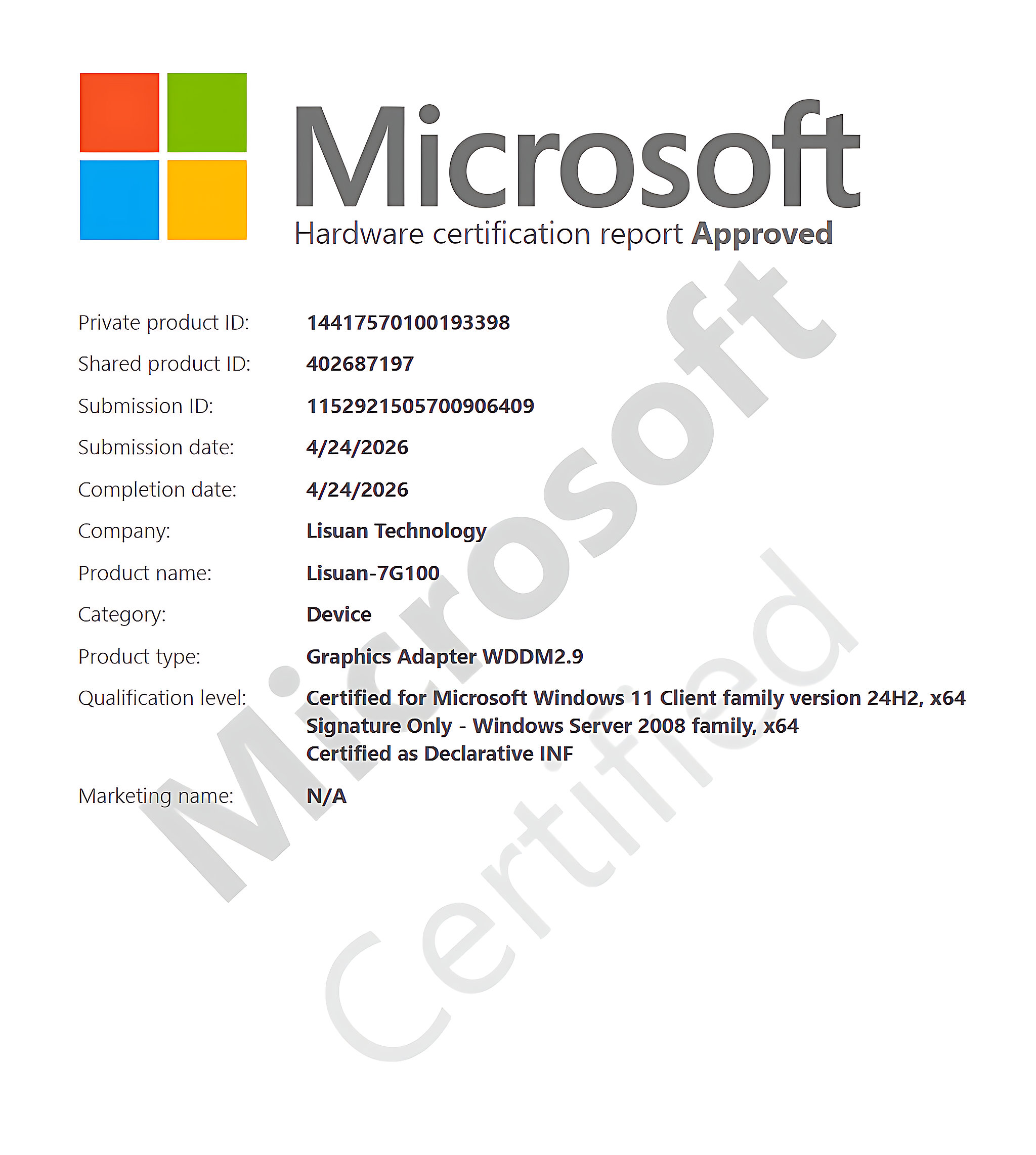
Lisuan 7G100 has reached another significant milestone ahead of its May 20, 2026 launch: it is described as China's first 6nm domestic gaming graphics card to achieve WHQL certification for Windows drivers. This detail means the product is no longer just a hardware demo, but is beginning to address what the gaming market cares about most: installation stability and smoother performance on Windows. According to source from Wccftech, Lisuan also stated that the card has entered the production and testing phase before being released for sale. However, the journey from a timely GPU launch to building an ecosystem capable of competing with NVIDIA, AMD, or Intel remains a much longer road.
Lisuan 7G100 shows China is going further in the gaming GPU race
The most notable aspect of the Lisuan 7G100 is not just that it is another new graphics card, but that China is attempting to build a relatively complete gaming GPU chain, from chip design to software. According to published information, this card model uses the 7G106 GPU on a 6nm process, featuring 12GB GDDR6, a 192-bit bus, PCIe 4.0 x16 interface, and a maximum TDP of 225W. In terms of configuration, these specifications indicate that Lisuan is no longer targeting the experimental segment but is looking to break into the mainstream gaming card tier.
Lisuan also announced a triple-fan design, four DisplayPort 1.4a ports, and support for DX12, Vulkan 1.3, OpenGL 4.6, and OpenCL 3.0. While these specs are not enough to guarantee that real-world performance will match major competitors, they show that the company is trying to avoid the weakness of many previous domestic GPUs: hardware that can run benchmarks, but lacks software coverage for games and drivers. Following recent hardware trends, readers can compare this milestone with solutions like XeSS 3 to see that the GPU race is no longer just about chip power, but also about the software ecosystem.
WHQL is a good sign, but performance and drivers are the real tests
WHQL certification from Microsoft has clear significance for Windows users: the driver has passed hardware compatibility testing and has an official release signature, rather than just being a beta version. On paper, this step helps make installation cleaner and reduces the risk of basic compatibility errors. Microsoft also describes WHQL as a mechanism through which drivers that have passed the certification toolkit can be released as Windows-compatible driver packages within the manufacturer's hardware ecosystem.
| Category | Available Data | Real-world Significance |
|---|---|---|
| Release Date | May 20, 2026 | Lisuan has finalized a commercial milestone rather than just a demonstration |
| Process | 6nm | The project has moved far beyond old experimental GPU levels |
| Memory | 12GB GDDR6, 192-bit bus | Meets mainstream gaming expectations |
| Driver | WHQL, certified on April 24, 2026 | A positive signal for Windows compatibility |
| Biggest Question Mark | Real gaming performance, stability, price | These are the deciding factors for whether the card is attractive |
However, WHQL does not mean the card will immediately become a major competitor in the gaming segment. Previous data regarding the 7G106 primarily showed synthetic benchmark results, with performance estimated around the RTX 4060 level, but there have not been many independent tests on actual games. For gaming graphics cards, the difference between "running many games" and "running smoothly, with few errors, and regular driver updates" is massive.
Therefore, the Lisuan 7G100 should be viewed as a significant step forward for the Chinese domestic GPU market, but not yet proof that the gaming card order has shifted. If the company sticks to its May 20, 2026 schedule, announces a reasonable price, and demonstrates stable drivers across popular games, it will be a milestone worth watching closely. At the current moment, the most reasonable approach is to remain cautious: acknowledging that Lisuan has moved beyond the conceptual stage, but waiting for independent benchmarks and real user feedback, much like how the market is scrutinizing every new product from the eGPU RTX 5060 Ti to other discrete GPU lines. The fact that this card model has achieved WHQL status also shows that the Lisuan 7G100 is moving closer to commercial readiness rather than just remaining at the demonstration stage.