
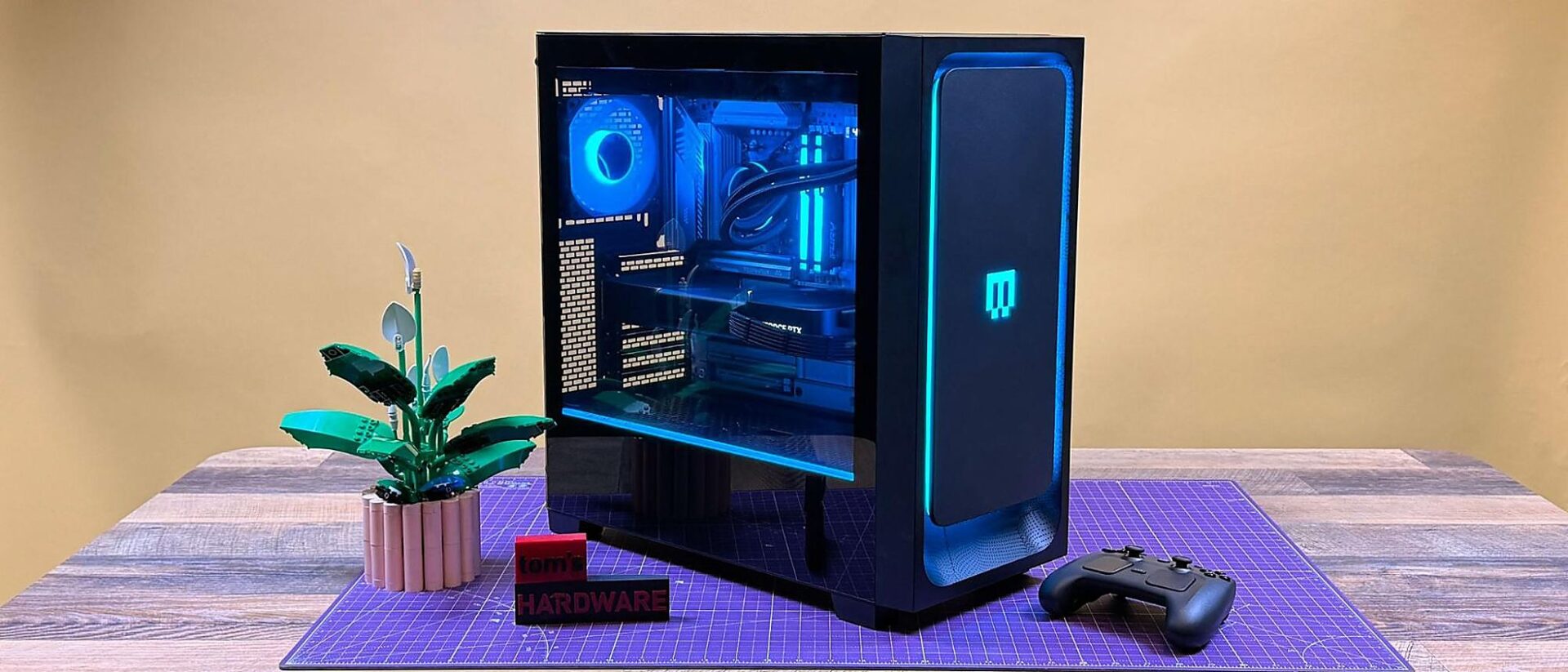
The Maingear MG-1 2026 is a pre-built gaming PC that makes a great first impression: it features a compact form factor, a replaceable front panel, and a component bay that looks as clean as a meticulously custom-built machine. According to Tom's Hardware's review, the strength of this machine lies not just in its configuration, but in its polished build quality and the near absence of bloatware. The issue is that when the configuration is pushed to its limits, the price enters a territory where mainstream buyers will have to think very carefully. Therefore, the question is not whether this model is powerful, but who actually needs to pay extra for that neatness and convenience.
What makes the Maingear MG-1 2026 attractive beyond its specs?
The tested unit features a Ryzen 9 9950X3D2, GeForce RTX 5090, 32 GB RAM, and a 2 TB SSD, with a reference price of $7,199, while the starting configuration for this line is $2,249. This price gap alone shows that this series can easily slide from "sufficient" to "luxury" if buyers choose configurations based on impulse. In return, performance is not something to complain about: the system averaged 188.39 fps in the Metro Exodus test and transcoded 4K video to 1080p in just 1 minute and 32 seconds.
The major difference lies in the build quality. Tom's Hardware describes the machine as having extremely clean cable management thanks to the rear-mounted connector design on the motherboard, making the main compartment look much more spacious and organized than many mass-produced pre-built PCs. The magnetic front panel also maintains a sense of personality without needing an overly aggressive design. More importantly, the system has almost no bloatware aside from essential utilities from MSI, AMD, and Nvidia, making the out-of-the-box experience much more pleasant.
In short, Maingear is selling an "unbox and go" experience, not just a CPU and GPU. For busy people who do not want to build or fine-tune every small detail themselves, this is real value. However, for those accustomed to building their own PCs, this intangible value is not always strong enough to justify the high price tag.
As a result, the Maingear MG-1 2026 is not a model built to compete on price. The Maingear MG-1 2026 is better suited for those who want a compact, powerful, and ready-to-use PC, whereas the high price will be a clear barrier for the group that prioritizes cost-optimization and wants to keep total expenses more practical.
Who is the high price of the Maingear MG-1 2026 best suited for?
The biggest factor to consider remains the price. In the $2,000+ range, the MG-1 is an understandable choice for those wanting to quickly buy a clean and synchronized pre-built gaming PC. But as the configuration climbs toward the $7,000 mark, buyers will start comparing based on different criteria: what else does that money buy besides performance, and is it worth the convenience, aesthetics, and unified warranty?
| Criteria | What the Maingear MG-1 2026 offers | Practical significance |
|---|---|---|
| Performance | Ryzen 9 9950X3D2, RTX 5090, RAM 32 GB, SSD 2 TB | More than enough for heavy gaming, streaming, and video editing |
| Design | Clean cable management, spacious case, replaceable front panel | Looks better on a desk |
| Software | Minimal bloatware | Less time spent cleaning up the system after purchase |
| Price | From $2,249, tested version $7,199 | Suits buyers who prioritize convenience and build quality over price/performance |
The group that fits best with the Maingear MG-1 2026 are those who want a powerful, beautiful, and compact machine that is ready to use without spending their weekend assembling or fixing minor details. These are also the types of customers who have previously been willing to pay extra for a polished experience in other high-end devices, much like how many people view the Dell XPS 16 2026 in terms of daily usage.
Conversely, if the goal is budget optimization or allocating funds across multiple devices, the equation changes. The price difference between the base model and the near-maxed configuration is large enough for many to consider a more practical approach, such as pairing a mid-range desktop with a mobile device like the Yoga Slim 7i. From that perspective, this is a very noteworthy pre-built gaming PC, but it is only truly worth the money when the buyer considers cleanliness, aesthetics, and convenience as inseparable from performance.