
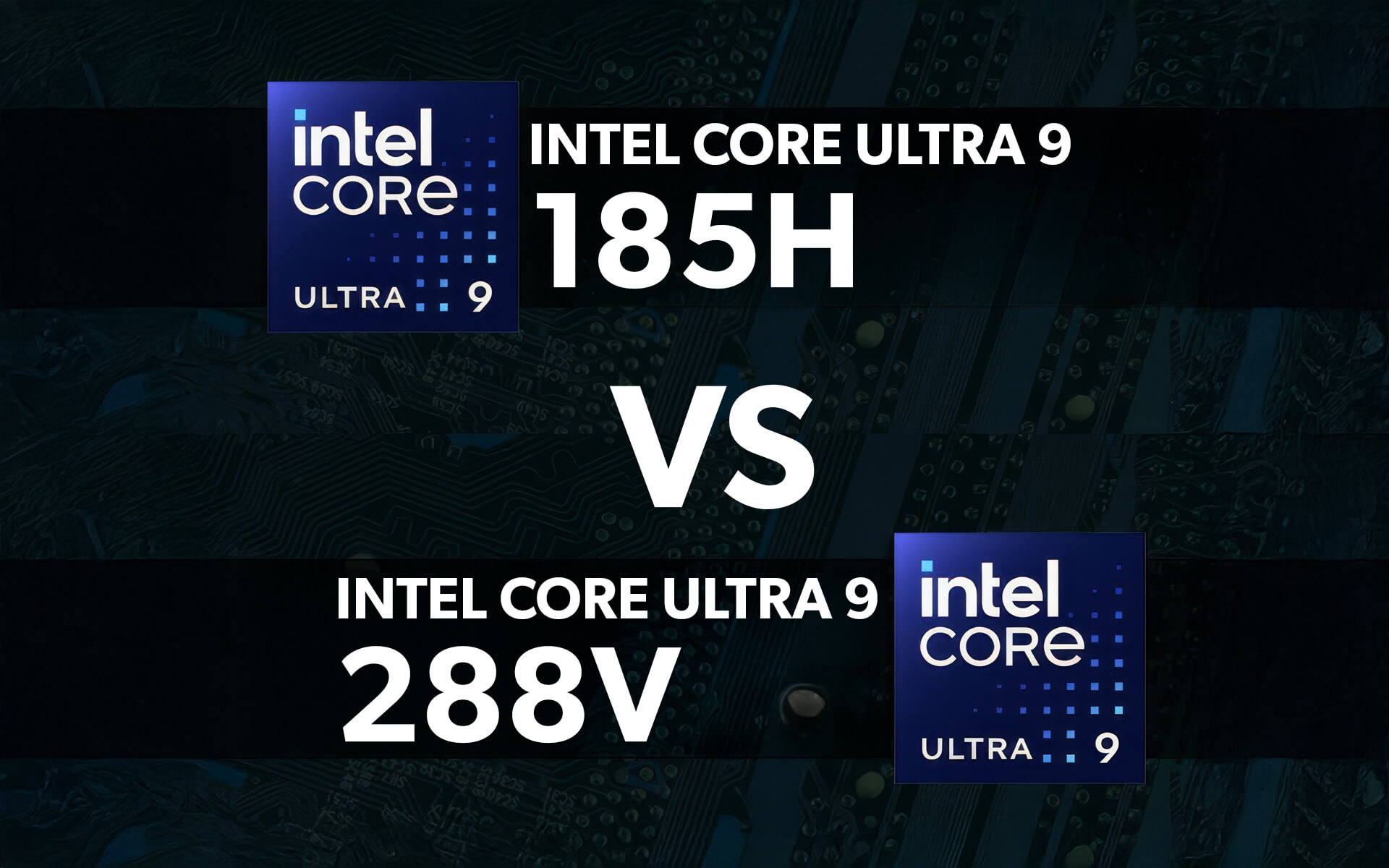
A quick comparison of Core Ultra 9 288V vs. Core Ultra 9 185H performance is a crucial topic for those seeking a high-performance laptop. Both CPUs belong to the Intel Core Ultra 9 series, but there are notable differences in configuration and performance. In this article, we will dive deep into analyzing technical specifications, benchmark performance, power consumption, and many other factors to help you make an informed decision.
Overview of Intel Core Ultra 9 288V and Intel Core Ultra 9 185H
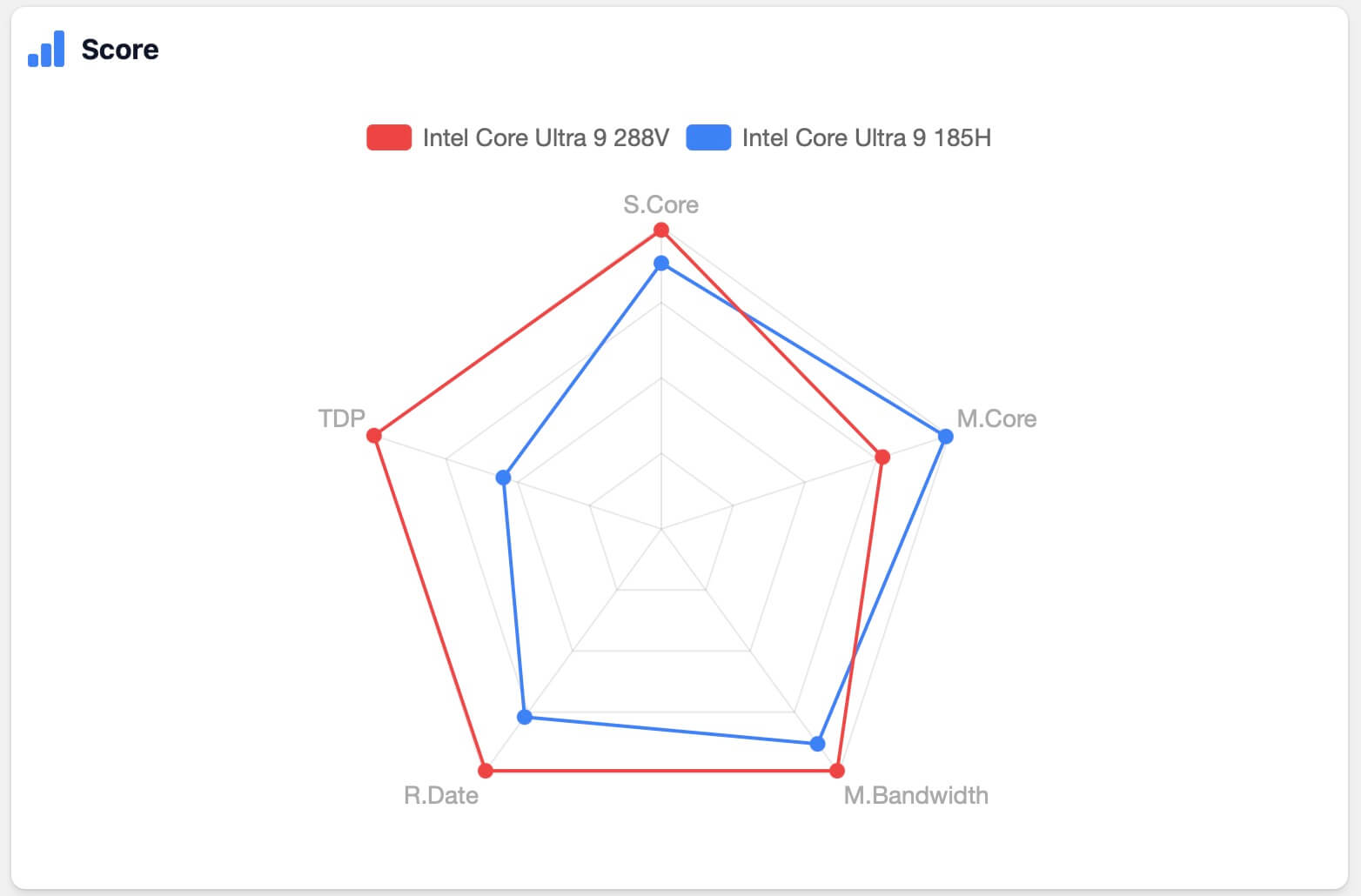
Intel Core Ultra 9 288V and Intel Core Ultra 9 185H are two laptop CPUs manufactured by Intel, coming from two different processor generations. The Core Ultra 9 288V is a Lunar Lake chip released in September 2024, while the Core Ultra 9 185H is a Meteor Lake chip introduced in December 2023.
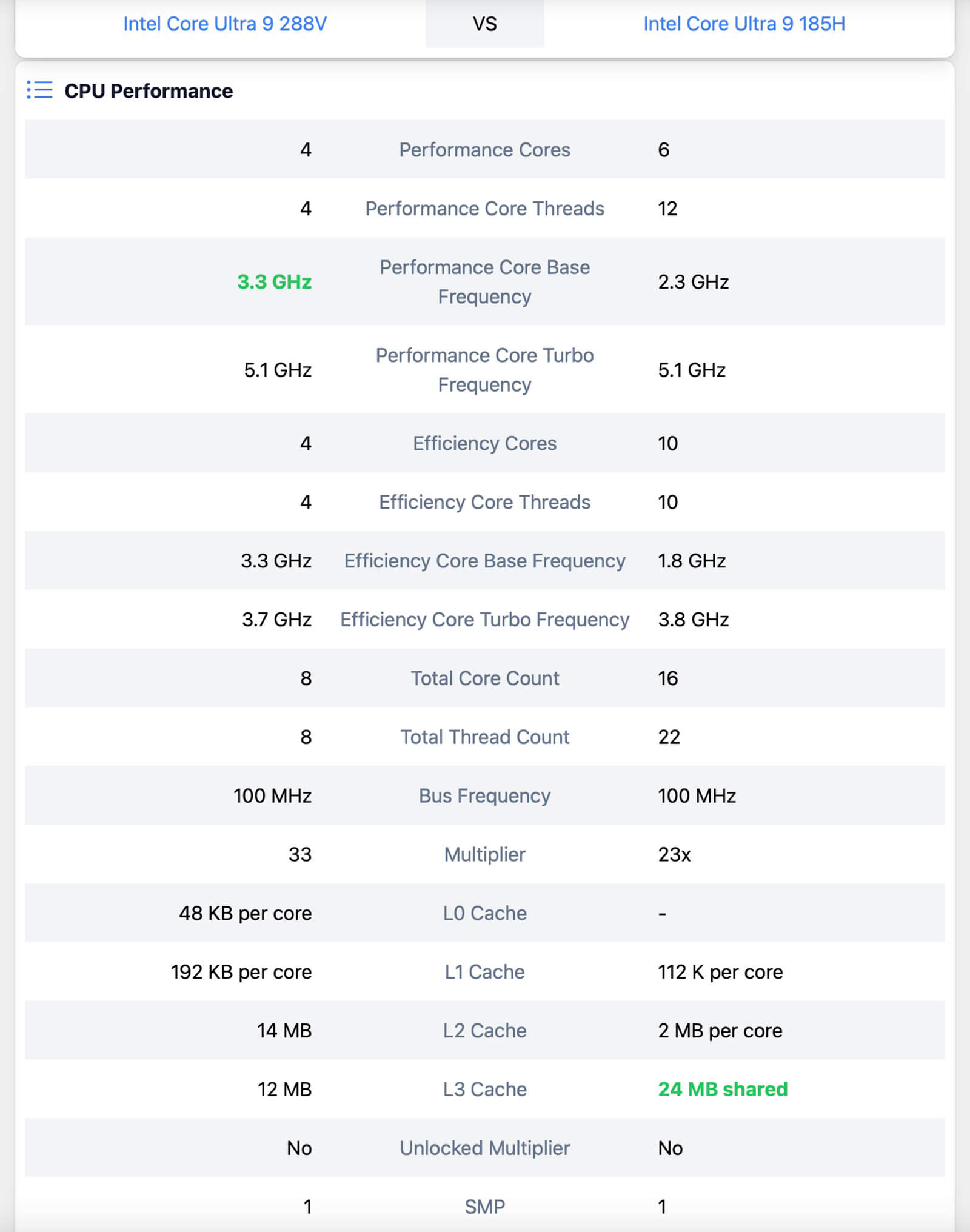
Regarding configuration, the Core Ultra 9 288V features 8 cores and 22 threads, with a base clock speed of 3.3 GHz and a max turbo speed of 5.1 GHz. Meanwhile, the Core Ultra 9 185H has 16 cores and 22 threads, with a base clock speed of 2.3 GHz and a max turbo speed of 5.1 GHz.
A notable point is that the Core Ultra 9 288V uses a 3nm manufacturing process, which is more advanced than the 7nm process of the Core Ultra 9 185H. This brings several advantages such as lower power consumption and higher efficiency.
In terms of graphics, both CPUs feature integrated Intel Arc graphics, but with different core counts and configurations. The Core Ultra 9 288V has 8 graphics cores, while the Core Ultra 9 185H has 128 graphics cores, helping it achieve higher graphics performance.
In summary, each CPU has its own strengths, so the choice will depend on your specific usage needs. Details regarding performance and technical specifications will be analyzed more deeply in the following sections.
Benchmark Evaluation and Overall Performance
To compare the real-world performance between these two CPUs, we will look at results from popular benchmark tests such as Cinebench R23, Geekbench 6, and Blender.
Cinebench R23
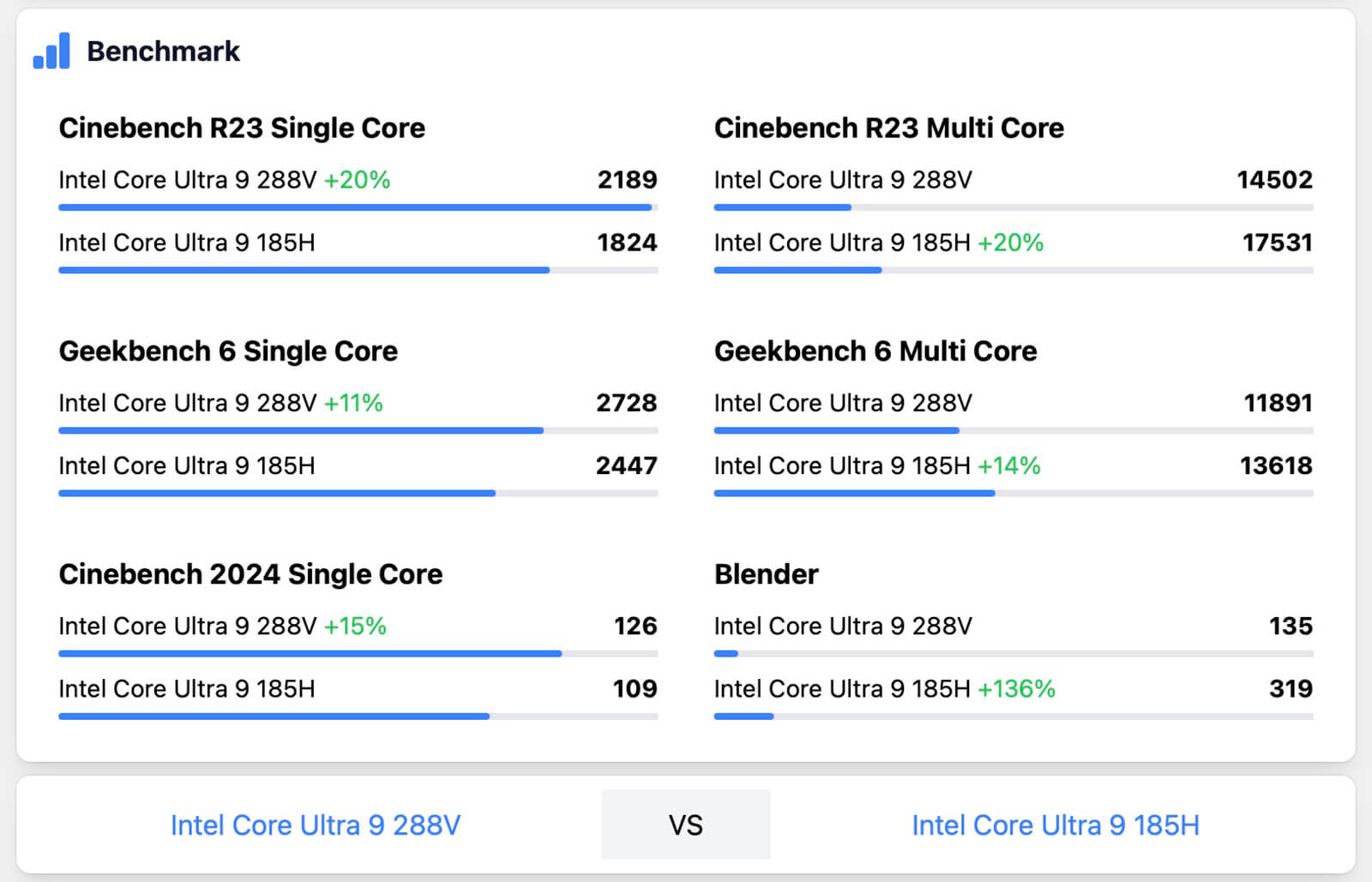
In the Cinebench R23 single-core performance test, the Core Ultra 9 288V achieved a score of 2189, which is 20% higher than the Core Ultra 9 185H at 1824 points. However, in the multi-core test, the Core Ultra 9 185H outperformed with 17531 points, a 20% increase over the 14502 points of the Core Ultra 9 288V.
This result reflects that the Core Ultra 9 185H, with 16 cores and 22 threads, can excel in multi-threaded tasks, while the Core Ultra 9 288V, with 8 cores and 22 threads, is stronger in single-core tasks.
Geekbench 6
Similarly, in Geekbench 6, the Core Ultra 9 288V outperformed the Core Ultra 9 185H by 11% in the single-core test but lagged by 14% in the multi-core test.
Blender
In the Blender test, the Core Ultra 9 185H demonstrated superior power, with a score of 319 compared to only 135 points for the Core Ultra 9 288V-an increase of up to 136%.
In summary, the benchmark results show that the Core Ultra 9 185H is stronger in multi-core performance and handling multi-threaded tasks like 3D rendering, while the Core Ultra 9 288V excels in single-core performance and single-threaded applications.
However, this does not mean one CPU is entirely better than the other. Each CPU will suit different usage needs, and users should consider other factors such as purpose of use, power consumption, integrated graphics, etc., to make an appropriate choice.
Technical Specifications and Configuration Comparison
To get a more comprehensive view of these two CPUs, we will dive deep into analyzing the detailed technical specifications and configurations.
Architecture and Manufacturing Process
The Core Ultra 9 288V uses the Lunar Lake microarchitecture, manufactured on TSMC's advanced 3nm process. Meanwhile, the Core Ultra 9 185H uses the Meteor Lake architecture, manufactured on Intel's 7nm process.
The 3nm manufacturing process allows the Core Ultra 9 288V to achieve higher performance, consume less power, and have a more compact chip size compared to the 7nm process of the Core Ultra 9 185H.
Core and Thread Count
Regarding core configuration, the Core Ultra 9 185H is superior with 16 cores and 22 threads, while the Core Ultra 9 288V only has 8 cores and 22 threads. This gives the Core Ultra 9 185H an advantage in multi-threaded tasks such as 3D rendering, video encoding, etc.
Processing Speed
Although it has fewer cores, the Core Ultra 9 288V has a higher base clock speed of 3.3 GHz compared to 2.3 GHz for the Core Ultra 9 185H. Regarding max turbo speed, both reach 5.1 GHz thanks to Turbo Boost technology.
This indicates that the Core Ultra 9 288V may be stronger in single-threaded applications, while the Core Ultra 9 185H will excel in multi-threaded tasks due to its higher core count.
Memory and Bandwidth
The Core Ultra 9 288V supports LPDDR5X-8533, with memory bandwidth up to 136 GB/s. Meanwhile, the Core Ultra 9 185H only supports LPDDR5-7467 with a maximum bandwidth of 120 GB/s.
This means the Core Ultra 9 288V has faster data access speeds, providing higher performance in applications that require large memory bandwidth.
Graphics Technology
Both CPUs feature integrated Intel Arc graphics, but with different configurations. The Core Ultra 9 288V has 8 graphics cores, while the Core Ultra 9 185H has up to 128 graphics cores.
This allows the Core Ultra 9 185H to achieve better graphics performance, suitable for tasks such as photo editing, 3D rendering, gaming, etc. Meanwhile, the Core Ultra 9 288V will be more suitable for standard office tasks.
In summary, each CPU has its own pros and cons regarding configuration. The choice will depend on the specific needs of the user.
Power Consumption and Operating Temperature
Another important factor to consider when comparing these two CPUs is power efficiency and operating temperature.
Power Consumption
The Core Ultra 9 288V has a TDP (Thermal Design Power) of 37W, which is significantly lower than the 65W of the Core Ultra 9 185H. This shows that the Core Ultra 9 288V consumes less power and simultaneously generates less heat.
This is thanks to the advanced 3nm manufacturing process of the Core Ultra 9 288V, which helps optimize energy efficiency. This also affects battery life and the system's cooling performance.
Operating Temperature
With a lower TDP, the Core Ultra 9 288V also has a maximum operating temperature of 100°C, which is lower than the 110°C of the Core Ultra 9 185H.
This means the Core Ultra 9 288V will generate less heat during operation, helping to reduce pressure on the cooling system and increase system reliability.
However, this also means that the Core Ultra 9 288V might not be suitable for applications requiring continuous high performance, as it may be constrained by a lower operating temperature threshold.
In conclusion, the Core Ultra 9 288V is clearly a more power-efficient CPU that generates less heat, but it may be limited in performance for tasks requiring high and continuous usage. The choice will depend on the specific needs of the user.
Target Users and Recommendations
After analyzing the technical specifications, performance, and other characteristics of the Intel Core Ultra 9 288V and Intel Core Ultra 9 185H in detail, we can provide recommendations for the appropriate target users and goals for each CPU.
Using Core Ultra 9 288V for Single-Core Tasks
With its advantage in single-core performance, the Core Ultra 9 288V is an excellent choice for users who need a computer that handles single-threaded tasks well, such as word processing, web browsing, simple photo editing, etc. Thanks to its higher base clock speed, the Core Ultra 9 288V will provide a fast and smooth experience in these applications.
Additionally, the Core Ultra 9 288V consumes less power, helping your computer have longer battery life and operate cooler. This is an important factor for laptop users who travel frequently.
However, if you need a computer to handle multi-threaded tasks like video rendering, multimedia encoding/conversion, or programming, the Core Ultra 9 288V might not be the optimal choice.
Using Core Ultra 9 185H for Multi-Core Tasks
The Core Ultra 9 185H is a great choice for users who need high performance in multi-threaded tasks. With more cores and a max turbo speed comparable to the Core Ultra 9 288V, but possessing stronger processing capabilities in applications requiring parallel execution like 3D rendering, video encoding, or gaming, the Core Ultra 9 185H will help you complete work faster and more efficiently.
In practice, when working in creative or technical environments that require processing large amounts of data, the Core Ultra 9 185H will clearly demonstrate its advantage. Having 14 cores along with high memory bandwidth allows this CPU to manage many tasks simultaneously with ease. This is very useful for software developers, graphic designers, as well as professionals in the field of data science.
Although the Core Ultra 9 185H consumes more power than the Core Ultra 9 288V and generates more heat, this can be mitigated by using a more efficient cooling system. If you are willing to invest more in cooling solutions, the performance provided by the Core Ultra 9 185H will be worth those efforts.
The Right Choice for Gamers
If you are a gamer or if you spend a lot of time playing online games, the Core Ultra 9 185H CPU is definitely the more suitable choice. With excellent multi-core processing capabilities, the Core Ultra 9 185H will help optimize performance in modern games that require high resources.
Meanwhile, the Core Ultra 9 288V may still allow you to play lighter games, but it cannot compare to the performance that the Core Ultra 9 185H brings in competitive matches or graphically intensive titles. Therefore, if you want the best gaming experience, consider the Core Ultra 9 185H immediately.
However, both CPUs have their own strengths, and the choice between them should be based on your personal needs and priorities. For users who only need simple office processing and do not require extremely high performance, the Core Ultra 9 288V is an ideal choice. Conversely, if you are a user who needs powerful performance for heavier and more complex tasks, the Core Ultra 9 185H will not disappoint you.
Reference: TopCPU