
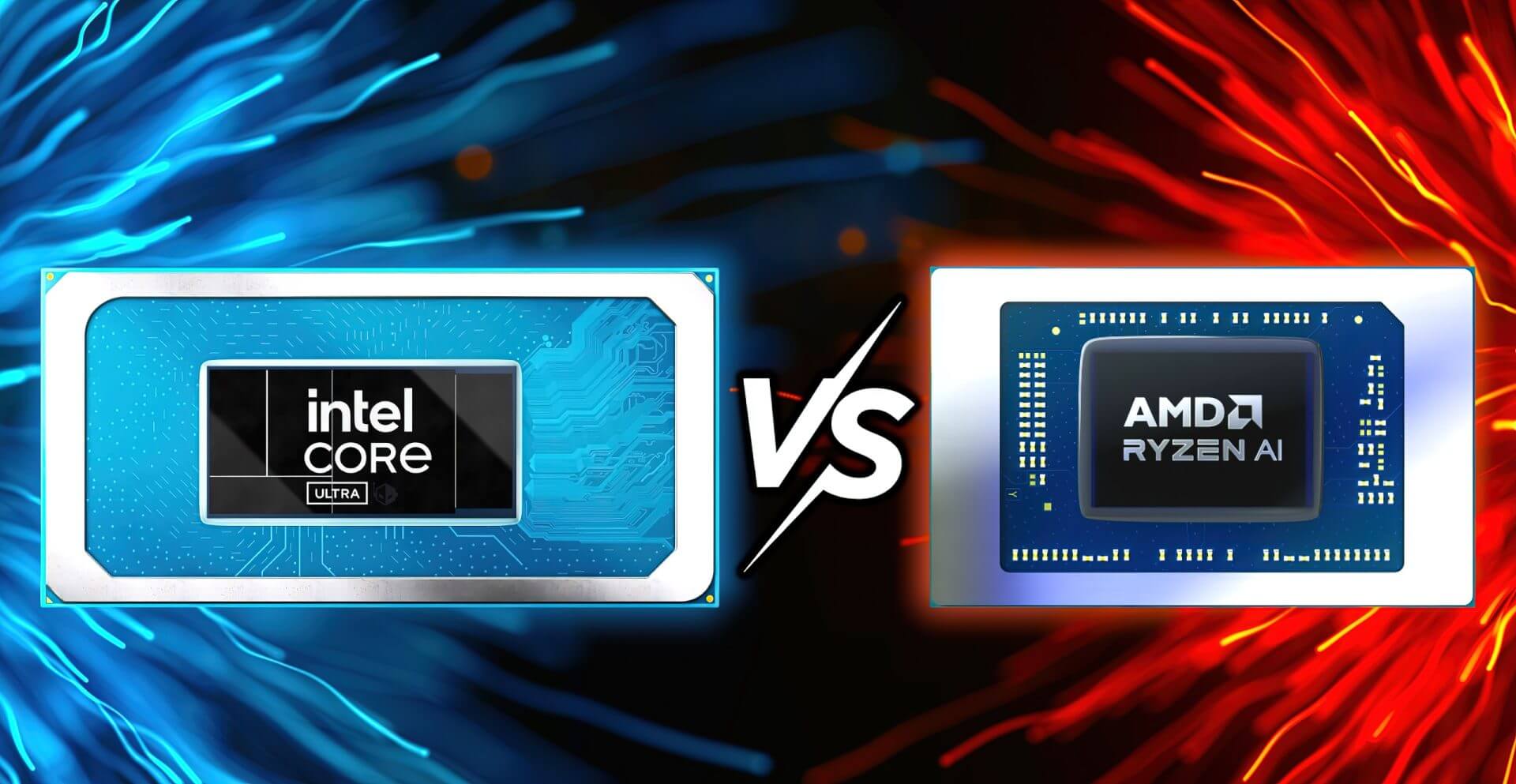
When comparing two laptop processors, the Intel Core Ultra 7 258V and the AMD Ryzen AI 9 HX 370, we will explore which processor is more powerful in performance benchmarks, key specifications, power consumption, and more.
Basic specifications of Intel Core Ultra 7 258V and AMD Ryzen AI 9 HX 370
Before diving deep into the performance comparison, let's take a look at the basic specifications of these two processors.
Intel Core Ultra 7 258V - A mid-range processor with exceptional capabilities
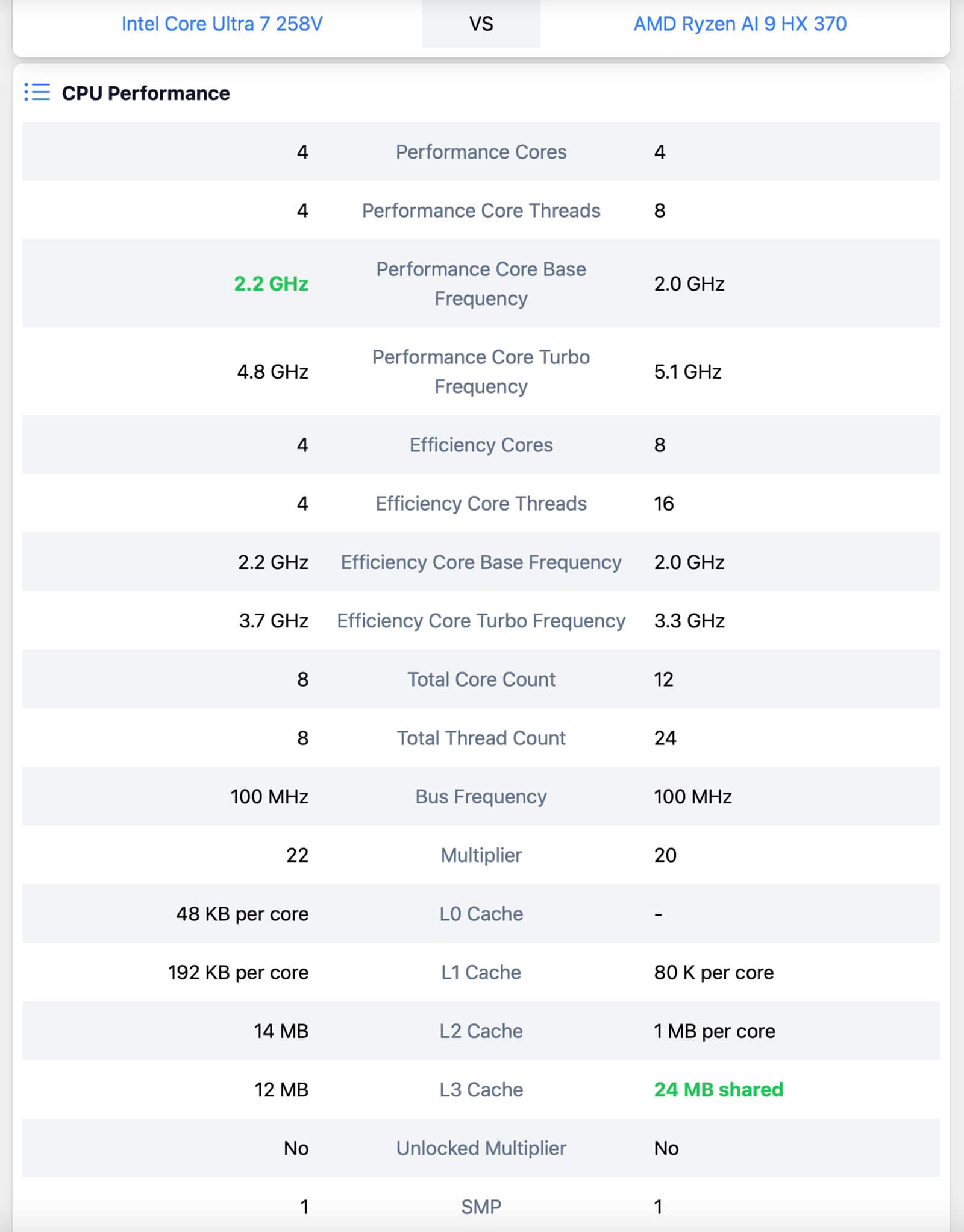
The Intel Core Ultra 7 258V is a mid-range processor from Intel, manufactured on the modern 3nm process. It features 8 cores and 16 threads, with a base clock speed of 2.2 GHz and a turbo boost speed of up to 4.8 GHz.
Key highlights of the Intel Core Ultra 7 258V:
- Integrated LPDDR5X memory with speeds up to 8,533 MT/s, significantly higher than the DDR5-5600 on the AMD Ryzen AI 9 HX 370.
- Memory bandwidth of up to 136 GB/s, much larger than the 89.6 GB/s of its AMD rival.
- Supports PCIe 5.0, a newer update compared to PCIe 4.0 on AMD.
- Slightly higher base clock speed at 2.2 GHz compared to AMD's 2.0 GHz.
- More modern 3nm manufacturing process compared to AMD's 4nm.
- Lower TDP, only 37W compared to AMD's 54W.
Overall, the Intel Core Ultra 7 258V is equipped with powerful specifications, enough to compete with the AMD Ryzen AI 9 HX 370 rival.
AMD Ryzen AI 9 HX 370 - An excellent choice for multi-threaded performance
On the other side, we have the AMD Ryzen AI 9 HX 370, a 12-core, 24-thread processor with a base clock of 2.0 GHz and a maximum of 5.1 GHz. This is a processor designed for high-end laptops, competing directly with the Intel Core Ultra 7 258V.
Key highlights of the AMD Ryzen AI 9 HX 370:
- Integrated powerful Radeon GPU, capable of handling graphics tasks well.
- L3 cache is twice as large, up to 24MB compared to Intel's 12MB.
- Supports DDR5-5600 and LPDDR5X-8000 memory standards.
- Maximum memory capacity of 256GB, 8 times more than Intel.
- Higher TDP, up to 54W to provide power to the cores and GPU.
Overall, the AMD Ryzen AI 9 HX 370 is an excellent choice for those who need high multi-threaded performance, especially in multi-threaded tasks such as rendering, video editing, or software development.
Performance in standard benchmarks
To get a comprehensive view of the capabilities of these two processors, let's look at the results of several standard performance benchmarks.
Cinebench R23 - AMD Ryzen AI 9 HX 370's impressive multi-core test
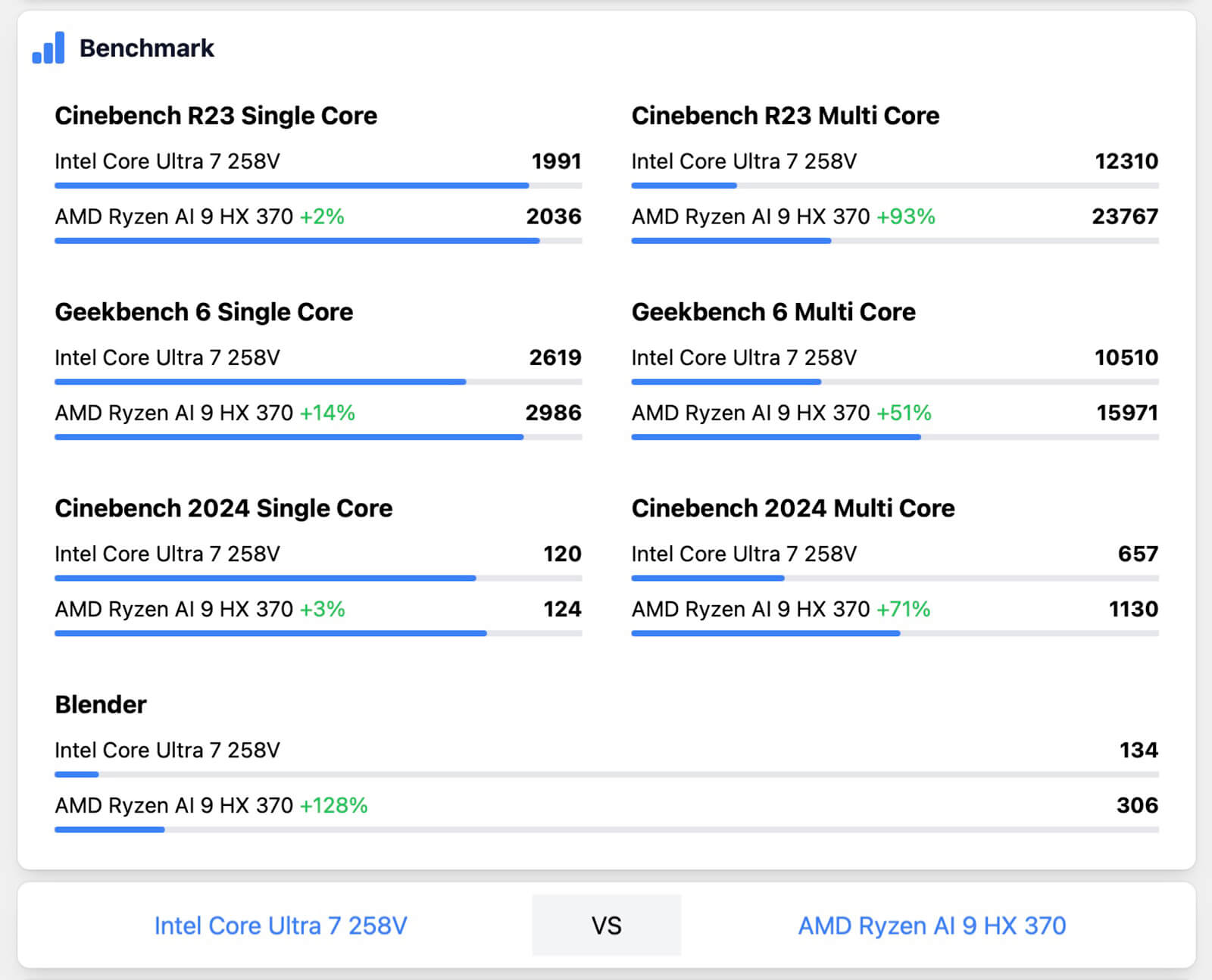
Cinebench R23 is a popular multi-core performance evaluation tool, reflecting the CPU's ability to handle 3D rendering tasks. The results are as follows:
- Single-Core Score:
- Intel Core Ultra 7 258V: 1,991
- AMD Ryzen AI 9 HX 370: 2,036 (+2%)
- Multi-Core Score:
- Intel Core Ultra 7 258V: 12,310
- AMD Ryzen AI 9 HX 370: 23,767 (+93%)
The results show that the AMD Ryzen AI 9 HX 370 significantly outperforms the Intel Core Ultra 7 258V in the multi-core test, with a score up to 93% higher. This reflects the impressive ability of AMD Ryzen to handle multi-threaded tasks like rendering and video encoding.
Meanwhile, in the single-core test, the Intel Core Ultra 7 258V has a slightly higher score, indicating slightly better single-thread performance. However, with the overwhelming advantage in multi-core, the AMD Ryzen AI 9 HX 370 remains a more worthwhile choice for tasks requiring high multi-threaded performance.
Geekbench 6 - Comprehensive performance evaluation of the two processors
Next, we will examine the results of the Geekbench 6 test, a comprehensive CPU performance evaluation tool:
- Single-Core Score:
- Intel Core Ultra 7 258V: 2,619
- AMD Ryzen AI 9 HX 370: 2,986 (+14%)
- Multi-Core Score:
- Intel Core Ultra 7 258V: 10,510
- AMD Ryzen AI 9 HX 370: 15,971 (+51%)
In the Geekbench 6 test, we see that the AMD Ryzen AI 9 HX 370 once again significantly outperforms the Intel Core Ultra 7 258V in the Multi-Core section, with a score up to 51% higher. This once again confirms the advantage of AMD Ryzen when handling multi-threaded tasks.
In the Single-Core section, the AMD Ryzen AI 9 HX 370 also proves to be superior, with a score 14% higher than the Intel Core Ultra 7 258V. This shows the improvement in AMD's single-thread performance compared to previous generations.
Performance in real-world tasks
In addition to standard benchmarks, we also need to consider the performance of these two processors in real-world tasks, such as 3D rendering, video editing, and high-performance tasks.
Cinebench R20 - 3D rendering performance evaluation
Cinebench R20 is a 3D rendering benchmark, reflecting the CPU's capability in 3D design, dynamics, and creative applications. The results are as follows:
- Single-Core Score:
- Intel Core Ultra 7 258V: 120
- AMD Ryzen AI 9 HX 370: 124 (+3%)
- Multi-Core Score:
- Intel Core Ultra 7 258V: 657
- AMD Ryzen AI 9 HX 370: 1,130 (+71%)
The results once again show the superiority of the AMD Ryzen AI 9 HX 370 in multi-threaded tasks, with a multi-core score up to 71% higher than the Intel Core Ultra 7 258V. This indicates that the AMD Ryzen AI 9 HX 370 will be an excellent choice for 3D rendering applications, graphic design, and other creative tasks.
In the single-core test, the performance of the two processors is quite close, with the AMD Ryzen AI 9 HX 370 only slightly ahead of the Intel Core Ultra 7 258V. This shows that Intel still maintains an advantage in single-thread performance.
Blender - In-depth 3D rendering performance evaluation
To evaluate 3D rendering performance more deeply, we continue to check the results of the Blender test, a professional 3D rendering software:
- Intel Core Ultra 7 258V: 134
- AMD Ryzen AI 9 HX 370: 306 (+128%)
Here, we see that the AMD Ryzen AI 9 HX 370 significantly outperforms the Intel Core Ultra 7 258V, with a score up to 128% higher. This once again confirms the power of the AMD Ryzen AI 9 HX 370 in 3D rendering tasks, especially those requiring high multi-threaded processing power.
Combined with the previous results, we can conclude that the AMD Ryzen AI 9 HX 370 is the top choice for those who need a powerful processor to serve creative tasks, graphic design, and 3D rendering.
Power consumption test
In addition to performance, power consumption is also an important criterion when choosing a processor for a laptop. Let's consider the difference in power consumption between the Intel Core Ultra 7 258V and the AMD Ryzen AI 9 HX 370.
Maximum power consumption
Regarding maximum power consumption, the Intel Core Ultra 7 258V has a TDP (Thermal Design Power) of 37W, while the AMD Ryzen AI 9 HX 370 has a TDP of up to 54W.
This shows that the Intel Core Ultra 7 258V will consume less power than the AMD Ryzen AI 9 HX 370, especially when the laptop is operating under high load. This can bring benefits to battery life and the operating temperature of the system.
Performance per watt
However, a simple comparison of TDP is not enough to evaluate power-saving capabilities. We need to consider performance per watt, which is the amount of work a CPU can complete per unit of power consumed.
In practice, the AMD Ryzen AI 9 HX 370, with 12 cores and 24 threads, can provide much higher multi-threaded performance than the 8-core, 16-thread Intel Core Ultra 7 258V. This means that, despite consuming more power, the AMD Ryzen AI 9 HX 370 can still deliver better performance per watt consumed.
Therefore, when considering overall performance and power consumption, the AMD Ryzen AI 9 HX 370 is still considered a choice worth considering, especially for those who need high multi-threaded processing power.
Summary of Intel Core Ultra 7 258V and AMD Ryzen AI 9 HX 370 performance
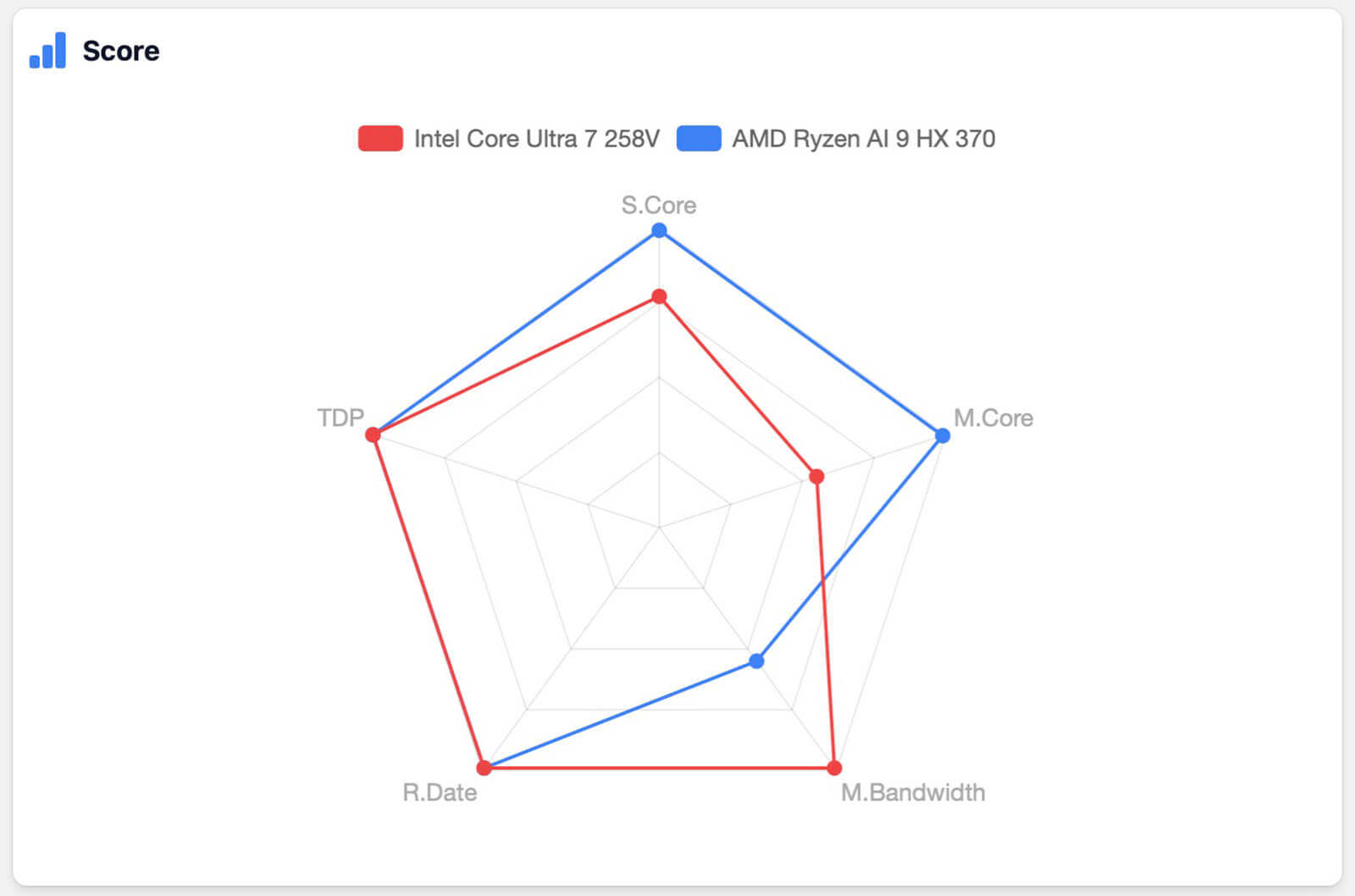
Through this comparison, we have gained an overview of the performance of the Intel Core Ultra 7 258V and the AMD Ryzen AI 9 HX 370-two leading processors on the market today. Detailed analyses of performance in real-world tasks such as 3D rendering or video editing clearly show that the AMD Ryzen AI 9 HX 370 is proving to be superior in multi-threaded processing capabilities, especially in applications requiring large computational power.
However, it cannot be denied that Intel still maintains an advantage in single-thread performance, which is very important for certain applications and games that require high performance from each individual core. This requires users to carefully consider their usage needs and the type of tasks they frequently perform to make the most suitable choice.
Additionally, when discussing power consumption, although the AMD Ryzen AI 9 HX 370 has a higher TDP, its processing performance per watt can compensate for that disadvantage, especially in multi-threaded tasks. This indicates that a comprehensive review of factors such as performance, power consumption, and type of work is very important before making a purchase decision.
Finally, both processors have their own strengths, and the choice between them will depend on the specific needs of each user. Users should clearly define their purpose of use to be able to choose the most suitable product, thereby optimizing work performance as well as the personal computer user experience.
This comparison is hoped to help consumers gain a deeper insight into these two product lines, thereby making informed decisions when investing in new technology.
Reference TopCPU