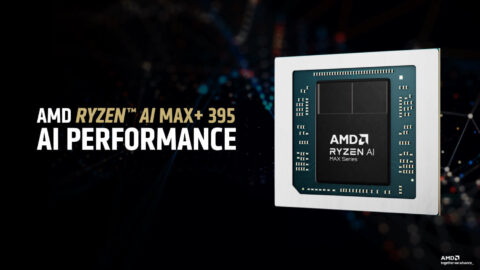

AMD's new chip effort, codenamed "Strix Halo," has been confirmed, and it will carry the Ryzen AI Max 300 series branding. These are chiplet-based mobile processors with one or two "Zen 5" CCDs, the same kind found in the "Granite Ridge" desktop PC processors, paired with a large SoC die and a powerful integrated GPU (iGPU). This combination lets AMD offer up to 16 full-size "Zen 5" CPU cores, along with an iGPU that can have up to 40 RDNA 3.5 compute units (2,560 stream processors) and a 256-bit LPDDR5/x memory interface for UMA.
"Strix Halo" is designed for ultraportable gaming laptops and mobile workstations, where a small PCB footprint matters and a discrete GPU is not a viable option. For enthusiast gaming laptops with a discrete GPU, AMD is developing the "Fire Range" processor, which is essentially a mobile BGA version of "Granite Ridge" and the successor to the Ryzen 7045 "Dragon Range" series. The Ryzen AI Max family has three models, split by CPU core count and iGPU compute units: the Ryzen AI Max 395+ (16 cores/32 threads with 40 CUs), the Ryzen AI Max 390 (12 cores/24 threads with 40 CUs), and the Ryzen AI Max 385 (8 cores/16 threads, 32 CUs). A test model with the engineering name "Ryzen AI Max 390" has now appeared in the online Geekbench AI benchmark database.

The entry in the online database for this Geekbench AI submission refers to a processor that identifies itself as "AMD Eng Sample: 100-000001421-50_Y," which matches the core and thread count of the Ryzen AI Max 390 (12 cores/24 threads, 40 CUs). The processor has a base CPU clock of 3.20 GHz and a maximum boost clock of up to 5.00 GHz, at least for this test model (retail processors may differ). It is powering a test workstation, the HP ZBook Ultra 14 G1a (mobile workstation), and is paired with 64 GB of memory.
The processor recorded a Geekbench AI single-precision score of 4733, a half-precision score of 4944, and a quantized score of 13944. HotHardware noted that this is a fairly large gap of 60% compared with the Ryzen 9 9900X desktop PC processor. There could be several reasons behind this number. The screenshot shows the workstation laptop running in "Power: Balanced" mode, and the test used 256-bit AVX2 SIMD instructions (not the latest AVX512). The "Zen 5" cores on "Strix Halo" are carried over from "Granite Ridge" and EPYC "Turin", since they share the same 8-core CCD and have a full 512-bit FP data path. This differs from the "Zen 5" cores on the monolithic "Strix Point" silicon, which are limited to a 256-bit FP data path and take twice as long even when executing AVX512 or VNNI instructions. As a result, AI tests that use AVX512/VNNI may produce different results. In addition, this is a test sample, and AMD may deliberately reduce the performance of test models.
Source: TechpowerUP