
Apple, long regarded as the most important and closest customer of semiconductor giant TSMC, now risks losing its spot at the top. Reports indicate the iPhone maker moved quickly to lock up more than half of the initial capacity of the advanced 2nm process for the A20 and A20 Pro chips in the upcoming iPhone 18, but the explosion of artificial intelligence (AI) has reshaped the landscape entirely. A recent source revealed that TSMC may no longer give Apple special priority on deliveries, since most of its profit now comes from a completely different field, not smartphones.
Chip Price Pressure and a Visit From TSMC's CEO
The partnership between Apple and TSMC has long been rumored in the tech world to be one of favoritism and special privileges. That belief has solid grounds: for years, the iPhone maker has contributed a huge share of revenue to the Taiwanese semiconductor giant. There was even a report that the two companies had a quiet agreement under which Apple only paid for batches of wafers (the silicon discs used to make chips) that met quality standards. However, respected analyst Ming-Chi Kuo dismissed the claim, clarifying that TSMC does not absorb the cost of defective wafers on Apple's behalf.
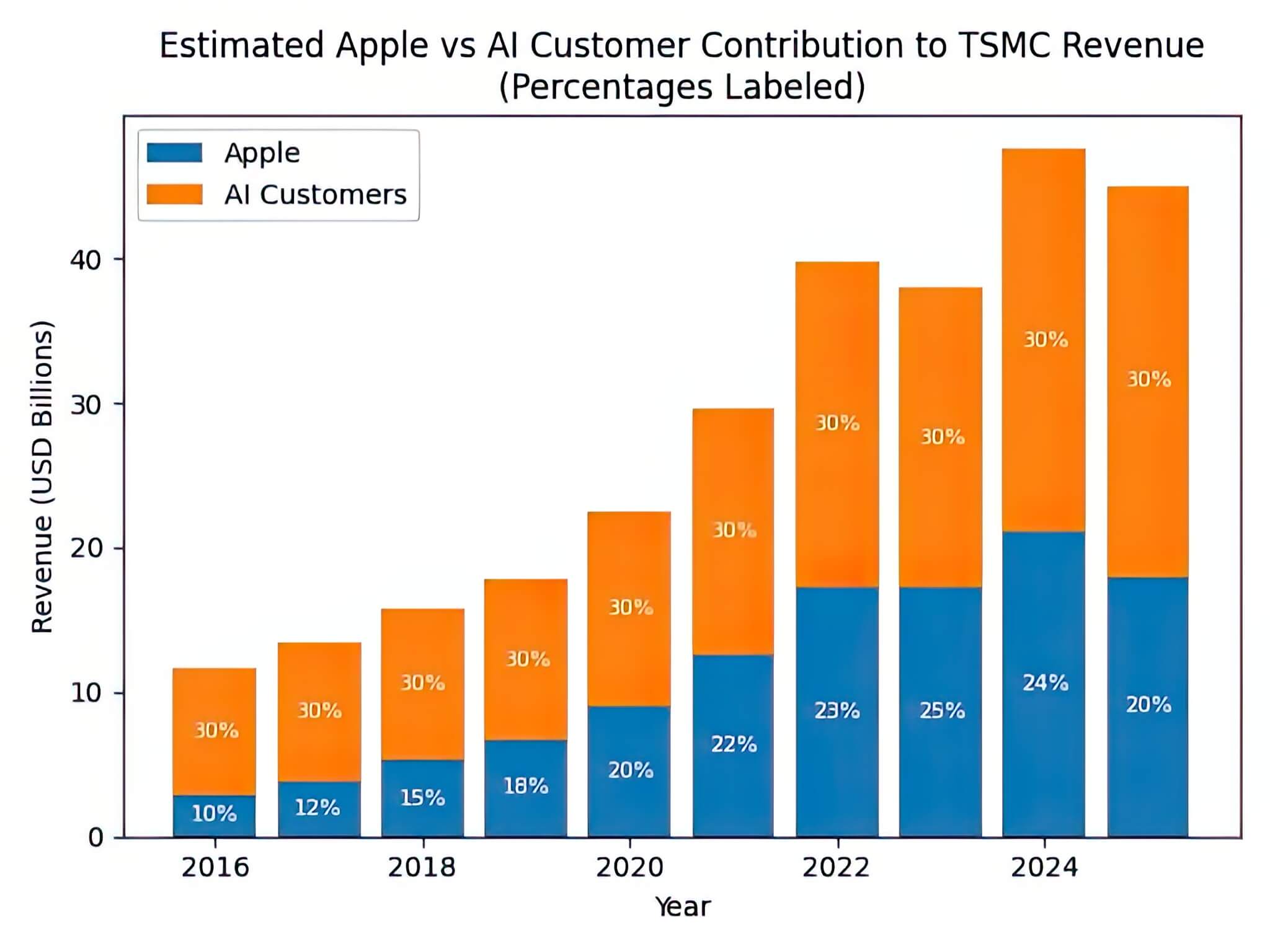
Even so, it has generally been assumed that Apple gets first access to TSMC's most advanced lithography technology. This year, though, could bring a major change. A leak says TSMC CEO C.C. Wei personally visited Apple's headquarters. The trip was reportedly meant to kick off the biggest price increase in recent years. The underlying reason is that smartphone processors (SoCs) are no longer TSMC's top source of revenue.
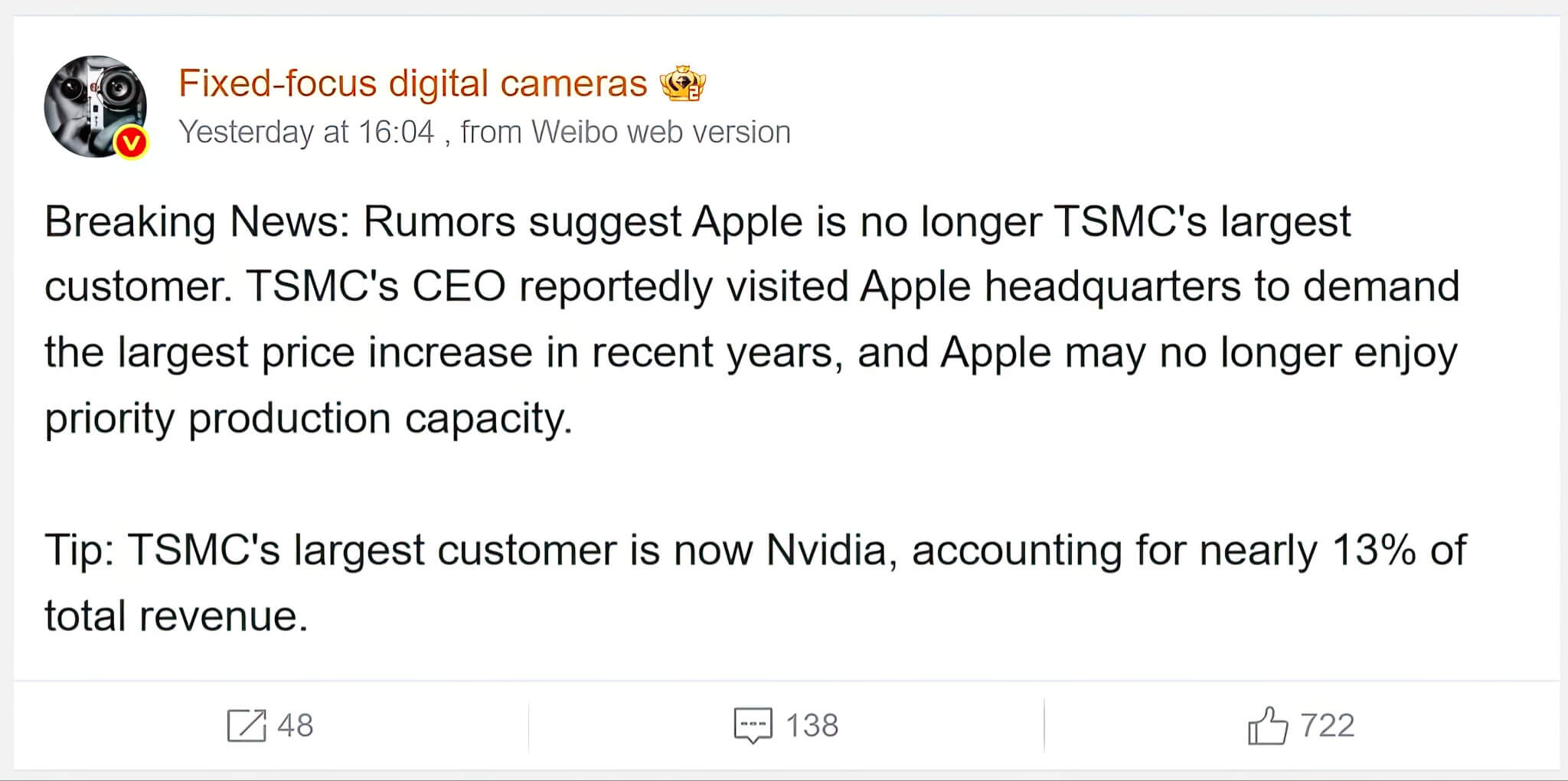
We previously reported that the California "giant" (Apple) accounted for 24% of TSMC's annual revenue in 2024. NVIDIA took that title in 2025, however. Now, according to a source on the Weibo account "Fixed-focus digital cameras," a shocking revelation has hit Apple as its dominant position is being badly shaken by the AI wave.
The AI Boom Changes TSMC's Customer Hierarchy
Apple appears to be getting left behind as the AI frenzy pushes TSMC's revenue to new heights. TSMC is reportedly facing a shortage of 2nm wafers. With enormous demand weighing on it, the chipmaker has reportedly been forced to raise prices on its advanced process nodes for four consecutive years, starting in 2026. While the increases do not necessarily apply to Apple alone, the estimated cost of each A20 SoC is set to reach 280 USD, a figure that quietly confirms price hikes may already have been applied.
The report also stresses that the 2nm process has recorded 1.5 times as many tape-outs (designs sent to trial production) as the 3nm process. This highlights the fact that Apple, Qualcomm and MediaTek are no longer the only customers in this fiercely competitive market.
At the end of the Weibo post, the source confirms that NVIDIA is now TSMC's largest customer, contributing 13% of the company's total revenue. Perhaps only when the AI bubble bursts will TSMC "return the favor" and treat Apple as generously as before. But the company is unlikely to see that happen anytime soon, as its capital expenditure (CapEx), driven by the AI boom, is expected to hit an unprecedented record this year, a huge 52 billion to 56 billion USD. That shows TSMC is placing a big bet on the future of AI, and Apple will have to accept sharing its standing in the global supply chain.