

Zluda is opening a new direction for the GPU industry by allowing CUDA applications to run on AMD and Intel GPUs without requiring source code modifications. This open-source tool is expected to break Nvidia's CUDA monopoly, helping the AI community, data scientists, and developers save costs while expanding hardware options for heavy computational tasks. With the potential to support modern AI applications and excellent compatibility on Linux and Windows, Zluda is becoming a notable project in the effort to reduce dependence on Nvidia and promote the development of a multi-platform AI ecosystem.
What is Zluda and how does it work
Zluda is a translation layer that allows CUDA applications to run on AMD and Intel GPUs without modifying the original code, achieving performance close to Nvidia GPUs. The project currently has two full-time developers continuously improving compatibility and performance. Zluda has already supported the accurate execution of many complex instructions such as cvt, enhanced logging and API tracking capabilities, and provides better support for ROCm/HIP on Linux and Windows, helping to expand GPU code execution capabilities across multiple platforms.
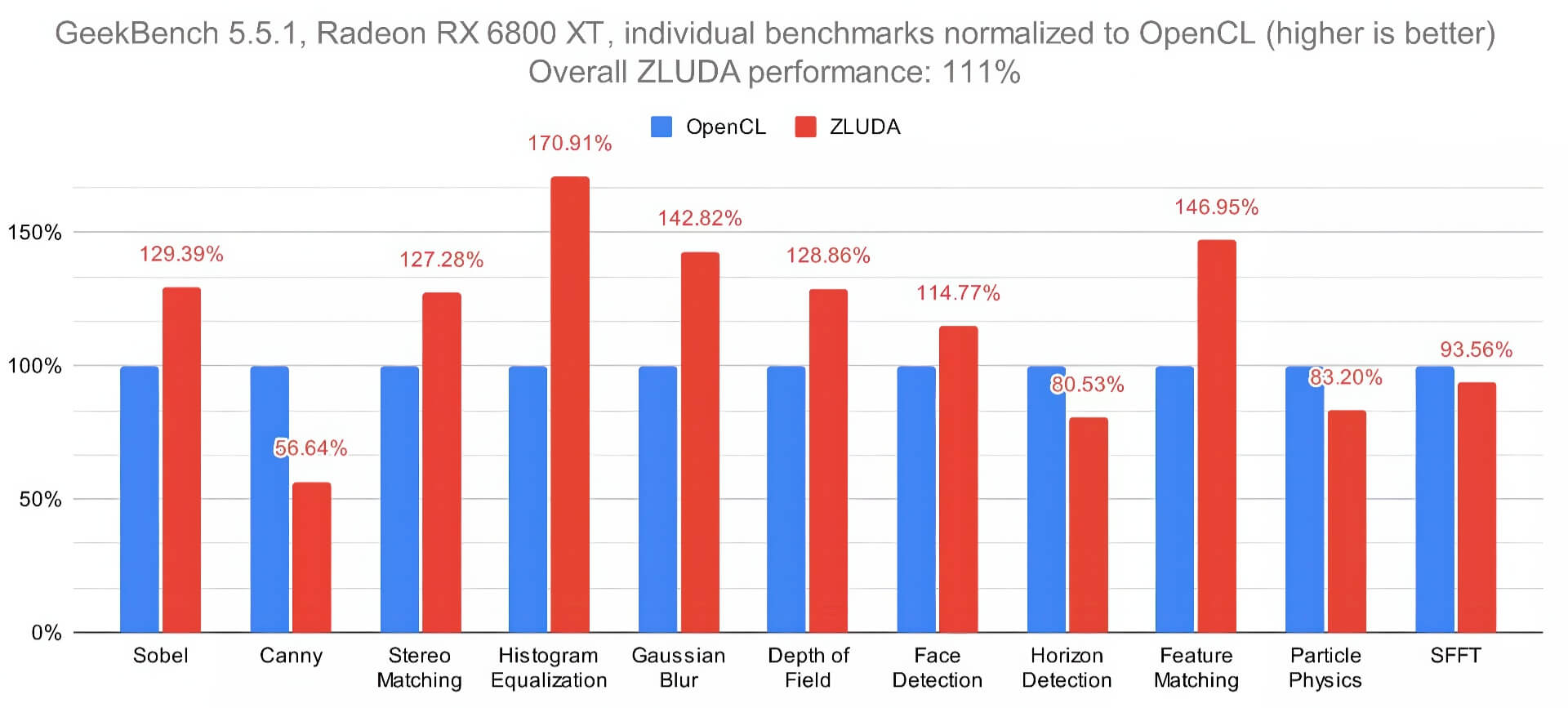
One notable highlight is that Zluda has supported 16/44 functions in the llm.c library, used for testing CUDA for large language models like GPT-2 and GPT-3. This is a positive signal, paving the way for the ability to run modern AI models on non-Nvidia GPUs.
Practical benefits of Zluda
Zluda's ability to run CUDA on AMD and Intel GPUs brings many practical benefits:
- Reduced dependence on Nvidia: Helps businesses and researchers are no longer limited in hardware choices, reducing vendor lock-in while saving GPU investment costs.
- Expanded access to AI technology: With Zluda, fields such as AI, machine learning, scientific research, and game engine development will have easier access to powerful GPUs instead of relying solely on Nvidia hardware.
- Support for legacy games using PhysX: The project is also aiming to support running older games that use PhysX on modern hardware or non-Nvidia GPUs.
- Encouraging open-source community participation: The Zluda project is in its refinement stage and requires contributions from the community to improve performance and fix potential bugs, especially in supporting 32-bit PhysX and legacy CUDA applications.
Challenges and future potential
Zluda still faces many challenges as the current development team has limited resources, while the workload required to achieve full CUDA compatibility is immense. Some potential bugs when running legacy CUDA applications still need to be addressed to ensure stability.
However, with the growing trend of open-source support from the tech community, Zluda promises to become an important project, contributing to changing the GPU market, driving multi-platform AI development, reducing costs for businesses and researchers, and increasing competition in the semiconductor industry. Nvidia losing its CUDA monopoly could be a major turning point, helping the AI and GPU ecosystems become more open, transparent, and accessible in the future.