
Netflix has officially confirmed a major milestone in video streaming technology, as the AV1 codec now handles nearly 30% of the company's streaming content. This is a massive effort to minimize network bandwidth consumption for users while maintaining sharp image quality. This move shows that Netflix-one of the primary backers of AV1-is continuing to expand the application of this technology across its platforms while preparing for new projects with the upcoming successor generation.
The Journey to Universal AV1 Compression Standard Adoption Across Multiple Platforms
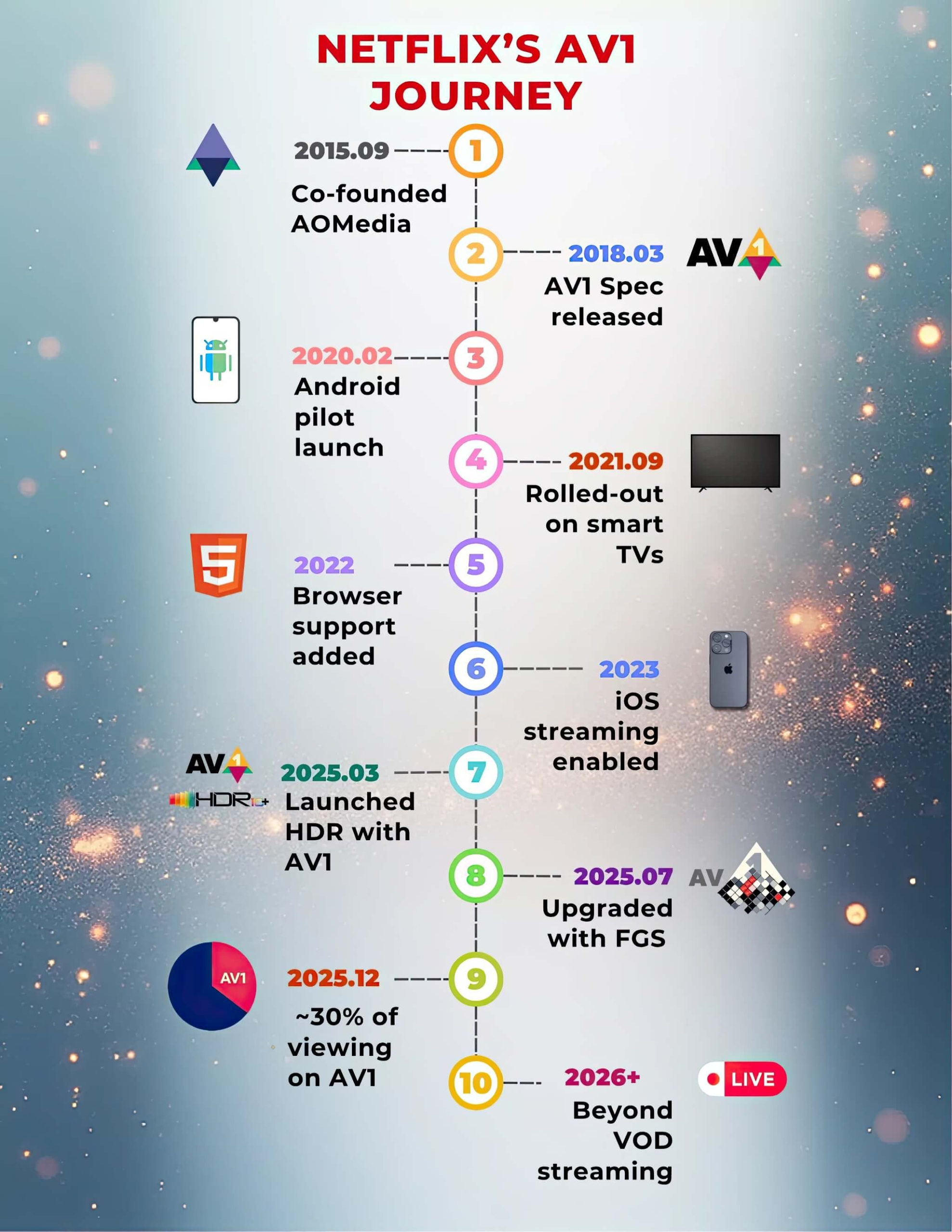
Support for the AV1 codec has grown significantly since its launch in 2018. Immediately, both large and small platforms quickly adopted this format with the goal of optimizing internet transmission. In a detailed recent post on the Medium platform, Netflix clearly explained how they contributed to the birth of this codec and the roadmap for bringing it to various types of devices.
To help readers visualize, AV1 was created by the Alliance for Open Media (AOMedia) in 2018. This is an organization that brings together the world's leading tech giants, including Netflix, Amazon, Apple, Google, Microsoft, Mozilla, Nvidia, and many other companies. AV1 was designed to be the successor to Google's VP9 format. The standout strength of AV1 is its ability to compress data much more efficiently than the currently popular H.264 format, and notably, it is completely royalty-free, unlike the expensive H.265/HEVC standard.
Over the past few years, AV1 decoding and encoding support has rapidly spread to modern mobile devices, computer graphics chips, and other hardware. Throughout that time, everyone from large corporations to independent content creators has praised the performance improvements brought by this technology.
Netflix began implementing AV1 software decoding on Android devices in 2020. The reason for this priority was the flexibility of the Android platform and the overwhelming popularity of mobile devices among the online movie-watching audience. By using the "dav1d" library-which has been optimized by developers for Arm architecture mobile chipsets-Netflix has significantly improved video playback quality for users, even when they are using unstable mobile networks.
However, bringing AV1 to Smart TVs and other home entertainment devices is a more complex story, requiring hardware-based decoding support. Netflix had to step-by-step certify System-on-Chip (SoC) providers. The company deployed this codec on TVs in late 2021, added support for web browsers in 2022, and expanded to Apple's M3 and A17 Pro chipsets in 2023.
Film Grain Processing Technology and the Future with AV2
Earlier this year, Netflix deployed AV1 HDR streaming using HDR10+ technology. This format now covers up to 85% of the company's HDR content catalog, and Netflix plans to transition its entire HDR content to the AV1 standard within the next few months. This promises to bring a more immersive visual experience to viewers.
An interesting technical feature explained by Netflix is AV1's smarter film grain integration through "Film Grain Synthesis" technology. Instead of compressing the actual grain-which consumes a lot of storage-this technology removes the grain from the content before compression and then recreates it at the decoder on the viewer's device. This process significantly reduces the amount of bandwidth used while maintaining the artistic quality of the film. The company also hopes this codec will enhance live streaming experiences with customizable graphics layers and improve cloud gaming performance.
Looking to the future, AOMedia recently announced plans to launch the AV2 standard before the end of this year. This next-generation codec will provide even more efficient compression than AV1, supporting advanced technologies such as Augmented Reality (AR), Virtual Reality (VR), split-screen streaming, and many other features.
This updated codec will become extremely useful as Netflix begins to exploit the massive library of both new and old content from Warner Bros. The streaming giant recently agreed to acquire this renowned film production company for a historic price of $82.7 billion. This blockbuster acquisition will grant Netflix control over extremely popular pop culture brands, including the Game of Thrones series, the DC Comics universe, HBO, and many other prestigious gaming studios.