
With the rise of generative AI, a trend is reshaping where language models run: bringing server-class inference to the desk. At the center of it is the GB10 chip, a superchip developed by NVIDIA on the Grace Blackwell architecture. Instead of depending entirely on the cloud, this platform lets you load and fine-tune large models locally, all inside a tiny desktop chassis. This article looks at what the chip is, how it is built, what it does in practice, and which machines use it.
What the GB10 chip is and why NVIDIA built it
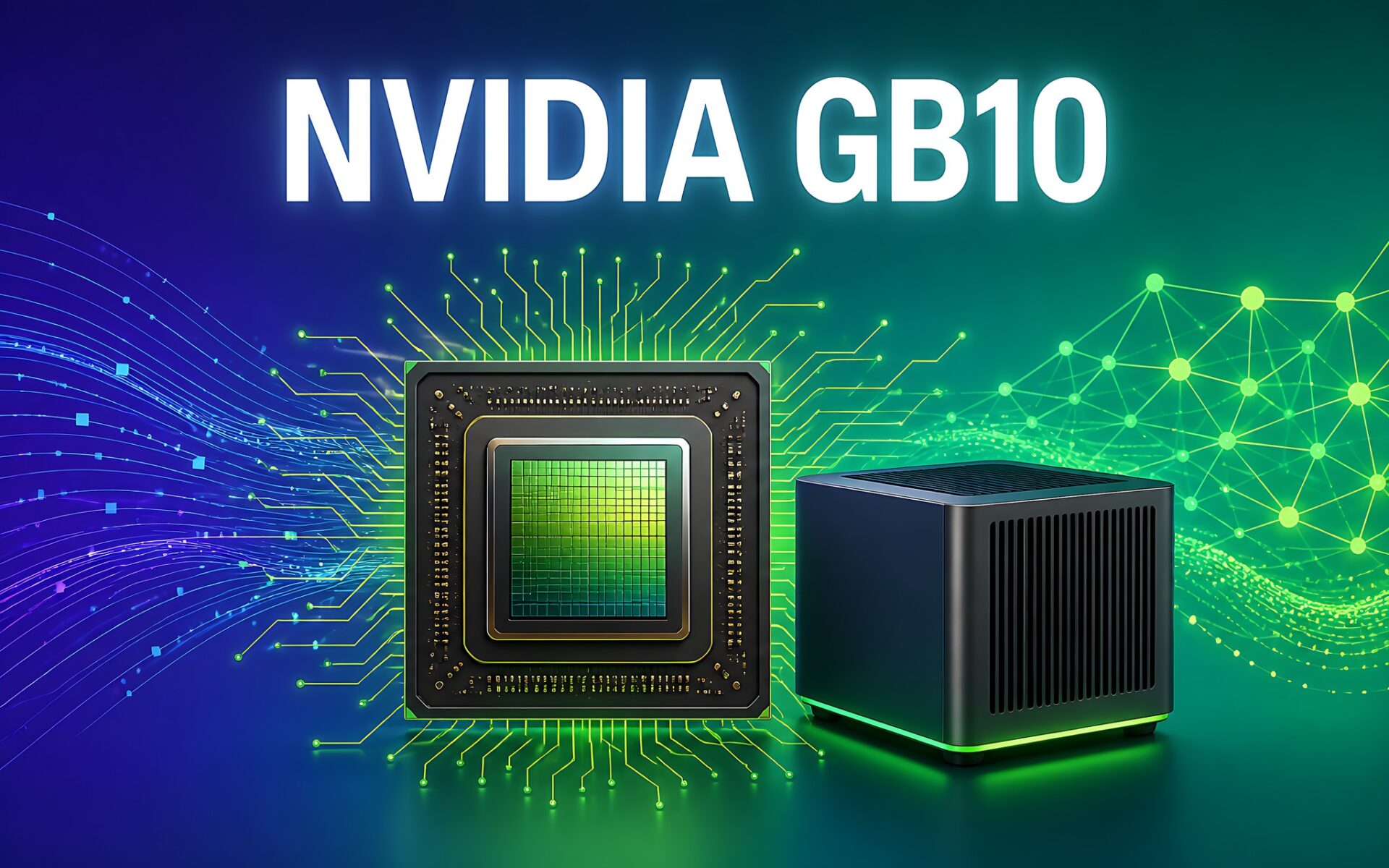
The GB10 chip is an SoC, or system on a chip, that NVIDIA introduced in early 2025 under Project DIGITS and that became the foundation for a line of tiny desktop AI computers. Unlike a discrete graphics card, the GB10 combines the processor, graphics cores, and memory in a single package. The core goal is to put a petaflop of AI performance into a desktop device that runs on ordinary household power instead of server-room infrastructure.

By name, the GB10 belongs to the Grace Blackwell family, pairing an Arm-based Grace processor with a Blackwell graphics core over an internal NVLink-C2C interconnect. This design lets data move between the two blocks with low latency, a key factor when loading large language models. NVIDIA publishes the platform's full specifications in its NVIDIA GB10 Grace Blackwell documentation for desktop AI machines.
Inside the GB10: a unified Grace Blackwell architecture
The GB10's processor section has 20 Arm cores, split into 10 performance-oriented Cortex-X925 cores and 10 power-efficient Cortex-A725 cores. The Blackwell graphics core integrates 6,144 CUDA cores and fifth-generation Tensor Cores, delivering up to 1 PFLOP of performance in the FP4 format. The key highlight is 128GB of unified LPDDR5X memory with 273 GB/s of bandwidth, which lets the processor and graphics core access a single shared pool of data.
| Component | GB10 chip specs | What it means in practice |
|---|---|---|
| Grace processor | 20 Arm cores: 10 Cortex-X925 and 10 Cortex-A725 | Balances performance and power for background tasks |
| Blackwell graphics core | 6,144 CUDA cores, 5th-generation Tensor Cores, 1 PFLOP FP4 | Accelerates AI model inference and fine-tuning |
| Unified memory | 128GB LPDDR5X, 273 GB/s bandwidth | Loads large models that a discrete GPU struggles to fit |
| Power and connectivity | 140W design power, ConnectX-7 200Gbps | Fits on a desk, and multiple units can be linked at high speed |
The unified memory architecture is the biggest difference from a traditional workstation. In a typical discrete GPU setup, a model has to be copied back and forth between system RAM and graphics memory, wasting both capacity and time. With the GB10, every compute block shares the same 128GB, so a small machine can still hold an entire large language model in memory. The 1 PFLOP FP4 figure should be read in terms of the four-bit format and data sparsity conditions; it does not equal performance at every precision.
What the GB10 chip can do for AI work
The platform's standout capability is running inference on language models of up to 200 billion parameters locally, along with fine-tuning models of up to 70 billion parameters. That is a threshold most mainstream personal computers cannot meet because of limited graphics memory. As a result, development teams can experiment with AI agents, build prototypes, and retrieve internal data without sending everything to a cloud service.
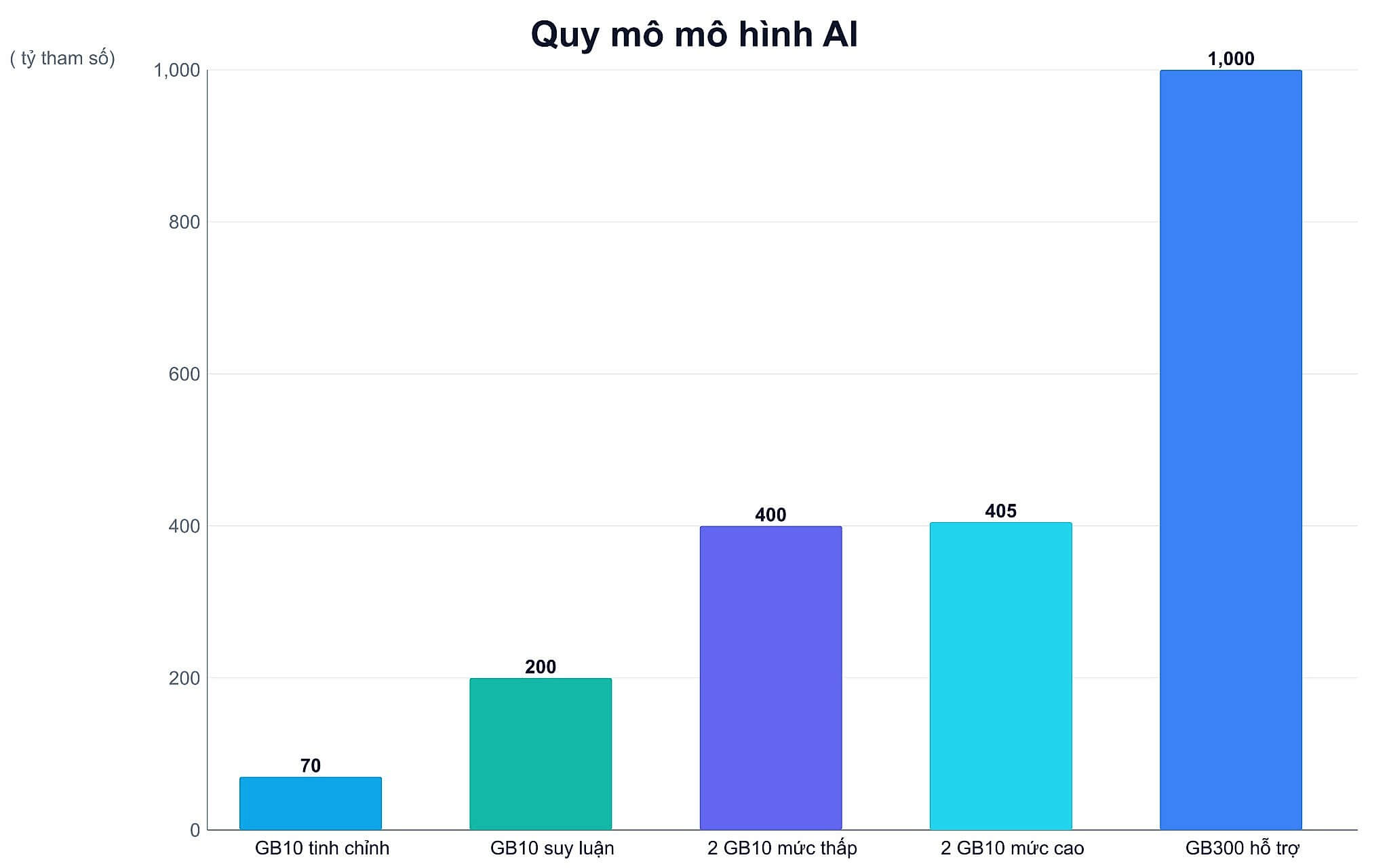
It helps to separate the two thresholds clearly: 200 billion parameters is the inference limit, while full fine-tuning at full precision is still outside what the platform promises. When you need more performance, you can pair two machines to raise total memory to 256GB, expanding model scale to roughly 400-405 billion parameters. To read performance figures correctly when comparing local AI capability, see the article Adding up TOPS: what does the 120 Platform TOPS figure really tell you? Training large-scale models from scratch still calls for data center infrastructure.
Mini desktop AI machines that use the GB10 chip
On the same platform, several brands have launched tiny desktop AI machines with different chassis, storage capacities, and network configurations. The NVIDIA DGX Spark is the reference design, listed internationally from about 3,999 USD. The ASUS Ascent GX10 uses the same GB10 chip but costs less, at around 2,999 USD. At the high end, the Dell Pro Max model FCM1253 sits in the most expensive tier with a list price of about 8,224 USD, in exchange for enterprise storage configurations and warranty coverage.
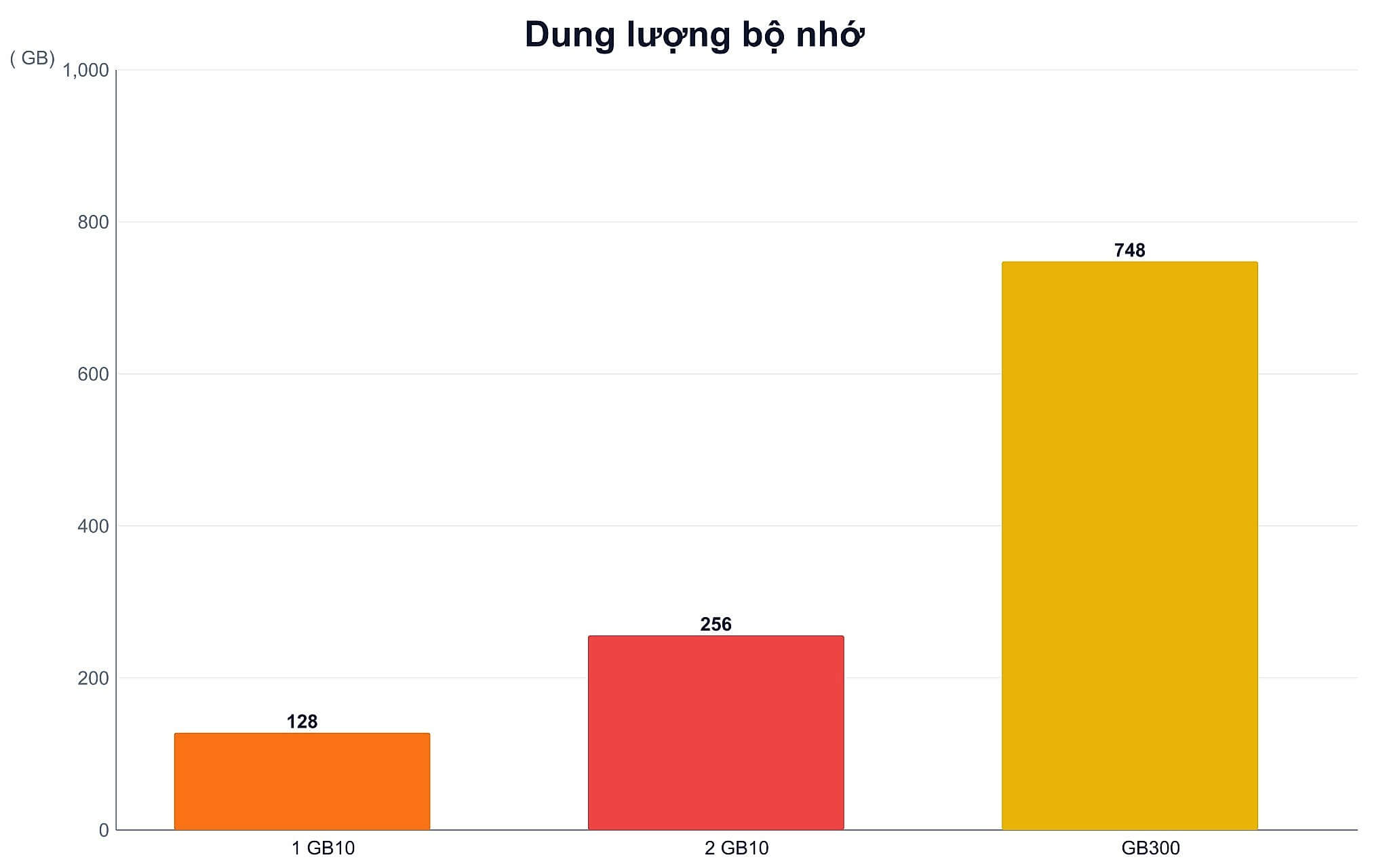
These machines all use the GB10 as their core, so their baseline inference capability is similar; the differences lie mainly in cooling, storage drives, and connection ports. When a workload exceeds a single machine, you can link multiple units over ConnectX-7 to pool their memory. At a much higher tier, the GB300 platform in the DGX Station line raises coherent memory to 748GB with 20 PFLOPS of FP4, aimed at models of up to 1,000 billion parameters. These are different deployment tiers, and a parameter count must always be paired with the precision requirement and context length.
Who should care about the GB10 chip and weigh the investment
The clearest beneficiaries are AI development teams, research labs, businesses handling private data, and specialists who need a local CUDA environment. For them, keeping models, source code, and prompts inside the internal network is both a security advantage and a way to control long-term usage costs. One machine handles the development, inference, and fine-tuning stages well within the published limits, in place of renting cloud resources by the hour.

On the other hand, if you only need an office assistant, basic photo processing, or AI through a browser, you do not need this platform yet. For those needs, a laptop with a sufficiently powerful NPU already handles local processing efficiently; the hardware thresholds are laid out clearly in the article 13 TOPS and 45 TOPS NPUs: which AI tasks can run locally? The GB10 chip only pays off when model size, CUDA libraries, and control over data become direct requirements for your work.
Frequently asked questions (FAQ)
Is the GB10 chip a discrete graphics card?
No. The GB10 is an SoC that combines an Arm processor, a Blackwell graphics core, and 128GB of memory in a single package. This design differs from a discrete graphics card, which has separate memory. Thanks to unified memory, the platform can load large models that a mainstream discrete GPU configuration struggles to fit.
How large a language model can the GB10 chip run?
A single GB10 machine runs inference on models of up to 200 billion parameters and fine-tunes models of up to 70 billion parameters. When two machines are paired, total memory reaches 256GB and model scale expands to roughly 400-405 billion parameters. These figures are tied to specific precision and context length conditions.
Which machines on the market use the GB10 chip?
Notable mini desktop AI machines include the NVIDIA DGX Spark, the ASUS Ascent GX10, and the Dell Pro Max model FCM1253. All three share the GB10 platform but differ in price, storage capacity, and connection ports. International list prices range from about 2,999 USD to 8,224 USD depending on configuration.
What does Grace Blackwell in the GB10 chip mean?
Grace Blackwell is the name for the architecture that pairs an Arm-based Grace processor with NVIDIA's Blackwell graphics core. The two blocks are connected by an NVLink-C2C interconnect for low-latency data sharing. It is the common foundation for both the GB10 used in desktop machines and higher-end lines such as the GB300.
Do mainstream users need the GB10 chip?
Most office users, students, and small-scale content creators do not need this platform yet. A laptop with an NPU of 40 TOPS or more already supports many local Copilot+ features at a suitable power draw. The GB10 chip makes more sense when you must load large models, use CUDA, or keep data entirely within internal infrastructure.