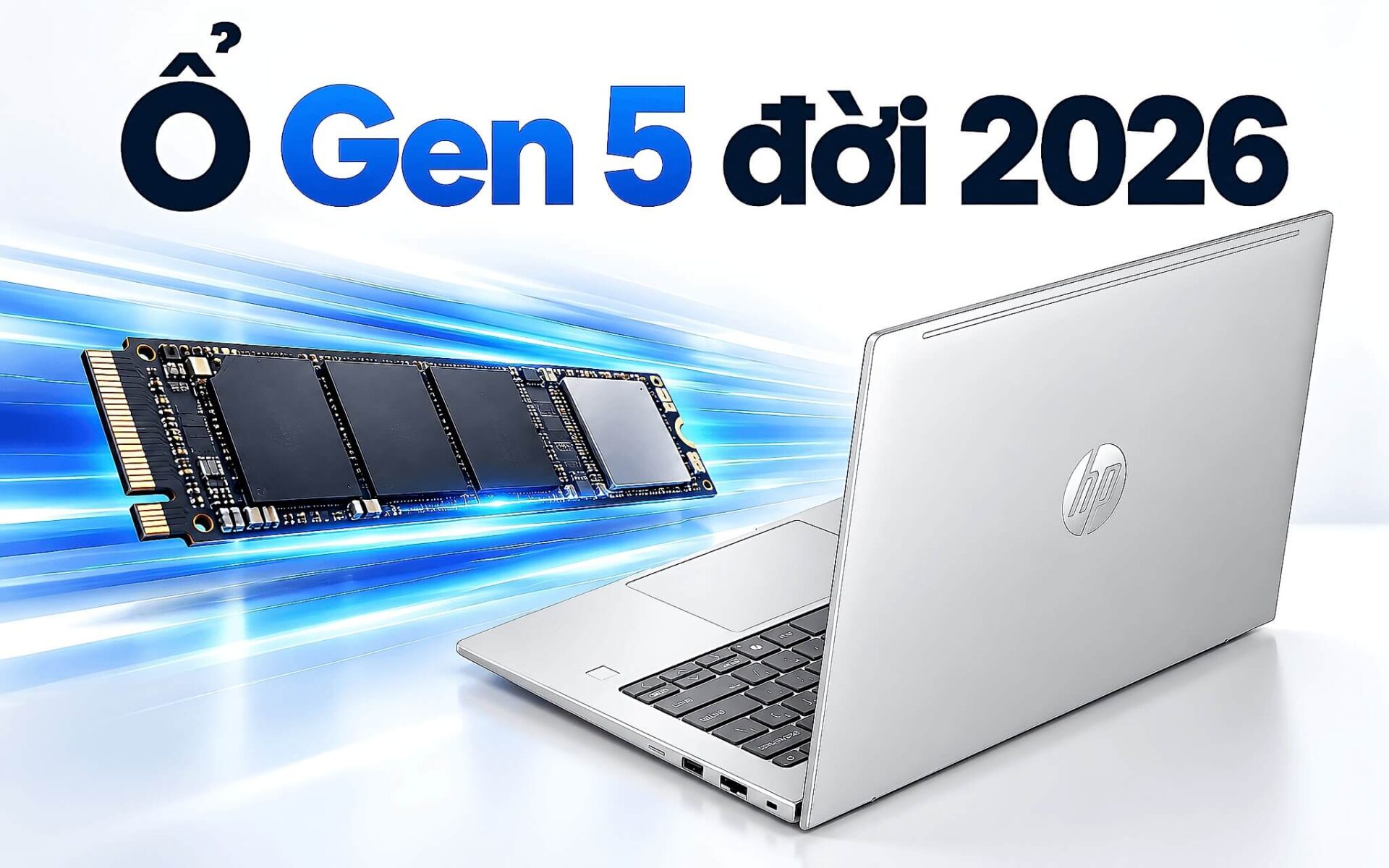
In 2026, the discussion surrounding Gen 5 SSDs in laptops is no longer just about the top speeds printed on the box. Instead, the focus has shifted to what lies beneath the sticker: the fabrication process of the SSD controller, whether the drive includes dedicated DRAM or borrows system memory, how many PCIe 5.0 lanes the CPU routes to the M.2 slot, and whether your software can actually utilize that bandwidth. This article synthesizes technical documentation from Silicon Motion, Phison, Samsung, Intel, AMD, Lenovo, Microsoft, and PCI-SIG to help you accurately decipher the spec sheet before picking a laptop.
2026 Gen 5 SSDs Change Starting From the Controller Chip
Every NVMe drive consists of NAND flash chips to store data, an SSD controller to manage read and write commands, and firmware coordinating the two. When Silicon Motion announced the SM2508 in August 2024, the company drew direct comparisons with competing Gen 5 controllers built on a 12nm process - the earlier wave of Gen 5 controllers. Since then, manufacturers have transitioned to 7nm, 6nm, and 5nm nodes, allowing newer Gen 5 drives to sustain high speeds while drawing less power - a prerequisite for fitting them into thin laptops.
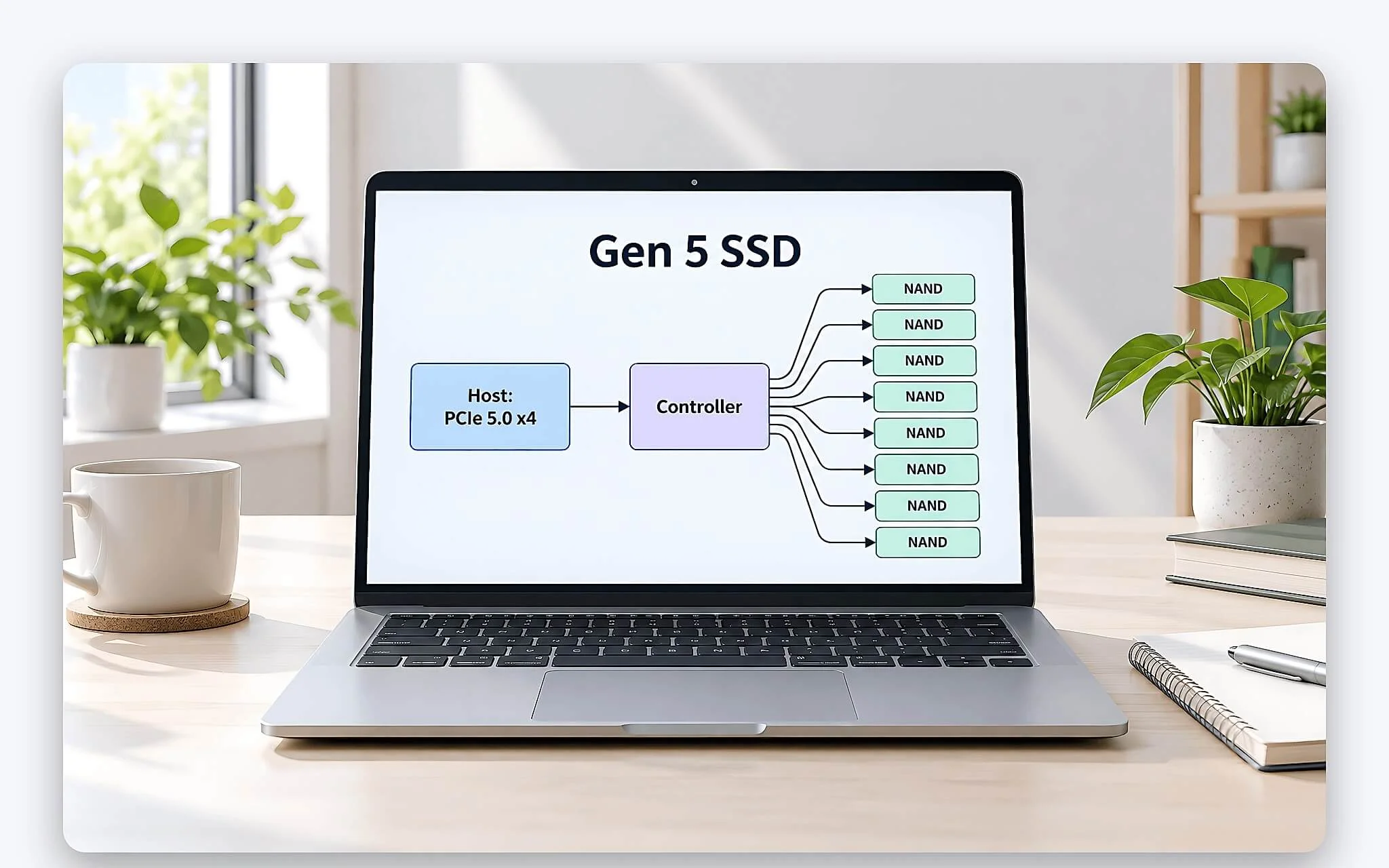
The SM2508 is the first client PCIe Gen5 x4 SSD controller manufactured on TSMC's 6nm EUV process, supporting 8 NAND channels at up to 3,600 MT/s per channel, with sequential read and write speeds reaching up to 14.5 GB/s and 13.6 GB/s. Silicon Motion states that the controller alone draws about 3 W, with the entire drive staying under 7 W - a 50% power reduction compared to 12nm competitors. The chip supports both 3D TLC and QLC NAND, two memory cell types with differing write endurances, as analyzed in Understanding NAND Flash Types in SSDs: SLC, MLC, eMLC, TLC, PLC - Which Is the Fastest and Most Durable?
Phison took a different path with the E31T: built on TSMC's 7nm process with a four-channel DRAM-less architecture, it delivers speeds up to 10.6 GB/s while drawing under 6 W under load and 3.5 mW at idle, with the company explicitly targeting notebooks. Samsung uses an in-house 5nm controller for the PM9E1, its Gen 5 OEM SSD line for PC makers, achieving sequential read and write speeds of 14.5 GB/s and 13 GB/s alongside an energy efficiency improvement of over 50%, as summarized in Samsung Launches the Gen5 PM9E1 SSD Featuring 8th-Gen V-NAND and Speeds Up to 14.5 GB/s
Eight or Four NAND Channels Divide Two SSD Controller Design Approaches
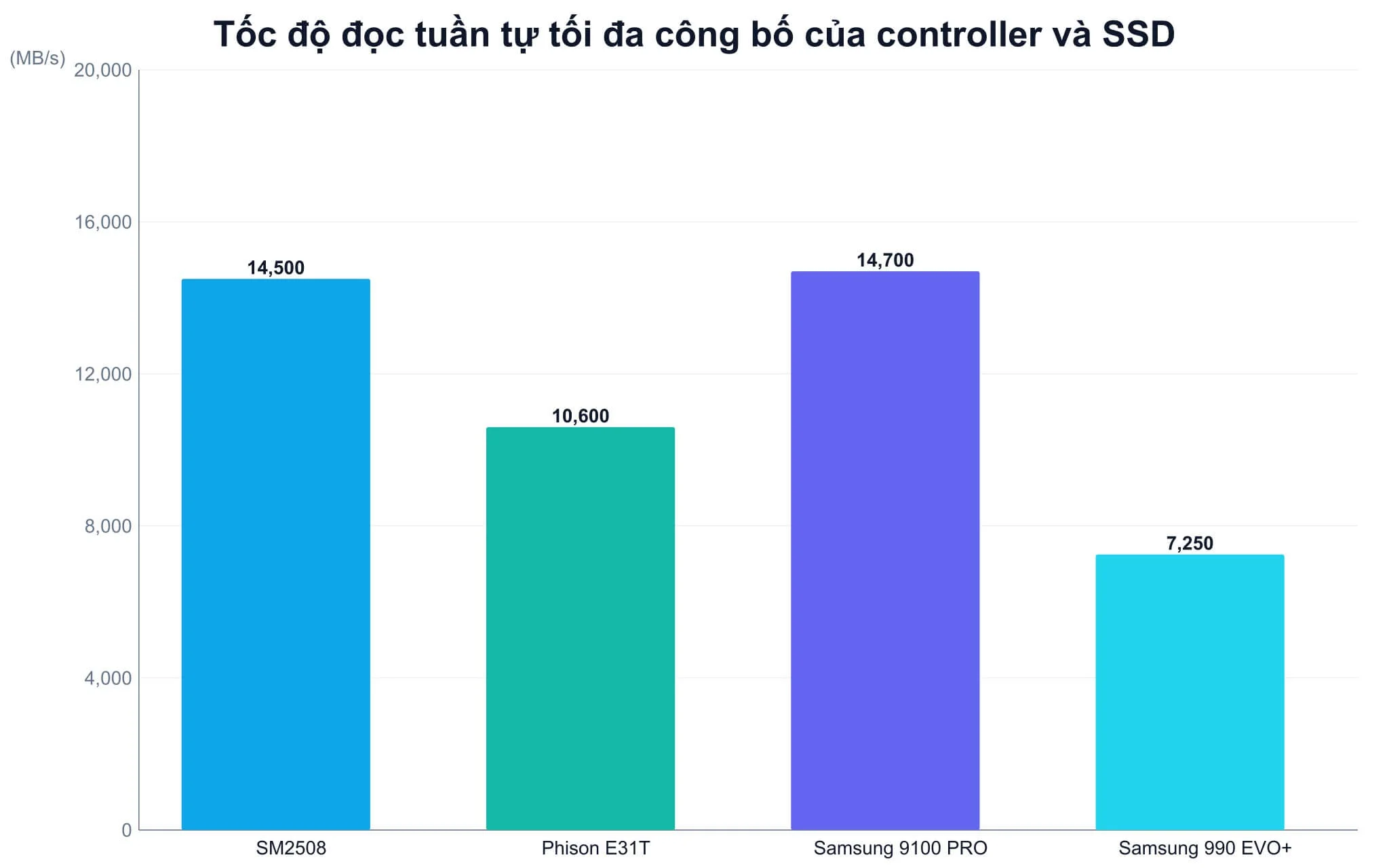
An SSD controller communicates with NAND flash chips over multiple parallel channels, and the channel count alongside the interface speed per channel dictates how much data the controller can read and write simultaneously. The SM2508 supports 8 NAND channels at up to 3,600 MT/s per channel, whereas the Phison E31T utilizes a four-channel architecture. According to figures published by both companies, the SM2508 achieves sequential reads of up to 14.5 GB/s, compared to 10.6 GB/s for the E31T. The table below compiles manufacturer-provided specifications for both Gen 5 and Gen 4 drives.
| Controller or Drive | Process, Buffer | Max Sequential Read (MB/s) | Power Consumption (Manufacturer Specs) |
|---|---|---|---|
| Silicon Motion SM2508 (controller) | TSMC 6nm EUV | 14,500 | Sub-7 W total drive, roughly 3 W for the controller alone |
| Phison E31T (controller) | TSMC 7nm, DRAM-less | 10,600 | Under 6 W active, 3.5 mW idle |
| Samsung 9100 PRO 1TB (PCIe 5.0 x4) | Samsung in-house controller | 14,700 | 7.6 W average read |
| Samsung 990 EVO Plus 2TB (PCIe 4.0 x4 / 5.0 x2) | Samsung in-house controller, HMB | 7,250 | 5.5 W average read |
Those two figures reflect two distinct design goals. Silicon Motion positions the SM2508 for AI laptops and gaming machines, prioritizing peak performance with an efficiency per watt that the company claims is 1.7 times that of PCIe Gen4 drives. Meanwhile, Phison tailored the four-channel DRAM-less E31T for notebooks, trading away top-end throughput for a compact PCB layout and sub-6 W power consumption. Even so, 10.6 GB/s still substantially outpaces the roughly 8 GB/s ceiling of PCIe 4.0 x4, based on conversions in Lenovo's PSREF.
Among retail SSDs, the Samsung 9100 PRO uses an in-house controller, reaching 14,700 MB/s on the 1TB and 2TB models and 14,800 MB/s on the 4TB and 8TB versions according to its datasheet - close to the roughly 16 GB/s theoretical limit of PCIe 5.0 x4. The performance spread between 10.6 GB/s and nearly 15 GB/s is why looking up the SSD controller matters when reading Gen 5 drive specs. Two drives labeled PCIe 5.0 x4 can stem from fundamentally different design philosophies: one tuned for raw speed, and the other optimized for power efficiency and form factor.
How DRAM-Less Drives Borrow System RAM via HMB
An SSD controller relies on a mapping table to track which physical memory cells hold logical data, and conventional drives store this table in dedicated on-board DRAM. Host Memory Buffer (HMB) is a feature introduced in NVMe 1.2 that allows DRAM-less drives to allocate a portion of system RAM, accessed directly across the PCIe bus. According to Marvell, this approach reduces total system cost, lowers power consumption in mobile devices, and enables compact drive form factors.
Omitting the DRAM chip frees up board space and eliminates a power-consuming component, a key advantage for 2230 or 2242 drives in thin laptops. In return, DRAM-less SSD controllers must optimize their firmware so mapping-table lookups over HMB do not degrade random access performance. Phison built its E31T Gen 5 controller as a DRAM-less design from the ground up, while Samsung notes that the 22 x 42 mm version of the PM9E1 places both V8 NAND and DRAM on both sides of the PCB to reach up to 4TB.
In the Gen 4 performance tier, the Samsung 990 EVO Plus offers an easy point of reference: its spec sheet lists an HMB buffer, a PCIe 4.0 x4 or PCIe 5.0 x2 interface, sequential read speeds of 7,250 MB/s on the 2TB and 4TB models, and an average read power of 5.5 W. Based on the conversions in Lenovo's PSREF, PCIe 4.0 x4 and PCIe 5.0 x2 both deliver about 8 GB/s, so the drive hits the same speed whether the slot supplies four Gen 4 lanes or just two Gen 5 lanes.
CPU PCIe Lane Counts Cap the Number of Gen 5 Slots
A Gen 5 drive can run at full speed only when its M.2 slot wires directly into PCIe 5.0 lanes supplied by the platform. AMD's spec sheet lists PCIe 5.0 support with 28 native lanes for the Ryzen 9 9955HX, while the Ryzen AI 9 HX 370 tops out at PCIe 4.0 with 16 lanes. Intel's quick reference documentation for the Core Ultra 200HX family notes that the processor provides 4 PCIe Gen 5 lanes plus 4 PCIe Gen 4 lanes. These figures represent the upper limit; laptop manufacturers decide which slots are wired for Gen 5.
| Laptop Processor | Supported PCIe Standard | Lane Count per Manufacturer Documentation |
|---|---|---|
| AMD Ryzen 9 9955HX | PCIe 5.0 | 28 native PCIe lanes |
| AMD Ryzen AI 9 HX 370 | PCIe 4.0 | 16 native PCIe lanes |
| Intel Core Ultra 9 275HX (200HX series) | PCIe Gen 5 and Gen 4 | 4 Gen 5 lanes plus 4 Gen 4 lanes (Intel SKU table) |
The four Gen 5 lanes in Intel's SKU table are just enough for a single x4 drive, meaning laptops powered by 200HX-series chips can have at most one Gen 5 slot pulled from this lane pool; a second M.2 slot must draw from a different group of lanes. Lenovo notes in its PSREF that a Gen 5 drive installed in a PCIe 4.0 slot will operate under the PCIe 4.0 protocol. On the Ryzen 9 9955HX, the 28 native PCIe 5.0 lanes must also be shared with discrete graphics and other peripherals, so the actual number of Gen 5 slots still comes down to motherboard design.
Laptops running the Ryzen AI 9 HX 370 represent the opposite case: because the processor supports only PCIe 4.0, the laptop has no Gen 5 slots, and any Gen 5 drive installed will cap out at the roughly 8 GB/s ceiling of PCIe 4.0 x4. For these laptops, a drive with Gen 4-class speeds like the 990 EVO Plus already saturates the slot's bandwidth. When reading a spec sheet, check the processor before looking at the storage description, as the CPU determines whether the laptop can offer a Gen 5 slot in the first place.
DirectStorage and GPU Decompression Are Needed to Maximize Fast Drives
A Gen 5 drive's raw speed translates into shorter game loading times only when software issues read requests quickly enough and processes the data without delay. DirectStorage is Microsoft's API designed to help games take full advantage of modern high-speed storage. Microsoft states that while the API runs on Windows 10, Windows 11 includes built-in storage optimizations and is recommended for gaming; the company also advises installing games on an NVMe drive for maximum IO performance.
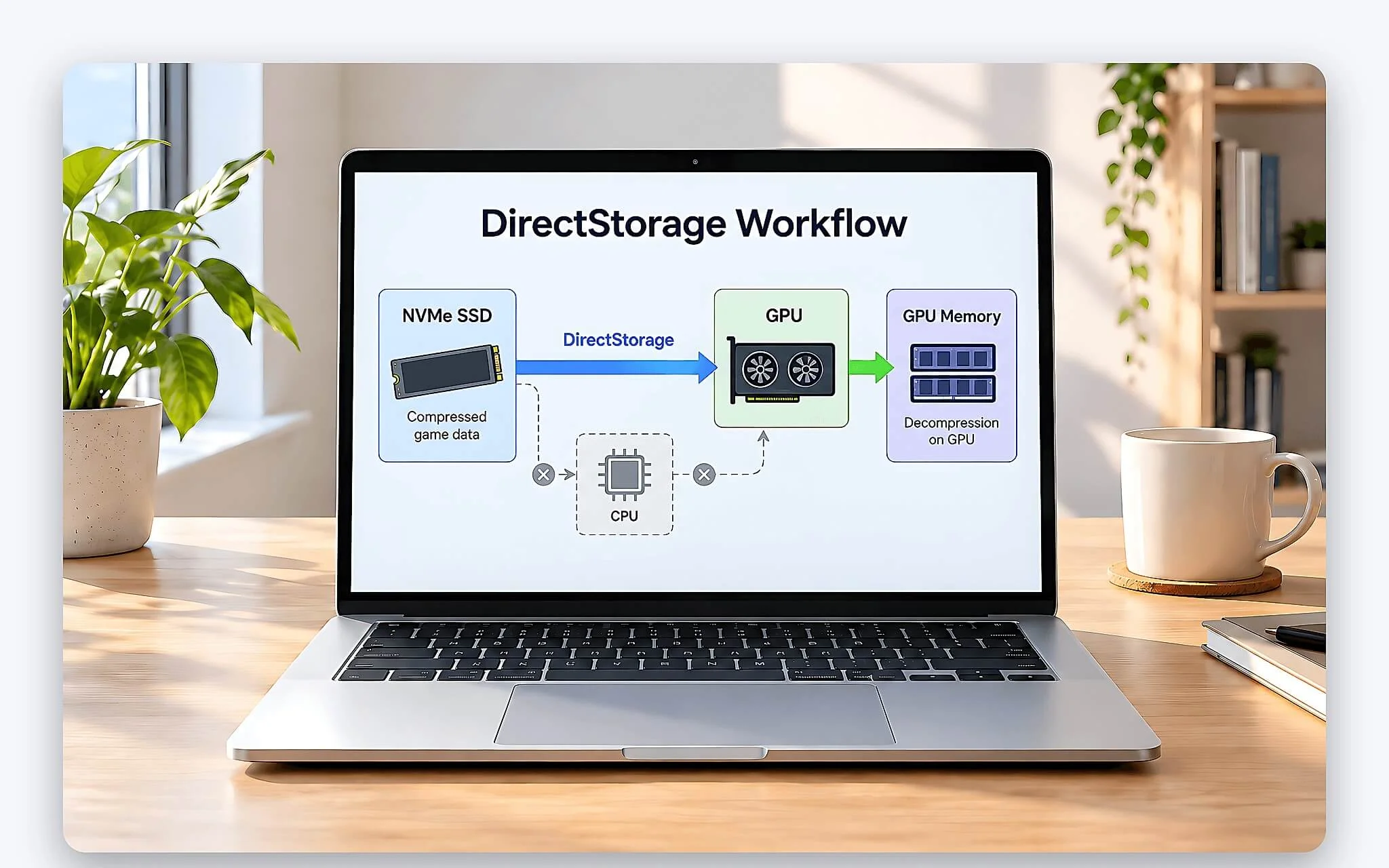
Starting with version 1.1, DirectStorage added GPU decompression using the GDeflate format. Assets are split into 64 KiB chunks, each compressed individually so the GPU can decompress them in parallel via compute queues, with a CPU fallback path included. According to the DirectStorage 1.1 announcement on Microsoft's DirectX blog, this feature works on all DirectX 12 GPUs supporting Shader Model 6.0 and includes dedicated driver optimizations from AMD, Intel, and NVIDIA. The key benefit is offloading decompression entirely from the CPU.
On laptops equipped with a Gen 5 drive, throughput hovering around 14 GB/s delivers its full potential only when a game supports DirectStorage and allocates a large enough staging buffer; Microsoft recommends roughly 128 MiB to keep the IO pipeline saturated. Games without the API still run normally on fast storage, but decompression remains on the CPU. Before prioritizing a drive based on speed alone, check whether the titles you play most often actually take advantage of DirectStorage.
PCIe 6.0 on the PCI-SIG Roadmap and Speeds by Generation
PCI-SIG, the consortium that oversees the PCIe standard, published the PCIe 6.0 specification on January 11, 2022, with a raw data rate of 64 GT/s - double the 32 GT/s of PCIe 5.0 - reaching up to 256 GB/s in an x16 configuration. The standard transitioned to four-level PAM4 signaling and Flit-based encoding while maintaining backward compatibility with all prior generations. In June 2025, PCI-SIG released PCIe 7.0 at 128 GT/s, reaching up to 512 GB/s bi-directionally across x16, and has begun research on PCIe 8.0.
| PCIe Generation | Data Rate per Lane (GT/s) | Bandwidth by Source | Notes |
|---|---|---|---|
| PCIe 5.0 | 32 | About 16 GB/s at x4 (Lenovo PSREF) | Standard for the fastest M.2 slots on current laptops |
| PCIe 6.0 | 64 | Up to 256 GB/s at x16 | Published by PCI-SIG on January 11, 2022; PAM4 signaling, Flit encoding |
| PCIe 7.0 | 128 | Up to 512 GB/s bidirectional at x16 | Released by PCI-SIG in June 2025; PCIe 8.0 research underway |
A published specification does not mean laptops already have the corresponding slots. The cited documentation from AMD, Intel, and Lenovo for current laptop lineups all stops at PCIe 5.0, and the three mentioned client SSD controllers are also Gen 5. For laptops purchased in 2026, a Gen 5 slot is the highest tier these platforms support, so waiting for PCIe 6.0 is not yet a factor to consider when choosing storage specs.
What proves more practical is the backward compatibility PCI-SIG preserves across every generation: a Gen 5 drive installed in a Gen 4 slot runs at the slot's speed, while a Gen 4 drive plugged into a Gen 5 slot runs at the drive's own speed. When upgrading, you only need to match the M.2 form factor (2230, 2242, or 2280) and prioritize putting the fastest Gen 5 drive in the Gen 5 slot if the laptop has multiple slots, reserving that spot for the operating system and frequently accessed project files.
Frequently Asked Questions (FAQ)
Can a laptop with only PCIe 4.0 slots take a PCIe 5.0 drive?
Yes. Lenovo's PSREF states that a PCIe 5.0 drive installed in a PCIe 4.0 M.2 slot runs on the PCIe 4.0 protocol, delivering roughly 8 GB/s at x4 instead of 16 GB/s. The drive still needs to match the supported slot form factor, such as 2280 or 2242, to be secured properly inside the laptop.
Are DRAM-less drives slower than drives with DRAM?
There is no universal answer. Marvell highlights advantages in cost, power, and size for HMB-based designs, while specific performance depends on the SSD controller and firmware of each model. The Samsung 990 EVO Plus uses HMB and still reaches 7,250 MB/s sequential read according to its spec sheet, so you should check the datasheet for the exact drive you plan to buy.
Does DirectStorage require a discrete graphics card?
Microsoft does not require a discrete GPU. The requirement for GPU decompression is a GPU supporting DirectX 12 with Shader Model 6.0, and the game must be programmed to call DirectStorage. Microsoft recommends Windows 11 alongside an NVMe drive for the best results.
When will laptops feature PCIe 6.0 slots?
The cited documentation from AMD, Intel, and Lenovo does not mention any timeline. While PCI-SIG released the PCIe 6.0 specification in 2022 and PCIe 7.0 in 2025, current laptop platforms still top out at PCIe 5.0. For laptops purchased in 2026, a Gen 5 slot running PCIe 5.0 x4 remains the fastest storage configuration you can get.