
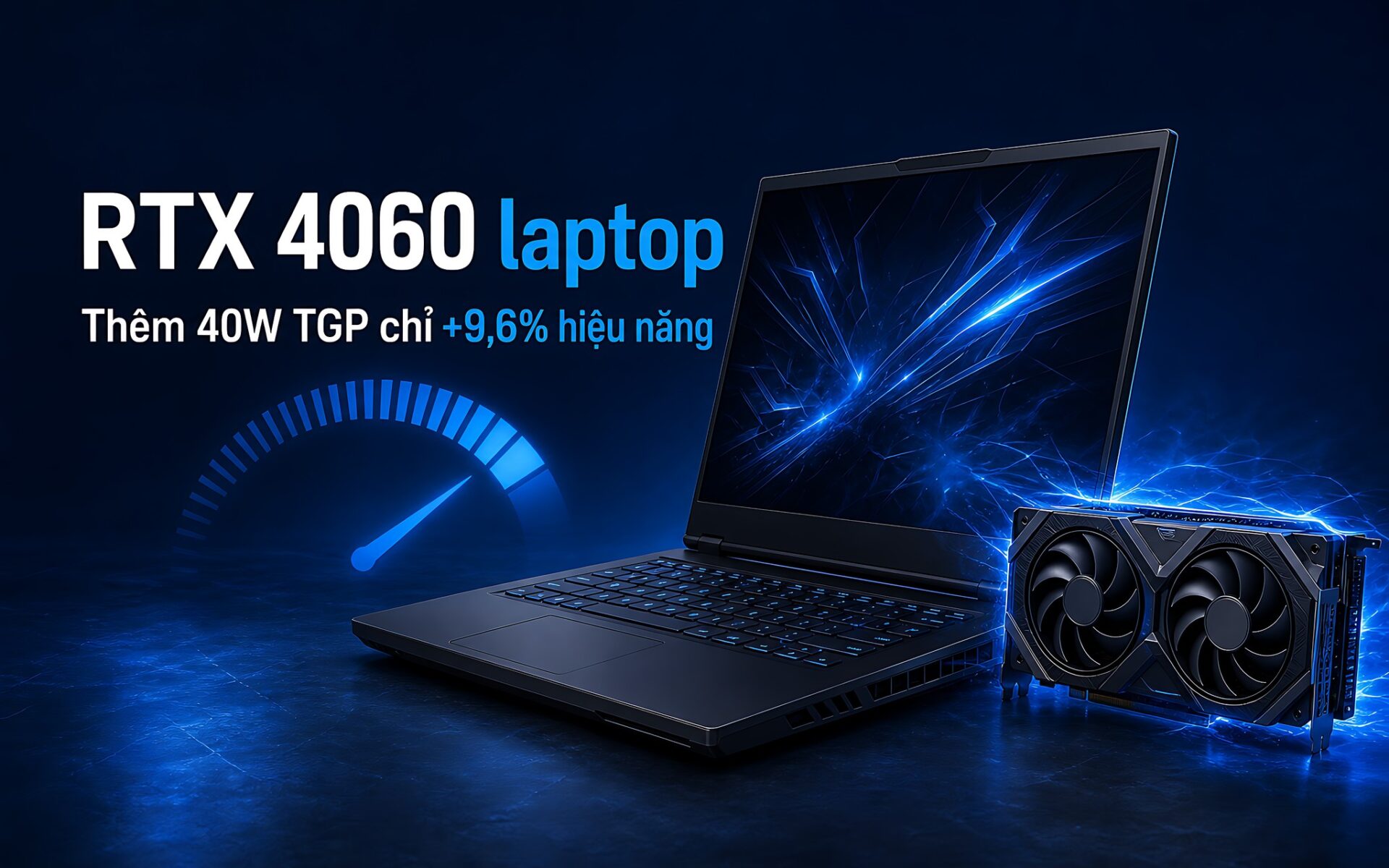
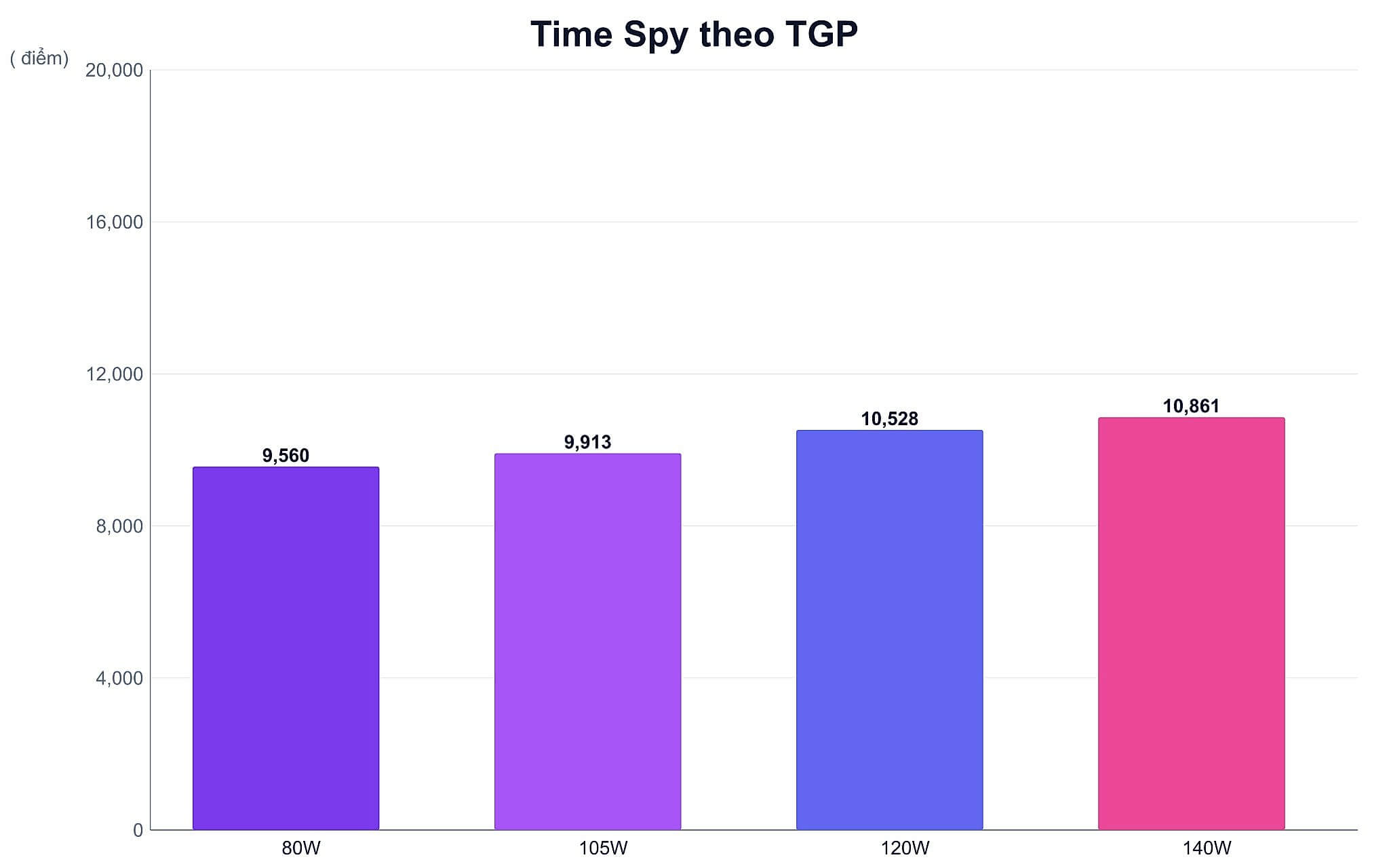
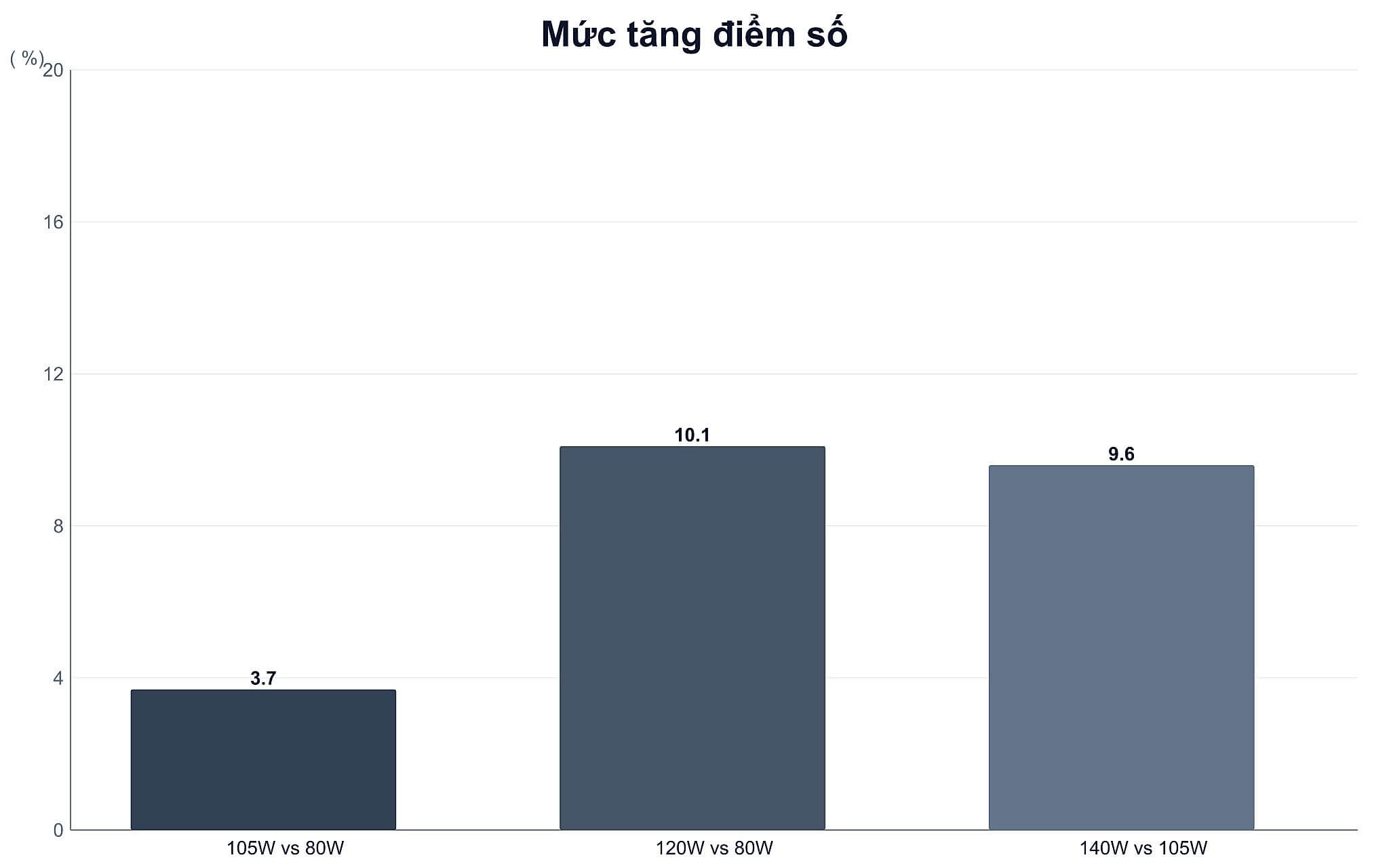
The 105W power level scores 9,913 in Time Spy Graphics, while 140W reaches 10,861, a gap of about 9.6% even though the rated power is 35W higher. The reason is that the GPU usually hits its voltage and clock ceilings before it uses all the power available. As a result, an RTX 4060 laptop at around 100W can still deliver performance close to the 140W version. To pick the right machine, you need to look at real power draw, temperatures, and the cooling system together.
The 105W and 140W RTX 4060 laptop 8GB GPUs Are Really Different in Practice
The NVIDIA GeForce RTX 4060 laptop 8GB is a discrete graphics processor for notebooks, launched on February 22, 2023. The GPU uses the Ada Lovelace architecture and has 3,072 CUDA cores, 8GB of GDDR6 memory, a 128-bit bus, 256 GB/s of bandwidth, and a Boost clock from 1470 to 2370 MHz. Think of TGP as the size of a water supply pipe: the performance of an RTX 4060 laptop depends both on how much the GPU can take in and on how well it can be cooled.
NVIDIA specifies a GPU Subsystem Power range of 35 to 115W. NVIDIA GeForce RTX technology can add roughly 15 to 25W through Dynamic Boost when conditions allow. So the 140W figure for an RTX 4060 laptop usually includes that conditional extra power, which is not sustained continuously in every game and workload.
On the market, the "100W" RTX 4060 laptop usually refers to a power range of roughly 100 to 105W. The 140W version has a higher limit, but that does not mean performance rises 40% over a version around 100W. When recommending a configuration, check how many watts the GPU actually draws in real workloads, how well it holds its clocks, and whether thermal throttling reduces performance.
Why RTX 4060 Laptop Benchmark Results Saturate Beyond 100W
In most games, the RTX 4060 laptop can reach its voltage or clock ceiling before it hits its maximum power limit. At that point, extra power produces only a small clock gain, while temperatures and fan noise rise more noticeably. Dynamic Boost also splits power between the CPU and GPU depending on system load. If the CPU needs a lot of power, the GPU will not receive the full extra allotment that is advertised.
| Rated power level | Time Spy Graphics | Reference difference | Usage assessment |
|---|---|---|---|
| 80W | 9,560 points | Baseline | Decent performance, suited to machines that prioritize portability |
| 105W | 9,913 points | About 3.7% higher than 80W | Starts to enter the sweet spot for performance |
| 120W | 10,528 points | About 10.1% higher than 80W | Worthwhile when cooling is good enough |
| 140W | 10,861 points | About 9.6% higher than 105W | The gain depends on the specific machine and workload |
LaptopMedia data on the RTX 4060 laptop shows that performance still rises with power, but not linearly. Measurements across many laptop models are also affected by the CPU, RAM, BIOS, and cooling. So this should be treated as a practical reference point, not a perfectly isolated test of the different TGP levels.
The reference Time Spy score for the RTX 4060 laptop is 10,338, while Fire Strike reaches 26,530 points. The 140W level adds headroom under heavy load, but the extra power does not convert proportionally into frames. A well-cooled 105W machine can still be more stable than a machine advertised at 140W but with high temperatures or a tight BIOS limit.
How RTX 4060 Laptop Specs Affect Real-World Use
The 8GB of GDDR6 suits gaming and general graphics work, but the 128-bit bus becomes a limit with large datasets or very high image settings. The Ada Lovelace architecture in the RTX 4060 laptop supports modern rendering technologies and AI capability that the manufacturer rates at 233 TOPS. However, TOPS cannot replace game benchmarks, rendering software tests, or task completion times.
When reading a laptop review, prioritize four data points: real GPU power under load, sustained clock speed, temperature, and noise level. The TGP on the sticker only reflects the design limit. A 140W RTX 4060 laptop may run at only around 100 to 115W in games if it has already hit its voltage ceiling. Conversely, a well-cooled 105W version can run near its maximum for longer.
The CPU and RAM also affect RTX 4060 laptop results. The Ryzen 7 7435HS is an 8-core, 16-thread processor with the Zen 3+ architecture and a 45W TDP, scoring 1,818 single-core and 9,679 multi-core in Geekbench 6. When the CPU and GPU are both under heavy load, the system has to split its power and thermal limits between the two. You can read more about balancing the processor, graphics card, and display in Mid-Range Gaming Laptops: Which Configuration Works for Both Play and Study?
How Do the RTX 4060 Laptop and RTX 4070 Laptop Differ?
The GPU name alone is not enough to determine the right option. Power level, cooling capability, and the price of the complete machine all affect its value. For the RTX 4060 laptop, the 100 to 105W range usually already delivers reasonable performance, while 140W makes sense when the machine has a large chassis and cooling that can handle it. The verified data does not provide consistent benchmark scores for the RTX 4070, so the size of the gap should not be guessed.
Some examples on the market show that manufacturers allocate RTX 4060 laptop power quite differently. The 140W Acer Nitro 16 Phoenix once had a reference price of around 28 million. The 105W Asus Zenbook Pro 14 OLED was once around 30 to 31 million, and the Asus ROG Zephyrus G14 (part of the Asus ROG & TUF line) sits in the segment of around 37 to 38 million. The higher prices also reflect the display, materials, size, portability, and build quality.
You should choose 140W if you usually keep the laptop plugged in, play demanding games, and accept a larger body and more audible fan noise. The 105W version suits people who need a balance of performance, temperature, and portability. If you pay a few million more just for a higher power label, the benefit may not justify it. The guide How to Choose a Laptop Configuration Without Wasting Your Budget in 2026 can help you allocate your spending more sensibly.
What Affects RTX 4060 Laptop Prices in Ho Chi Minh City?
The price of a machine depends on the CPU, RAM, SSD, display, cooling, and warranty policy. Two RTX 4060 laptop models can still differ by a few million because their overall configurations differ. A 140W machine usually appears in gaming designs with a large charger and cooling system. A 105W version may come in a more compact machine or one with a better display and finish.
The figures of around 28 million, 30 to 31 million, and 37 to 38 million are only reference prices at particular points in time, not confirmation that stock is available. When buying an RTX 4060 laptop, ask for the machine's condition, warranty period, GPU warranty coverage, and exchange terms to be stated clearly. Offers such as RAM, SSD, cleaning, or software installation should also be itemized on the invoice.
Hung Phat recommends that people who prioritize performance per cost choose a version of around 105 to 115W with a good cooling system. If you need sustained heavy loads and rarely move the machine, the 140W version still has value when the price gap is reasonable. Don't decide based only on the TGP in the product title. Ask for test results on real power, temperature, noise, and warranty policy before choosing an RTX 4060 laptop.
Frequently Asked Questions (FAQ)
What criteria should you use to evaluate the RTX 4060 laptop and RTX 5060 laptop?
You should compare benchmark scores on the same CPU, RAM, power mode, and cooling conditions. The available data has not verified the RTX 5060 specs, so the size of the gap cannot be stated yet. For the 4060, the reference points are 10,338 in Time Spy and 26,530 in Fire Strike.
Are the RTX 4060 laptop and RTX 5050 laptop enough for 3 to 5 years of use?
Usability depends on the games, resolution, image settings, and software requirements. The 4060 has 8GB of GDDR6, 3,072 CUDA cores, and a 128-bit bus, which suits gaming as well as general content creation. There is no verified RTX 5050 data in the reference source, so you should look at real-world benchmarks.
Can the mobile 4060 and the desktop RTX 3060 be compared directly?
The two GPUs belong to different platforms, so they cannot be judged by name or power level alone. A desktop has different cooling space and power delivery from a laptop, while a notebook depends on Dynamic Boost, the BIOS, and the charger. You need to use the same game, resolution, and settings to compare them.
How does the laptop version of the 4060 differ from the desktop RTX 4060?
The laptop version has a power range of 35 to 115W and can receive roughly 15 to 25W more from Dynamic Boost. A desktop PC works with different power and cooling conditions, so equal performance cannot be inferred from the name alone. The GPU in an RTX 4060 laptop is usually soldered to the motherboard and can almost never be upgraded by the user.